
Is buying in bulk cheaper? The industry settled that question for you before you walked in the door. The unit price is lower, the package is bigger, and the store was designed from the concrete floors up to make sure you feel smart about all of it. What the industry does not volunteer is that the bulk package is sometimes more expensive per ounce than the smaller one, that the savings evaporate the moment any product hits the trash, that the membership fee is quietly changing every decision you make inside the building, and that people who shop at warehouse clubs regularly end up spending more, shopping more often, and eating more than they did before they joined. That is the math the industry skips. This article runs it.
The Unit Price Is Not What You Actually Pay
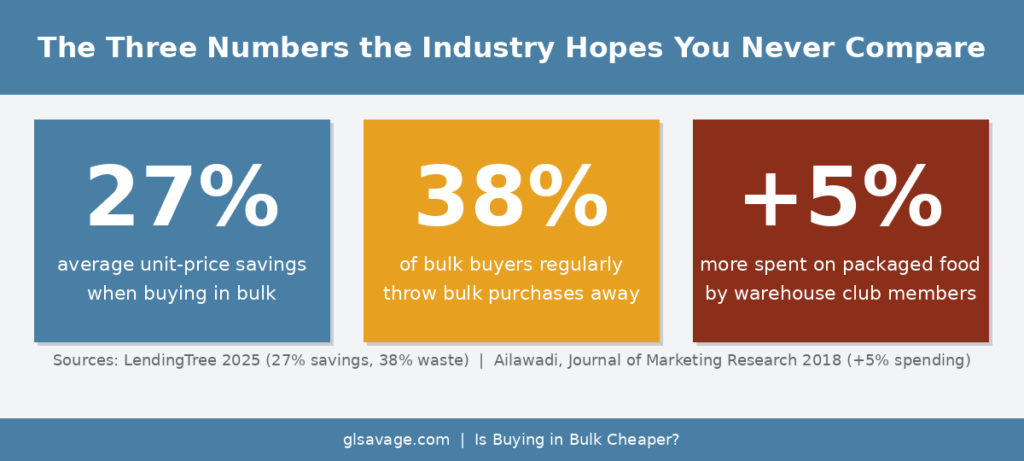
Start with the number the industry advertises. A 2025 LendingTree analysis of 44 common products found average unit-price savings of 27 percent when buying in bulk. That is the headline. Buried in the same study: 38 percent of bulk buyers regularly throw away bulk purchases. The average hides the items that were actually higher in price, and it disappears entirely the moment any product hits the trash.
Some of it goes the wrong direction before waste even enters the picture. A SoFi investigation that visited multiple stores found a larger tub of Folgers coffee cost more per pound than the smaller can. A 3-pound container of OxiClean cost more per pound than two of the 1.77-pound containers sitting right next to it on the same shelf. King Arthur flour was the same price per pound in the 5-pound and 10-pound bag. Not cheaper. Identical. The “value pack” label did its job before anyone did the math.
Then there is waste. Buy a 5-pound bag of spinach and throw away 2 pounds before it wilts. You did not pay the unit price. You paid for 3 pounds of spinach and 2 pounds of garbage. That is the waste-adjusted cost: the real price per ounce after you factor in what you threw away. It is almost always higher than the smaller bag you would have finished. The USDA estimates the average American family of four throws away $1,500 worth of food per year. Buying more of something you already partially waste does not fix that number. It scales it up.
Before any bulk purchase, one question cuts through all of it: has every previous package of this exact item been finished completely before it expired or went bad? If the answer is no, you are not paying the unit price. Calculate what you actually use, price that amount, and compare it to the smaller size you would have finished. That is the real number.
The Store Was Engineered to Work Against You, and the Founder Said So
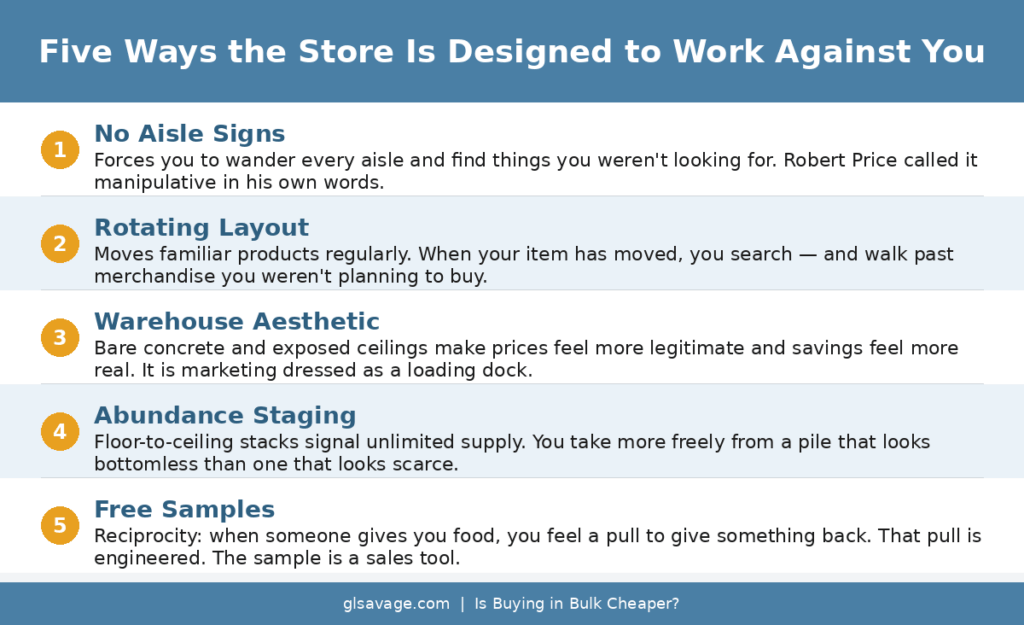
Robert Price, co-founder of Price Club, the company that merged with Costco in 1993, was asked in a 2015 NPR Planet Money interview why there are no directional signs in the store. His answer was direct. He said he was adamant there would be no signs telling customers where things were because it would make them likely to wander through all the aisles and find other things to buy. The interviewer noted that sounded a little devious. Price’s response: he agreed, and called the policy manipulative. That word belongs to him, not to his critics.
The layout changes regularly for the same reason. When the item you came for has moved, you have to search for it. While you search, you walk past things you were not planning to buy. Some of them end up in the cart. Costco calls this the treasure hunt experience and presents it as a feature. It is a revenue mechanism. The disorientation is the product.
The warehouse aesthetic, the bare concrete, the exposed ceiling, the merchandise stacked on pallets, is also deliberate. Research consistently shows that shoppers in stripped-down environments judge prices as more legitimate and savings as more real. The visual language of a loading dock tells your brain that the middleman has been cut out and the savings are being passed to you. That perception is doing marketing work without looking like marketing.
Then there is the staging. Sol Price, who founded Price Club before Robert, built the original model around stacking merchandise floor to ceiling. The visual signal of abundance makes people more willing to take from a supply that looks bottomless. The wall of product in a Costco crate does not create the hesitation that a near-empty bin does. It is a sales technique dressed up as inventory management.
Free samples close the loop. When someone hands you food, you feel a small social pull to give something back. That is the well-documented principle of reciprocity. In-store sampling drives purchase rates on sampled items significantly higher, not because the product is better than what you already use, but because the free food created an obligation that feels uncomfortable to ignore. You do not have to skip the samples to understand what they are for.
The store is not hiding any of this. It operates exactly as designed. What it does not do is explain the design to you on the way in.
The Membership Fee Is Changing How You Think, Whether You Notice It or Not
Once you have paid the annual fee, you are no longer evaluating purchases in isolation. You made a financial commitment and your brain is now quietly working to justify it. Psychologists call this the sunk cost effect. The fee is gone whether you shop there or not, but the mind does not process it that way. It processes it as an investment that needs to return something. So you go back. You fill the cart. You buy things you would not have bought at a regular store because buying them feels like making the membership pay off.
Marketing professor Kusum Ailawadi at Dartmouth documented this in a 2018 study published in the Journal of Marketing Research. Members reported thinking: I am going to make sure I get my money’s worth from this fee by shopping here every chance I get. The study found those who shopped regularly at club stores spent 5 percent more on packaged food overall, made 2.5 additional shopping trips per month compared to non-members, and took home 3,500 more packaged food calories per person per month than if they had never joined. Ailawadi’s summary: the members were not saving time, not saving money, and were eating more. That finding held regardless of income, education level, or how health-conscious the shopper reported being.
There is something else bulk buying does that almost never gets named. When more is in the house, you consume more. This is not a willpower failure. Researchers call it consumption acceleration: visible, accessible supply increases the rate at which you use it. The giant container of snacks on the counter gets finished faster than the small bag in a closed cabinet. The savings on the unit price get eaten, literally, before the product runs out.
The store is barely selling groceries. Costco’s average product markup is around 11 percent, far below the 25 to 50 percent typical at regular retailers. The membership fee is the profit center. The goods are almost beside the point. Costco’s US and Canada membership renewal rate is around 92 percent. Costco is in the subscription business. The warehouse is how it keeps you subscribed.
Costco’s base membership now costs $65 per year, raised from $60 in September 2024. That is $5.42 a month. Your genuine savings on the specific items you reliably buy there need to exceed $5.42 every single month before the membership earns its cost. Not the savings on things that looked good. Items you actually buy, at prices confirmed to beat your regular store including sales and store brands.
Both Costco and Sam’s Club offer full membership refunds with no time limit. A trial run is low-risk if you track the math honestly. Once a year, add up everything you actually spent at the warehouse club including the fee, and compare it to what those same purchases would have cost at your regular store at their lowest available price. If the warehouse wins by more than the membership cost, it is working. If it does not, cancel. The refund policy exists. Use it.
The Part Nobody Says About Buying in Bulk When Money Is Tight
The warehouse store model was built for a household with slack. Spare cash to front-load purchases. A large pantry or chest freezer. A schedule that allows cooking from scratch. Storage that does not flood. Enough financial buffer that a bulk purchase going wrong is a minor irritation rather than a real problem. Most advice about buying in bulk is written for that household.
When cash is tighter, every one of those conditions compresses. The $48 jumbo package instead of the $12 smaller one is a real trade-off against something else in the cart that week, not a straightforward saving. And if nobody checks the shelf tag unit price before grabbing it, that $48 package might not even be the better deal per ounce. The person stretched thinnest is also the person least likely to have time to stand in an aisle doing math, and the store knows it. Less storage means some of the bulk purchase gets lost, damaged, or expires before it is used. Less freezer reliability, less predictable cooking schedule, all of it increases the waste risk that bulk buying silently assumes away.
The cruelest part of the dynamic is this: the motivation to feel smart about money is highest when money is tightest. That is exactly when the store’s signals land hardest. The giant packages. The low unit prices. The membership card that frames you as the kind of person who plans ahead. The store did not design these signals to target people under financial pressure specifically. But they work harder on people under financial pressure. The person who most needs the savings to be genuine is also the person most susceptible to the psychology and least able to absorb the cost when it does not work out.
Cheap over time is not the same as affordable today. Advice that treats those as identical is not written for people who have to choose between them. If that is your situation, the rule for buying in bulk on a tight budget is narrow: non-perishable, essential items you already buy at a steady rate, where the upfront cost does not create strain on the rest of the week. Nothing perishable. Nothing new. Nothing that requires a behavior change to use up in time. The Poverty Premium Explained: How to Fight Back covers the wider system that makes this dynamic so persistent, and Why a Second Job Often Costs More Than It Pays covers another version of the same trap.
Where Buying in Bulk Actually Delivers, and Where It Does Not
Regular grocery stores run sales. Warehouse clubs generally do not. When a supermarket discounts canned tomatoes, two smaller cans of the same total weight can cost 20 to 40 percent less than the large warehouse club can. On-sale cereal at a regular grocery store consistently beats the warehouse club price per ounce. Eggs at a supermarket typically run about 50 cents less per dozen than at Costco. This is the sale-price problem: the bulk price can be lower than full retail but still lose to a sale price at a regular store. Check both before you decide.
Warehouse clubs do deliver genuine savings in specific categories, and those categories are worth naming because they are not the ones near the entrance. The items near the entrance are how the store makes money. The items near the back are where you save it.
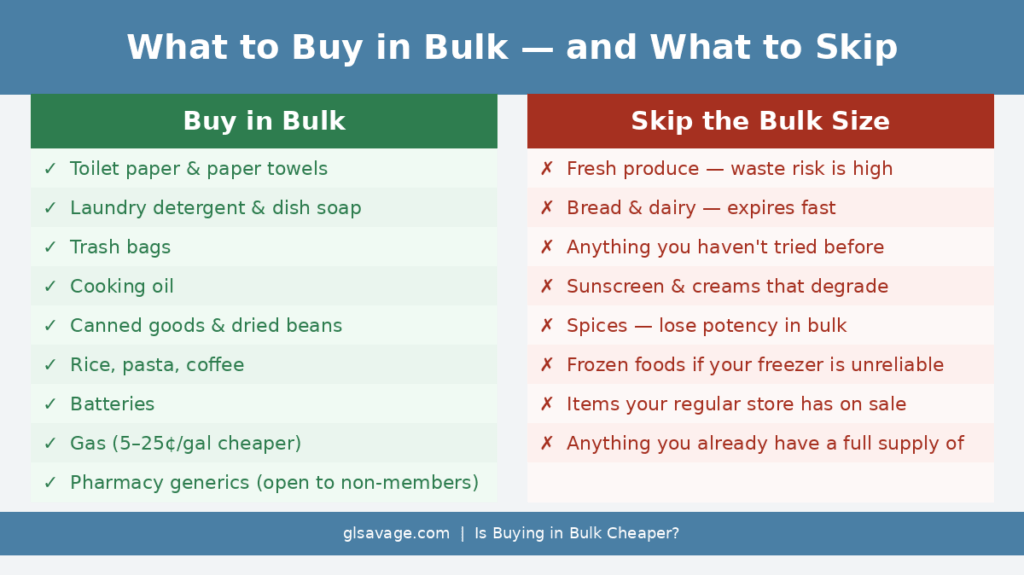
Toilet paper, paper towels, trash bags, laundry detergent, dish soap, cooking oil, canned goods, dried beans, pasta, rice, coffee, and batteries are where the economics actually work. The LendingTree analysis confirmed this directly: paper towels at Costco ran 3 cents per sheet versus 8 cents at Walmart, a 65 percent difference. Batteries saved 60 percent. These are real savings on items you will finish completely. Non-perishable, consistent consumption rate, no waste risk, no temptation to use more just because more is available.
The items that disappoint most reliably are perishable goods, personal care products that degrade over time (sunscreen, spices, certain creams), anything you have not tried before, and products where you already have a full container at home that will need to be used first. Buying a giant container of something you end up not liking is an expensive lesson. Buying a giant container of something that expires before you finish it is the same lesson twice.
Two things inside warehouse clubs that most people under-use deserve specific mention. The gas station typically runs 5 to 25 cents per gallon below local stations. A household filling a 15-gallon tank twice a month can cover the full membership fee on gas alone before buying a single grocery item. And in most states, Costco’s pharmacy is legally required to be open to non-members. Prescription pricing on many generics is among the lowest available anywhere. Most people do not know this is an option. The pharmacy is at the back of the store by design: non-members who come for prescriptions have to walk past all the merchandise twice. The placement is not accidental. It is the same logic as everything else in the building.
The Bulk Buying Story Was Never Really About You
The framing of bulk buying as smart, responsible, and forward-thinking did not come from a neutral source. It came from an industry that profits when you buy more, in larger quantities, behind a membership fee, and come back to renew every year because the sunk cost effect is one of the most reliable mechanisms in consumer psychology.
The receipt does not show the full bill. The full bill includes waste, storage, cash flow strain, purchases justified by the membership rather than by need, and consumption that accelerated because more was available. The store does not calculate any of that for you. It has no incentive to.
Is buying in bulk cheaper? For non-perishable staples you finish every time, with savings that exceed the membership cost, yes. For everything else, run the waste-adjusted cost first. Then decide. The Real Cost of Eating Cheap covers the trade-offs at the other end of the food budget, and Build an Emergency Fund Living Paycheck to Paycheck covers what to do with what you save.
Frequently Asked Questions About Buying in Bulk
Are there things that are actually more expensive to buy in bulk?
Yes, and more often than most people realize. Stores count on shoppers assuming bigger means cheaper without checking. A larger tub of the same coffee can cost more per pound than the smaller can. Two small cans of tomatoes on sale at a regular grocery store can cost 20 to 40 percent less than the large can at a warehouse club. Eggs at a supermarket typically run about 50 cents less per dozen than at Costco. Cereal on sale at a regular store regularly beats the warehouse price per ounce. The fix is simple: look at the unit price printed on the shelf tag, not the total price on the package. Compare every size of every item before deciding. The bulk size is not automatically the best deal. It just looks like it is.
Is buying in bulk actually cheaper?
Sometimes. A 2025 LendingTree analysis found that bulk buying saves shoppers an average of 27 percent on unit price across 44 common products. That same study found 38 percent of bulk buyers regularly throw away bulk purchases. Once waste, cash flow strain, and membership fees enter the calculation, the savings often shrink or disappear. The honest comparison is not unit price versus unit price. It is total cost of what you actually used versus what you would have paid buying smaller quantities that you finished completely.
Does buying in bulk save money on groceries?
On specific grocery categories, yes. Non-perishable staples with long shelf lives and predictable use, things like paper towels, toilet paper, rice, pasta, canned goods, laundry detergent, and coffee, tend to deliver real savings. Fresh produce, dairy, bread, and anything with a short shelf life are where savings most often vanish before the product does. The category matters more than the store.
What items are actually worth buying in bulk?
The reliable list is non-perishable and unglamorous: toilet paper, paper towels, trash bags, laundry detergent, dish soap, cooking oil, canned goods, dried beans, rice, pasta, coffee, and batteries. These have low waste risk, consistent consumption rates, and store easily. Items to avoid buying in bulk include fresh produce, anything you have not tried before, sunscreen and personal care products that degrade over time, spices that lose potency in large quantities, and frozen foods if your freezer is unreliable.
Why does Costco not have aisle signs?
It is intentional. Robert Price, co-founder of Price Club which merged with Costco, said in a 2015 NPR Planet Money interview that he was deliberately against directional signs because they would make customers wander all the aisles and find things to buy. He called the policy manipulative in his own words. The store layout also changes regularly to produce the same wandering effect. When familiar items have moved, shoppers search for them and encounter merchandise they were not planning to buy along the way.
Is a Costco or Sam’s Club membership worth it?
It depends on what you actually buy there and whether those items genuinely beat your regular store. Costco’s base membership is $65 per year as of September 2024, about $5.42 a month. Your real savings on the specific items you reliably buy need to beat that amount every month before the membership pays for itself. Both Costco and Sam’s Club offer full refunds on memberships with no time limit. Run the math on your actual shopping list for a few months before committing to renewal.
Can you use Costco’s pharmacy without a membership?
In most states, yes. State pharmacy laws generally require Costco’s pharmacy to be open to non-members. Prescription pricing on many generics and some brand-name medications is among the lowest available anywhere. You can call the pharmacy directly or check prices without a membership card. Worth knowing: the pharmacy is located at the back of the warehouse by design, so non-members walk past all the merchandise to reach it. That placement is intentional.
Does buying in bulk make sense when money is tight?
Only for non-perishable essentials where the upfront cost does not strain the rest of the week. The warehouse store model was designed for households with financial slack: storage space, a working freezer, cash to front-load purchases. When those resources are limited, the bulk buying math changes but the store’s psychology stays the same. Cheap over time is not the same as affordable today. If the bigger package means something else gets cut from the cart that week, that is a real cost that does not show up on the receipt.
How does paying a membership fee change what you buy inside the store?
More than most people realize. Once an annual fee is paid, the mind wants to justify it. This is the sunk cost effect: money spent in the past influences present decisions even though it is already gone. A 2018 Dartmouth study found that club store members spent 5 percent more on packaged food, made 2.5 extra shopping trips per month, and took home 3,500 more calories per person per month than non-members. The lead researcher’s conclusion was that they were not saving time, not saving money, and were eating more. Knowing the mechanism does not make you immune to it, but it makes it easier to notice when a purchase is being driven by the membership rather than by actual need.