
The call comes in. Someone says you owe money. Your stomach drops and your first instinct is to figure out how to pay them. That is exactly what they are counting on. Most people never stop to ask the one question that changes everything: who are you, actually? Because the debt collector on the phone is almost certainly not the company you originally borrowed from. They are more likely a stranger who purchased your debt like a commodity, paid a fraction of what you owe, and is now legally entitled to collect the full amount while being under no obligation to tell you any of that. The debt collection industry runs on one assumption: that you do not know how it works. This article is going to fix that.
Your Debt Was Probably Sold. Here Is What That Means.
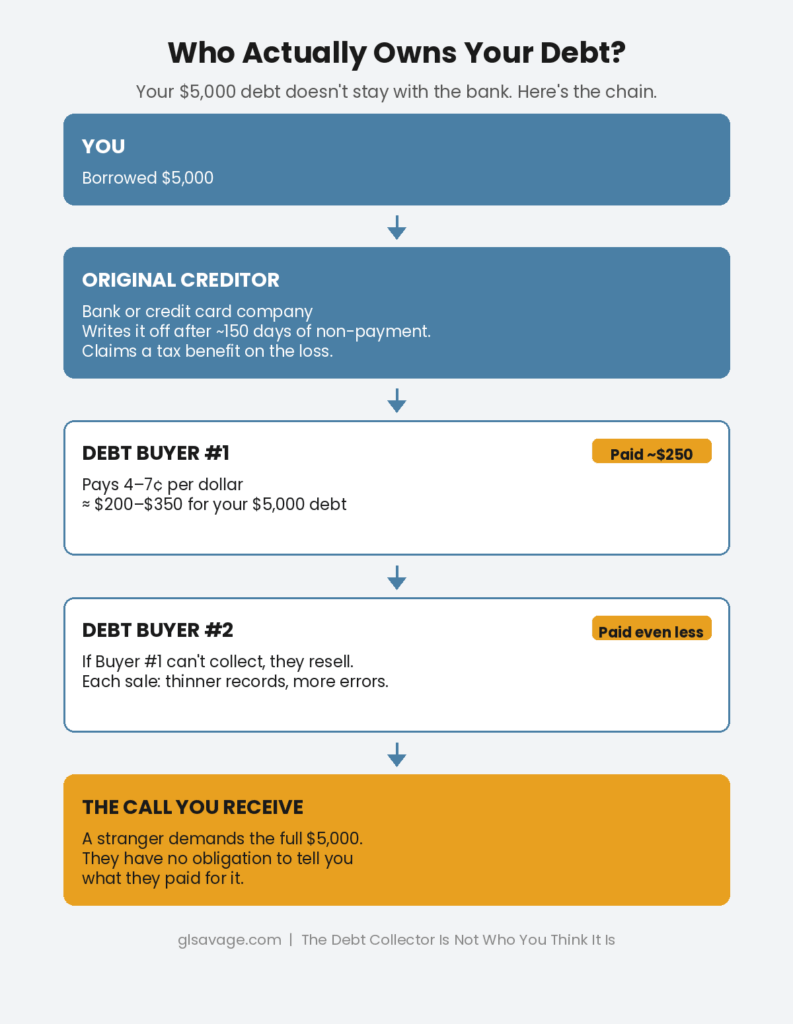
When you stop paying a debt, the original creditor, the bank or credit card company you actually borrowed from, does not chase you forever. After a certain point, usually around 120 to 180 days of nonpayment, they write it off as a loss on their books. This is called a charge-off. It sounds like the debt disappears. It does not. The creditor takes a tax benefit for the loss and then sells the account, often bundled with thousands of other defaulted accounts, to a debt buyer for a fraction of what you owe.
How much of a fraction? The numbers are not hidden, but the industry does not advertise them either. Debt buyers routinely pay less than five cents for every dollar of debt they purchase. Credit card debt typically sells for four to seven cents on the dollar. Older debt that has already been through one or more collection attempts can go for less than a penny on the dollar. The largest debt buying companies purchase portfolios containing millions of accounts for an average of around four to five cents on the dollar.
What that means in plain terms: if you owe $5,000 and your account was sold, the company calling you today may have paid somewhere between $200 and $350 for the right to collect that full $5,000 from you. They need you to pay the whole thing. You do not need to help them turn a profit. That is the actual dynamic in the room when a debt collector calls, and most people go through the entire conversation without knowing it.
Who You Are Actually Talking To Determines What You Can Do About It
The word “debt collector” gets used for three completely different kinds of companies, and your legal rights are not the same with all of them. Most people have no idea which one is calling. The industry counts on that.
If the company calling you still works for the bank or credit card company you originally borrowed from, that is an in-house collector. Here is what nobody tells you: the main federal law that protects you from abusive debt collection, the Fair Debt Collection Practices Act, the FDCPA, generally does not apply to the original creditor collecting its own debt. Chase calling you about your Chase account is largely outside those protections. The law was written to cover third parties, not the original lender. Some states fill that gap with their own laws, but federally, if it is the original creditor calling, your hands are closer to tied than you think.
If an outside company is calling on behalf of the original creditor, without having purchased the debt, that is a third-party collection agency. They collect a percentage of whatever they bring in and pass the rest back. They do not own your debt. The FDCPA applies here and you have the full set of federal protections.
If the company calling you purchased your account outright, that is a debt buyer. They own it. They paid pennies for it. They are not collecting on anyone else’s behalf. They keep everything they collect. This is who most people are actually dealing with by the time a stranger is calling about an old account, and knowing it changes every conversation you will have with them.
Your Debt Can Be Resold. Multiple Times. With Fewer Records Each Time.
A debt buyer who cannot collect does not necessarily give up. They resell the account to another debt buyer, who may sell it again. Your original $5,000 credit card debt can pass through three or four different companies over several years. Every time it changes hands, the documentation gets thinner. The new buyer typically receives an electronic file with basic information: your name, an account number, and a dollar amount. They rarely receive the original credit agreement, complete payment history, or documentation proving you actually owe what the file says you owe.
This is how a debt collector ends up calling you about a debt you paid off years ago. Or a debt that belonged to someone else with a similar name. Or a debt where the amount is wrong. The industry has documented cases of collectors pursuing people for debts discharged in bankruptcy, debts past their legal expiration date, and debts that were simply never theirs to begin with. The Human Rights Watch documented debt buyers winning court judgments against the wrong people, for wrong amounts, on debts that were legally unenforceable. This is not rare fringe behavior. It is a known and documented feature of how the industry operates.
The takeaway is not that every collector is lying. It is that you should never assume the debt is correct just because someone is calling to collect it. The burden of proof belongs to them. More on that shortly.
Zombie Debt Is Real and One Wrong Move Brings It Back to Life
Some collectors are not calling about a debt you currently owe. They are calling about a debt that is legally dead. Paid off years ago but the records did not survive the resale chain. Past the statute of limitations, meaning no court will let them sue you for it. Discharged in bankruptcy. Or belonging to someone else entirely. They buy these accounts for almost nothing precisely because they cannot legally enforce them. Then they call anyway, banking on the fact that you do not know the difference.
Here is the trap that ends badly for a lot of people: in most states, making any payment on a debt past the statute of limitations restarts the clock. A single payment of $25 on a debt you have no legal obligation to pay can revive it completely and give the collector fresh legal standing to sue you for the full amount. Verbally acknowledging the debt in certain states can do the same thing. The FTC has received more than 77,000 reports in a single year of collectors using abusive or threatening tactics or trying to collect money not actually owed. Some of the people calling you do not own a legitimate debt at all. They bought your personal information from a data breach and are betting that fear alone will get you to pay.
Before you say anything to a collector about an old debt, find out when the last payment was made and look up the statute of limitations for that type of debt in your state. Those two pieces of information tell you whether the debt is even legally collectible.
The Lawsuit Strategy That Wins Without Proving Anything
This is the part of the debt collection industry that nobody talks about and everyone should know.
Debt buyers file lawsuits by the thousands. Not because they expect to go to trial. Because they expect you not to respond. When someone is sued for a debt and does not file a written answer with the court within the deadline, the judge enters a default judgment automatically. No evidence required. No proof that the collector actually owns the debt. No documentation showing the amount is accurate. You simply did not respond, so the court assumes everything in the complaint is true and rules against you.
Studies across multiple states consistently show that more than 70 percent of debt collection lawsuits end in default judgments. In some courts the rate reaches 95 percent of cases that go to judgment. That is not an accident. It is the business model. Collectors file thousands of lawsuits counting on that number. When you ignore a lawsuit, a default judgment can lead to wage garnishment, frozen bank accounts, and property liens. And here is the detail that makes it worse: debt buyers often wait until close to the end of the statute of limitations to file, meaning a high-interest debt has been quietly accumulating the entire time. The Human Rights Watch documented that a $2,000 debt carrying a 25 percent interest rate grows to over $6,000 if the collector waits five years before suing.
The good news: when people do respond to these lawsuits, debt buyers frequently cannot win. They often do not have the original credit agreement. They cannot always prove an unbroken chain of ownership from the original creditor to themselves. They cannot always prove the amount is accurate. Attorneys who specialize in this area report that the mere appearance of a lawyer for the defendant regularly results in the case being dropped. The lawsuit depends on you doing nothing. If you do something, the whole strategy collapses.
If a collector sues you, respond in writing within the deadline your state requires. That deadline is typically 14 to 35 days from when you were served. If you need help, legal aid organizations in most areas provide free or low-cost assistance with debt collection cases, and many consumer rights attorneys handle these cases on contingency, meaning you pay nothing unless you win.
The Rights You Have That the Industry Hopes You Never Use
Congress passed a law in 1977 that gave people real power over debt collectors. Forty-some years later, most people being collected on have never heard of it. That gap between what the law allows and what people actually do is where the entire industry makes its money.
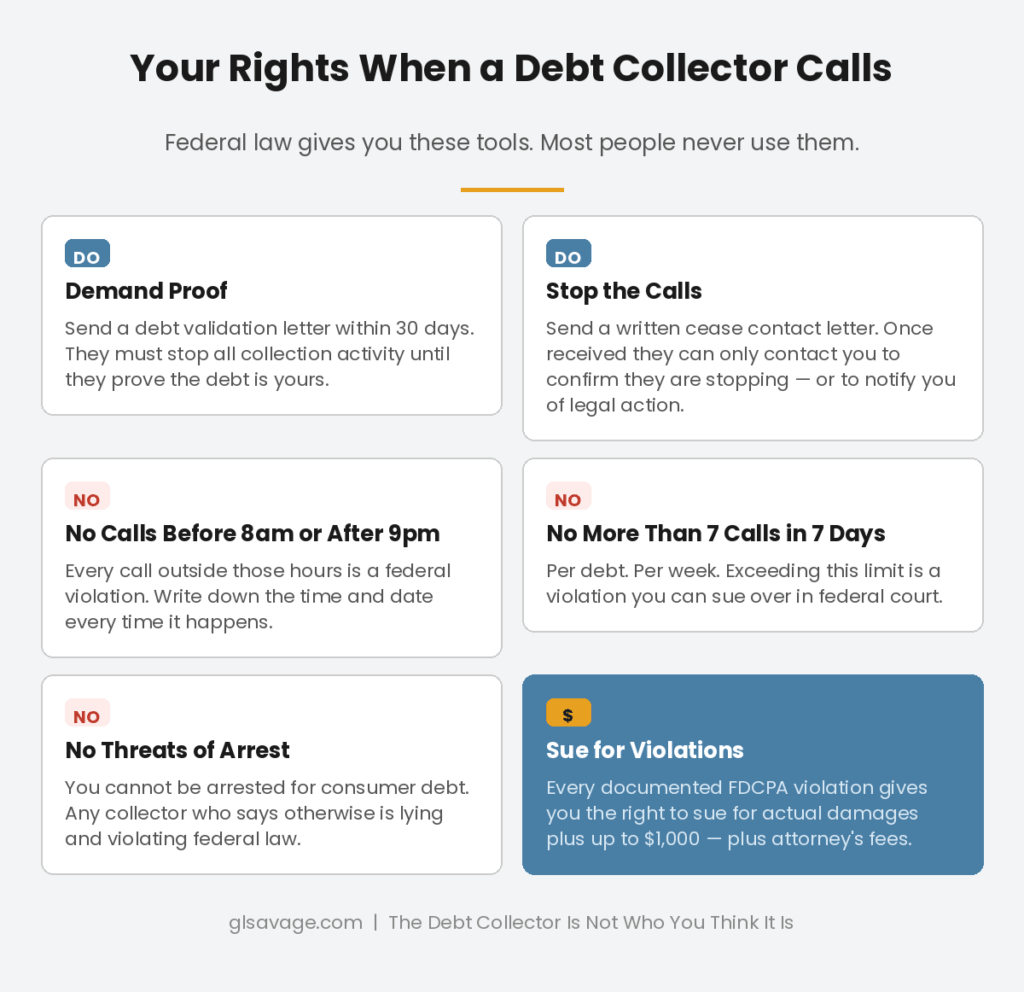
Within 30 days of a debt collector first contacting you, you can send a written request demanding they validate the debt. Validation means they must send you written proof of the amount owed, the name of the original creditor, and evidence they have the legal right to collect it. Once you send that letter, all collection activity must stop until they provide verification. If they cannot provide it, they cannot legally continue collecting or report the debt to the credit bureaus.
You can also send a written cease contact letter. Once they receive it, they can only contact you to confirm they are stopping collection or to notify you of specific legal action. That letter does not erase the debt, but it stops the calls entirely.
The law also prohibits collectors from calling before 8 a.m. or after 9 p.m., calling your workplace if you tell them your employer does not allow it, calling more than seven times in a seven-day period about a single debt, threatening legal action they do not actually intend to take, and pretending to be attorneys or government officials. Every documented violation gives you grounds to sue in federal court. If you win, you can recover your actual damages plus up to $1,000 in additional penalties plus attorney’s fees. The law has teeth. Use them.
Send the debt validation letter and any cease contact requests by certified mail with return receipt. That creates a paper trail proving they received it. The CFPB provides sample letters you can use as a starting point.
The Negotiation Position Nobody Tells You About
If the debt is legitimate, you owe it, it is within the statute of limitations, and you are dealing with a debt buyer, your negotiating position is dramatically stronger than they want you to know.
Because they paid four to seven cents on the dollar for your account, a debt buyer can settle for 20 or 30 cents on the dollar and still make money. If you offer 25 percent of the balance on a $5,000 account, you are offering $1,250 on a debt they may have paid $250 to acquire. That is a profit. They may counter. That is fine. Start lower than you expect them to accept.
Never pay anything before you have a written settlement agreement. That agreement must state the specific dollar amount being paid, confirm that amount satisfies the debt in full, and ideally state they will update the credit bureaus to reflect the settlement. Get it in writing before a single dollar leaves your account.
If you are dealing with the original creditor or a third-party agency collecting on their behalf, the math is different. They want as much as possible because anything short of full payment is a loss on their end. You still have room to negotiate, but you are not starting from the same position. Know who you are talking to before you name a number.
The Tax Bill Nobody Warns You About
This one blindsides people who do everything right with debt settlement and then get hit with a surprise the following April.
When a debt is forgiven or settled for less than the full amount owed, the IRS treats the forgiven portion as taxable income. If you owe $5,000 and settle for $1,500, the $3,500 the collector wrote off is considered income by the IRS. The collector is required to send you a Form 1099-C, Cancellation of Debt, for any forgiven amount of $600 or more. That amount gets added to your taxable income for the year the settlement happened.
Two situations let you avoid that tax hit. If your total debts exceeded your total assets at the time of the settlement, the IRS considers you insolvent and you can exclude the forgiven amount from your taxable income by filing Form 982. Debt wiped out in bankruptcy is also excluded. Neither exclusion applies automatically. You have to claim it, and if you do not know it exists, you will pay taxes you never had to pay.
The practical consequence: if you settle $10,000 in debt and you are in the 22 percent tax bracket, you could owe $2,200 in additional federal taxes that year. That changes the math on whether settlement was actually the right move. Factor the tax hit into the calculation before you agree to anything, and if your situation is complicated, talk to a tax professional before you settle.
What to Do When a Debt Collector Contacts You
Do not pay on the first call. Do not confirm any information you are not certain they already have. Write down the company name, the collector’s name, a callback number, and what they claim you owe. Then get off the phone and do your homework before the next conversation happens.
Pull your credit reports at AnnualCreditReport.com. All three bureaus are required to give you a free one. If the debt is real and in collections it will be there, with the collector’s name attached. If what the caller described does not show up anywhere on your credit reports, that is a significant red flag and you should not pay anything until you understand why.
Look up the statute of limitations for that type of debt in your state before you say another word to them. Find out when your last payment was made. If that payment is outside the window, the debt is time-barred. They cannot sue you. Do not make a payment, do not acknowledge the debt in writing, do not say anything that could be read as an admission until you know where you stand.
Send a debt validation letter by certified mail with return receipt requested. Make them prove the debt is yours, the amount is accurate, and they have the legal right to collect it. That letter stops all collection activity until they respond. If they cannot verify it, they cannot legally collect or report it. The CFPB provides a sample letter you can use as your starting point.
If you are sued, respond. Do not ignore a lawsuit because the amount feels overwhelming or because you do not know where to start. An unanswered lawsuit hands them a judgment they may never have been able to earn in court. Legal aid organizations operate in most areas and handle debt collection cases at no cost. Many consumer rights attorneys take these cases on contingency. Responding costs you nothing. A default judgment can follow you for years.
The debt collector contacting you is running a system designed to move fast and end before you understand your position. Slow it down. Make them prove everything. The burden of proof belongs to them, not you, and most of them are counting on you never figuring that out.
Frequently Asked Questions
Is the debt collector calling me the same as the company I originally borrowed from?
Almost certainly not. By the time a third-party collector contacts you, your original creditor has either hired an outside collection agency or sold your account entirely to a debt buyer. The company calling may have no prior relationship with you and likely paid pennies on the dollar for the right to collect your account.
What is a debt buyer and how is it different from a debt collector?
A debt collector is typically hired to collect on behalf of another company. A debt buyer purchases delinquent accounts outright and collects for themselves. Debt buyers commonly pay less than five cents per dollar of the balance owed, then attempt to collect the full amount. Because they paid so little, they have far more room to settle for less than the full balance and still make a profit.
What is a debt validation letter and how do I use it?
A debt validation letter is a written request demanding the collector prove the debt is yours, confirm the amount owed, and show they have the legal right to collect it. Send it within 30 days of first contact by certified mail with return receipt. Once they receive it, all collection activity must stop until they provide written verification. If they cannot verify it, they cannot legally continue collecting or report it to the credit bureaus.
What is zombie debt and do I have to pay it?
Zombie debt is old debt that is past the statute of limitations, has already been paid off, or was discharged in bankruptcy. Collectors cannot sue you for time-barred debt. Be careful: making even a small payment or verbally acknowledging the debt in some states can restart the statute of limitations and give the collector fresh legal standing to sue you for the full amount.
What happens if a debt collector sues me?
If you do not file a written answer with the court within the deadline, which is typically 14 to 35 days depending on your state, the judge will enter a default judgment automatically without requiring the collector to prove anything. That judgment can be used to garnish wages, freeze bank accounts, and place liens on property. Respond to every lawsuit, even if you believe the debt is invalid or the collector cannot prove their case.
Can I negotiate a debt settlement for less than the full amount?
Yes, especially with debt buyers. Because they purchased your account at a steep discount, they can settle for significantly less than the full balance and still profit. Always get a written settlement agreement before making any payment. The agreement must confirm that the amount being paid satisfies the debt in full. Also account for the tax consequences: forgiven debt of $600 or more is generally treated as taxable income by the IRS.
How do I know if a debt collector is legitimate or a scam?
Legitimate collectors must provide written notice of the debt within five days of first contact, including the original creditor name and the amount owed. They cannot demand payment by gift card, wire transfer, or prepaid debit card. They cannot threaten arrest. They cannot call before 8 a.m. or after 9 p.m. If any of these rules are being broken, report it to the FTC at reportfraud.ftc.gov and to the CFPB.
What rights do I have under the FDCPA when a debt collector contacts me?
The Fair Debt Collection Practices Act applies to third-party collectors and debt buyers but generally not to original creditors collecting their own debts. It prohibits calls before 8 a.m. or after 9 p.m., more than seven calls in a seven-day period, workplace calls if your employer prohibits them, threats of actions not actually intended, and impersonating attorneys or government officials. Violations give you the right to sue for actual damages plus up to $1,000 in additional penalties plus attorney’s fees.
Will settling a debt for less than I owe hurt my taxes?
Yes, potentially. The IRS treats forgiven debt of $600 or more as taxable income. The collector should send you a Form 1099-C showing the forgiven amount. You report that as income unless you qualify for an exclusion. The two most common exclusions are insolvency, meaning your total debts exceeded your total assets at the time of settlement, and bankruptcy discharge. File IRS Form 982 to claim either exclusion. Factor the tax consequence into your decision before agreeing to any settlement.
For more on what happens to your credit once a debt hits collections, read How Collection Accounts Affect Your Credit Report. And if you are dealing with minimum payments that never seem to shrink the balance, Minimum Payments Keep You in Debt. That Is Not an Accident. explains exactly how that math was designed to work against you. Every debt collector in this industry is counting on you not knowing any of this. Now you do.
