
About one in four renters never gets their security deposit back. According to a survey of 1,000 renters, 26 percent lost their deposit entirely. And the most telling number in that survey: 36 percent of the people who lost their deposit received no explanation from their landlord at all. No itemized list. No letter. Nothing. Just silence, and the assumption that the tenant would not do anything about it. Knowing how to get your security deposit back is not complicated. But the landlord is counting on the fact that most tenants do not know where the deadline is, what the law says, or how easy small claims court actually is. This article covers all of it.
The average security deposit is roughly one month’s rent. In expensive markets that can mean several thousand dollars sitting in your landlord’s account. It is your money. The law gives you specific tools to get it back. Most tenants never use them.
What Your Landlord Can and Cannot Deduct
The single most contested issue in every security deposit dispute is whether something counts as damage or normal wear and tear. Getting this distinction right is the foundation of getting your money back.
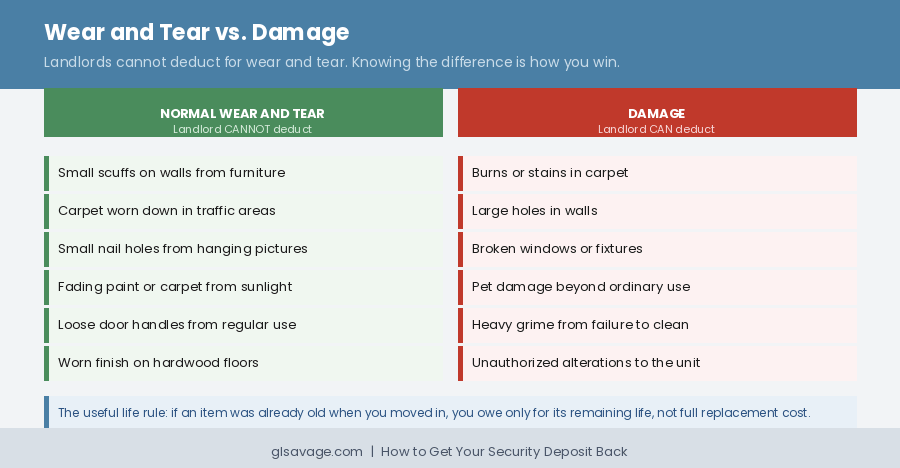
Normal wear and tear means the gradual deterioration that comes from ordinary, reasonable use of a home over time. It is not damage. A landlord cannot deduct it from your deposit. Examples of normal wear and tear include small scuffs on walls from furniture or everyday movement, carpet that has worn down in traffic areas from two years of walking, small nail holes from hanging pictures, minor fading of paint or carpet from sunlight, and loose door handles or hinges from regular use. These are things that happen to every rental property over time. They are the cost of renting to someone, not the cost of having a bad tenant.
Damage is something different. Burns or stains in carpet. Holes in walls beyond small nail holes. Broken fixtures. Pet damage beyond ordinary use. Significant grime buildup from failure to clean. Broken windows. These are things a tenant caused through negligence or misuse, and a landlord can legitimately charge for them.
The line between the two is not always clean, and landlords know it. Some will try to charge for repainting an entire apartment after a normal tenancy, replacing carpet that was already old when you moved in, or cleaning that goes beyond what was reasonable to expect. These deductions can be disputed. The law in most states puts the burden of proof on the landlord, not on you. They have to show that the damage was real, that you caused it, and that the cost to repair it was reasonable. If they cannot, the deduction does not hold.
One specific trap to know: landlords cannot charge you the full replacement cost of something that was already old. This is called the useful life rule. If the carpet in your unit was ten years old when you moved in and you are being charged to replace it entirely, that is not legal in most states. The landlord can only charge for the remaining useful life of the item. A carpet with a fifteen-year expected life that was already ten years old when you arrived had roughly five years of life left. You are responsible for a proportional share of that remaining value if you damaged it, not the cost of a brand new carpet. Many tenants pay full replacement costs on old items because they do not know this rule exists. See What Your Landlord Is Not Required to Tell You for the broader picture of how the information gap works against tenants before, during, and after a tenancy.
The Deadline Is the Thing Your Landlord Is Counting On
Most tenants focus on the condition of the apartment. The landlord is focused on the deadline. Here is why that matters.
Every state sets a deadline by which the landlord must either return your deposit or send you a written itemized list of deductions. The deadline ranges from 14 days in some states to 30 or 45 days in others. A landlord who misses this deadline in many states loses the right to keep any of the deposit, regardless of whether there was actual damage. In some states, missing the deadline triggers automatic penalties of double or triple the deposit amount owed to you, without you having to prove anything other than that the deadline passed.
This is the rule landlords are counting on you not knowing. If you do not know the deadline exists, you will never notice when it passes. You will wait. You will send a text. You will assume it is coming. By the time you realize something is wrong, weeks will have gone by and the landlord has already violated the law. Your leverage was at its maximum the day after the deadline passed, and you did not use it.
Look up your state’s security deposit laws and deadline before you move out. Write it down. Count the days from your move-out date. If that date arrives and you have not received your deposit or an itemized statement, the clock has run and your legal position is strong. Do not wait longer than a day or two past that deadline before sending a demand letter.
What You Must Do Before You Move Out
Knowing how to get your security deposit back starts before you hand in the keys. The work that protects your money happens in the weeks before you leave, not after.
Give proper written notice. Your lease specifies how much notice you must give before vacating, often thirty, sixty, or ninety days. Give that notice in writing, keep a copy, and send it in a way that creates a record, such as email or certified mail. If you do not give proper notice you may owe additional rent and give the landlord grounds to withhold the deposit.
Request a pre-move-out inspection. Many states give tenants the legal right to a walk-through inspection with the landlord before they vacate, typically within two weeks of the move-out date. At that inspection, the landlord must give you a written list of anything they intend to charge for. This gives you the chance to fix those items yourself before you leave rather than paying the landlord’s rate after the fact. Always ask for this inspection in writing and keep a copy of any list they give you. Some landlords will not mention you have this right. That is the point.
Document everything. Photograph and video every room, every wall, every surface, every appliance. Do this the day you move out after the unit is clean and empty. Date-stamp your photos. Compare them to any move-in photos you took. This documentation is your evidence if the landlord claims damage that was not there or tries to charge for preexisting conditions. Without it, it is your word against theirs in any dispute.
Clean thoroughly. Return the unit to the condition it was in when you moved in, accounting for normal wear and tear. You are not required to make it look new. You are required to make it clean. Do not leave furniture, food, personal items, or trash. A landlord can legitimately charge you for cleaning that goes beyond what you did.
Give your forwarding address in writing. Several states require tenants to provide a forwarding address before the deposit deadline begins running. If you do not provide one, the landlord in some states can argue the deadline clock never started. Give your forwarding address in writing the day you hand in your keys. Keep a copy.
What to Do When Your Landlord Is Withholding Your Deposit
If your landlord returns less than your full deposit and you believe the deductions are wrong, you can dispute them. There is a specific order that matters.
Step one is to review the itemized statement carefully. Compare each charge to your move-in and move-out photos. Is the damage in your photos? Was it there when you moved in? Is the charge for something that is normal wear and tear? Is the cost reasonable? Write down every charge you dispute and the specific reason you dispute it.
Step two is to send a written demand letter. This is a short letter stating that you dispute specific charges, naming which ones and why, and demanding the return of the disputed amount within a specific timeframe, usually ten to fourteen days. Send it by certified mail so you have proof it was received. Keep a copy. This letter serves two purposes: it gives the landlord a chance to resolve the dispute without court, and it creates a paper trail that will help you in small claims court if it comes to that.
Your demand letter does not need to be formal or legal-sounding. It needs to state: what you are owed, which deductions you dispute and why, what amount you are demanding back, and a deadline for response. One page. Direct. Specific. In writing. See What Your Landlord Is Not Required to Tell You for background on how documentation and written records function as your primary protection in any landlord dispute.
What to Do If the Landlord Ignores You or Refuses
If the landlord does not respond to your demand letter, responds with a refusal, or simply keeps the deposit past the legal deadline without explanation, small claims court is the right next step. This is not as intimidating as it sounds.
Small claims court is specifically designed for disputes exactly like security deposit cases. The filing fee is typically between $30 and $100 depending on your state. You do not need an attorney. The process involves filing a simple form with your local court, serving the landlord with notice of the claim, and appearing before a judge to present your evidence. The evidence is your photos, your demand letter, the landlord’s itemized statement, and your lease. Most hearings last less than thirty minutes.
The key number to know: in many states, if a landlord wrongfully withheld your deposit, you are entitled to two or three times the amount wrongfully kept, not just the amount itself. A $1,500 deposit wrongfully withheld in a state with triple damages means you can sue for $4,500. That is not a bonus. That is what the law is designed to do, because the penalty has to be large enough to make it worth pursuing and costly enough to deter landlords from doing it routinely.
In Texas, for example, tenants can recover three times the amount wrongfully withheld. In California, a landlord who retains a deposit in bad faith faces up to twice the deposit in additional damages on top of the actual amount. In New York, a landlord who willfully violates the security deposit rules faces up to twice the deposit in punitive damages on top of returning what was wrongfully kept. These penalty structures exist in most states. Look up your state’s specific penalty before you file so you know exactly what you are entitled to claim. The landlord almost certainly knows this number. Now you do too.
The Tactics Landlords Use and How to Counter Them
Understanding how to get your security deposit back means understanding how landlords try to keep it. Most security deposit disputes are not about genuine damage. They are about the landlord knowing the tenant will not fight back. These are the most common tactics used to withhold deposits unlawfully and what to do about each one.
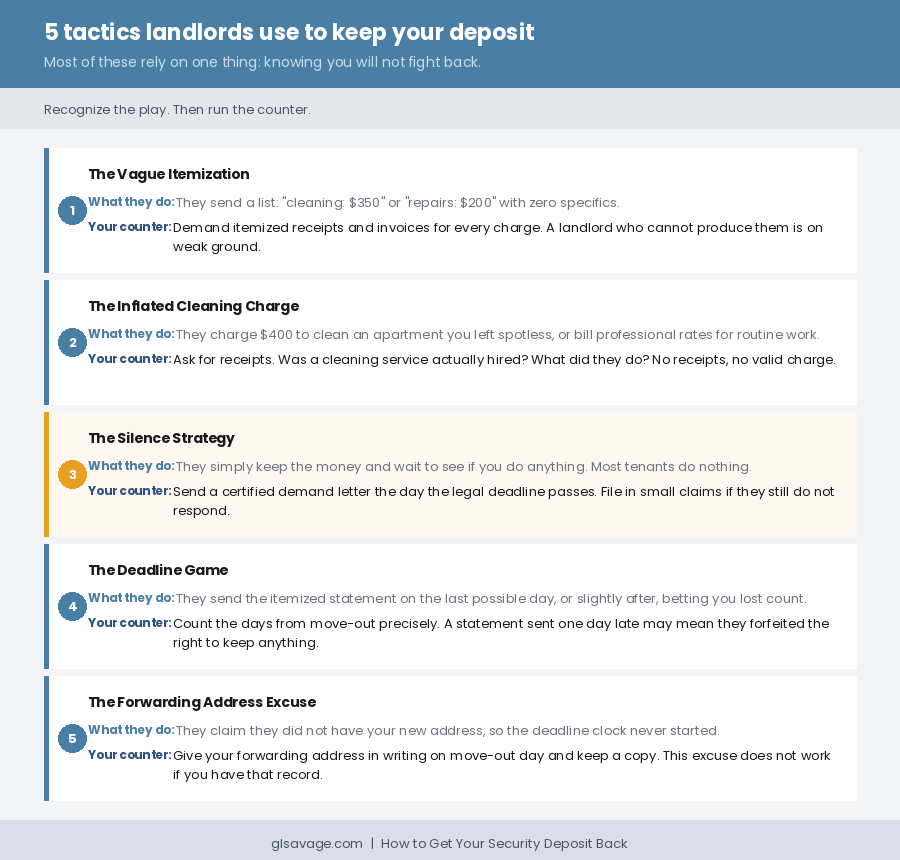
The vague itemization. The landlord sends a list with charges like “cleaning: $350” or “repairs: $200” with no specifics. In most states, itemized statements must be specific enough that the tenant can understand what was damaged and what it cost to fix. A vague list may not satisfy the legal requirement for itemization. Respond in your demand letter by asking for the specific items, the specific amounts, and the receipts or invoices. A landlord who cannot or will not produce receipts is on weak ground.
The inflated cleaning charge. The landlord charges $400 to clean an apartment that you left clean, or charges professional cleaning rates for a unit you left in reasonable condition. Ask for the receipts. Was a cleaning service actually hired? What did they actually do? If the cleaning charge is not supported by documentation, it can be disputed.
The silence strategy. The landlord simply does not respond. They keep the money and wait to see if you do anything. This is the most common tactic because most tenants do nothing. Sending a certified demand letter and filing in small claims court if there is no response is the direct counter to this. The landlord is betting you will not. Show them you will.
The deadline game. The landlord sends the itemized statement on the last possible day of the deadline window, or slightly after, betting you do not know exactly when the deadline was. This is why knowing your state’s deadline and counting the days precisely matters. A statement sent on day 22 in a state with a 21-day deadline may mean the landlord has already forfeited their right to keep anything.
The forwarding address excuse. The landlord claims they did not know your forwarding address, so the clock never started. This is why giving your forwarding address in writing on move-out day, and keeping a copy, is essential. If you have that documentation, this excuse does not work.
Where to Find Free Help
You do not have to do this alone. Free resources exist specifically for security deposit disputes.
Your state’s attorney general office often has a consumer protection division that handles landlord-tenant complaints. Many have sample demand letter templates available for download on their websites. Local legal aid organizations provide free legal assistance for tenants in most jurisdictions. To find legal aid near you, search your state name plus “legal aid housing” or check the LawHelp.org directory, which connects tenants to free legal resources by state.
The HUD website maintains a directory of tenant rights organizations by state at hud.gov. Many of these organizations have staff who can advise you on your specific situation, help you draft a demand letter, and tell you exactly what your state’s deadline and penalty structure looks like.
For the small claims filing itself, the clerk of your local court can walk you through the forms. Their job is to help people file correctly. You do not need a lawyer to file a small claims case, and in many states attorneys are not permitted to represent clients in small claims court anyway. It is designed for exactly this.
The Honest Takeaway
The security deposit system works the way it does because most tenants do not know the rules and most landlords do. The 36 percent who lose their deposit with no explanation are not people who had worse apartments. They are people who did not know the deadline, did not send the demand letter, and did not walk into small claims court. The landlord gambled correctly that they would absorb the loss quietly.
Knowing how to get your security deposit back is not about being combative. It is about knowing the law, following the steps, and using the tools the law already gave you. Document the unit. Know the deadline. Send the letter. File the claim if you have to. The landlord is not afraid of you because they think you will be unpleasant. They are afraid of the process, because the process works.
Frequently Asked Questions
How long does a landlord have to return a security deposit?
It depends on your state. Deadlines range from 14 days in some states to 30 or 45 days in others after you move out. Some states start the clock from when you vacate; others from when the landlord receives your forwarding address. Look up your specific state’s deadline before you move out and count the days precisely. A landlord who misses the deadline in many states loses the right to keep any portion of the deposit.
What can a landlord deduct from a security deposit?
Landlords can deduct for unpaid rent, damage beyond normal wear and tear, and excessive cleaning costs if you left the unit in unreasonably dirty condition. They cannot deduct for normal wear and tear, which covers ordinary deterioration from everyday use. They also cannot charge you full replacement cost for items that were already old when you moved in. Most states require that deductions be itemized in writing with specific costs.
What is normal wear and tear?
Normal wear and tear is the gradual deterioration that comes from ordinary, reasonable use of a home. Small scuffs on walls, carpet wear in traffic areas, minor fading from sunlight, and small nail holes from hanging pictures are all normal wear and tear. Burns, stains, large holes, and damage from pets or neglect are not. Landlords cannot deduct for normal wear and tear even if the lease says they can, because state law overrides that kind of lease clause.
What do I do if my landlord keeps my deposit without explanation?
First, check whether the legal deadline has passed. If it has, the landlord may have already forfeited their right to keep the deposit under your state’s law. Send a written demand letter by certified mail stating the amount you are owed and a deadline to respond. If there is no response or the landlord refuses, file in small claims court. The filing fee is typically under $100 and you do not need an attorney.
How do I write a security deposit demand letter?
Keep it short and specific. State your name, the property address, your move-out date, and the amount of deposit you paid. List each deduction you dispute and the specific reason you dispute it. State the total amount you are demanding back and give a clear deadline, typically ten to fourteen days. Send it by certified mail and keep a copy. You do not need legal language. You need to be specific about what you are owed and why.
Can I get double or triple my security deposit back?
In many states, yes. If a landlord wrongfully withheld your deposit, state law often allows you to recover two or three times the amount that was wrongfully kept, not just the original amount. This applies in states including California, Texas, New York, and many others. The penalty exists specifically because the deterrent has to be larger than the amount at stake or landlords would routinely withhold deposits knowing most tenants will not fight back.
What if I did not do a move-in inspection?
It makes things harder but not impossible. If you have any photos, texts, or emails from when you moved in that document the condition of the unit, those can serve as evidence. If the landlord is charging you for damage that was clearly preexisting, witness statements from people who saw the unit can help. From this point on, always do a move-in inspection with photographs the day you move in. It is the single most important thing you can do to protect your deposit.
Can a landlord charge for carpet cleaning after I move out?
Only in specific circumstances. If the carpet requires cleaning beyond what is reasonable for a normal tenancy, the landlord may be able to charge for it. But if the carpet simply needs routine cleaning after normal use, that is a normal cost of renting and not deductible from your deposit in most states. And if the carpet was already old when you moved in, the landlord cannot charge you full replacement cost. The useful life rule means you only owe for the proportion of the carpet’s remaining value that you affected.
