
When you sign a lease, one person in that transaction has a lawyer, years of experience, and a document they wrote themselves. The other person has thirty minutes and the fear of losing the apartment. That information gap is not an accident. There are things your landlord knows about the unit, the building, and the fine print that they are under no legal obligation to tell you. Some of those things would change your decision to sign.
What landlords are not required to disclose varies by state, but in most jurisdictions it includes flooding history from plumbing failures, the previous tenant’s rent, neighbor complaints or building history, pending property sales, and the age or condition of major building systems. Federal law requires only one disclosure. Everything else depends on where you live and whether you know to ask.
This article covers what the law actually requires, what it does not, the lease clauses that quietly shift costs onto tenants, and the specific questions to ask before you sign anything.
What the Law Actually Requires Landlords to Disclose
Understanding what landlords are not required to disclose starts with knowing what they are required to disclose. The gap between those two lists is where the real surprises live.
There is only one federally required disclosure for residential landlords: lead-based paint. If the property was built before 1978, the landlord must give you a government pamphlet about lead paint hazards and disclose any known lead paint or lead paint inspections on the property. That is the entire federal requirement. Everything else comes from state and local law, which varies significantly by location.
Most states require some version of the following: the landlord’s identity and contact information, the terms of the security deposit and where it is held, information about smoke and carbon monoxide detectors, and notice of any known mold that exceeds health limits. Some states require disclosure of known flooding history, known methamphetamine or fentanyl contamination, asbestos in buildings constructed before 1981, radon levels if the landlord has tested, and information about whether the property is in foreclosure. A handful of states require landlords to disclose if someone died in the unit within the past one to three years, though the rules on this vary significantly by state.
In seven states, including Arkansas, Colorado, Idaho, Louisiana, Mississippi, Missouri, and Vermont, there are no state-level landlord disclosure requirements beyond the federal lead paint rule. In those states, the landlord is legally obligated to tell you almost nothing.
The law establishes a floor, not a ceiling. The things landlords are required to disclose are the ones that tend to be easier to document and verify. The harder ones, the ones that directly affect how much you pay and how you live, are typically not required at all.
What Landlords Are Not Required to Tell You
This is where the information gap gets expensive.
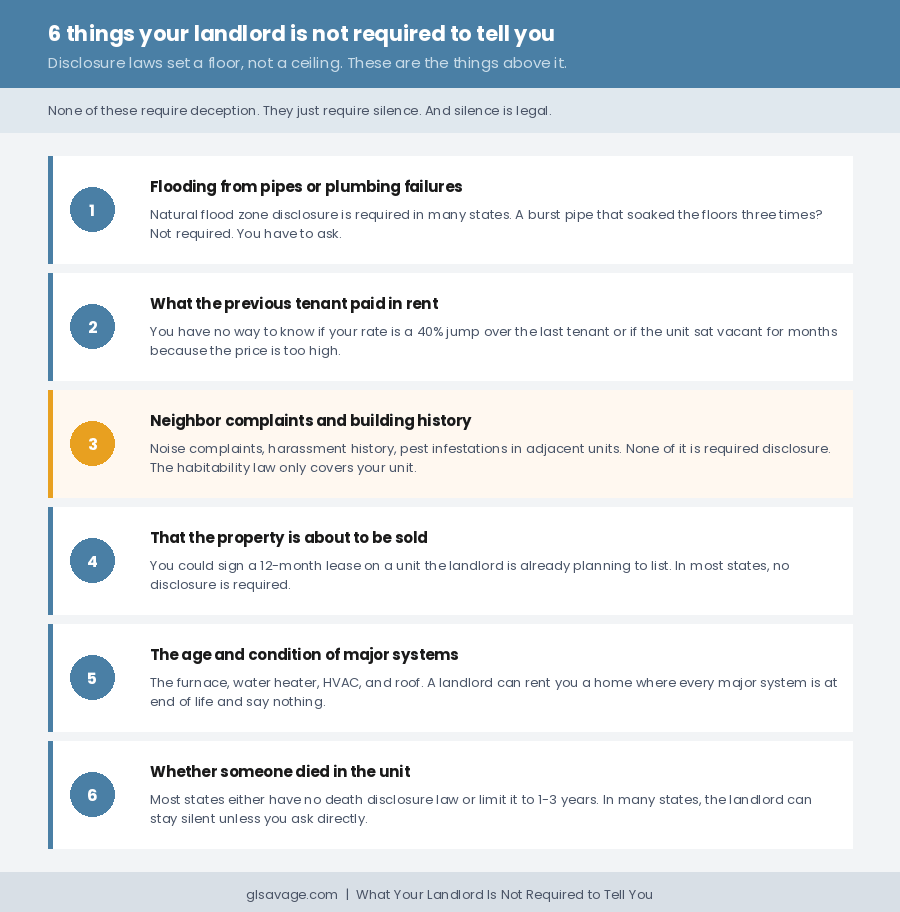
In most states, landlords are not required to disclose whether the unit has a history of flooding from plumbing or mechanical failures. Natural flood events and flood zone status are required disclosures in many states, but a burst pipe that soaked the floors, a ceiling that has leaked three times from the unit above, or a basement that fills with water every heavy rain? Not required. The burden is on you to ask, and the landlord is only obligated to answer truthfully if you do ask directly.
Landlords are generally not required to tell you what the previous tenant paid in rent. In most jurisdictions, rent history is not a required disclosure. You have no way of knowing from the lease itself whether the advertised rate is a significant increase over what the last tenant paid or whether the unit has been sitting vacant for months because the price is too high for what you are getting.
Landlords are not required to disclose neighbor situations. If the unit above has had repeated noise complaints filed against it, if the neighbor across the hall has a history of harassment complaints, or if the building has an ongoing pest infestation in adjacent units, none of that is required disclosure. The habitability standard covers active infestations in your unit, but the building’s history and current neighbor situation is generally not something landlords are legally required to surface.
In most states, landlords are not required to disclose that the property is about to be sold. You could sign a twelve-month lease on a unit that the landlord already knows they are listing in two months. A few states require disclosure of imminent condo conversion plans, but a sale to a new owner who may not want to continue renting is not required disclosure in most places. Your lease protects you in most states from immediate displacement, but it does not prevent the disruption and uncertainty that comes with a property changing hands mid-tenancy.
Landlords are not required to disclose the age or condition of major appliances and building systems. The furnace, the water heater, the HVAC unit, the roof: none of this has to be disclosed. You are signing a lease on a home where major systems could be at end of life, and the landlord has no obligation to tell you that before you sign.
In most states, landlords are not required to proactively disclose whether someone died in the unit unless a state law specifically requires it, and even where those laws exist, the window is often limited to one to three years and the method of death may not need to be specified.
The Lease Clauses That Quietly Cost You Money
What landlords are not required to disclose extends beyond verbal disclosures into the lease document itself. Disclosure law covers what landlords say before you sign. The lease itself is a separate problem. Leases are written by landlords or their attorneys to serve the landlord’s interests. Most tenants sign them without reading past the rent amount and move-in date. What they miss often costs them for the entire length of the tenancy.
Auto-renewal clauses are among the most commonly missed. Many leases automatically renew for another full term, sometimes another twelve months, if the tenant does not provide written notice to vacate within a specific window, often sixty to ninety days before the end of the lease. Miss that window by a day and you can be legally bound to another full year. The clause is in the lease. It is legal. And most tenants encounter it only when they are trying to move out.
Early termination fees can be structured in ways most tenants do not anticipate. Some leases require the tenant to pay rent for every remaining month on the lease after vacating, not just a flat penalty fee, meaning that leaving a twelve-month lease at month four can cost eight months of rent. Tenant advocacy organizations across the country identify this as one of the most costly lease surprises renters encounter.
What Is RUBS Utility Billing and How Does It Affect Renters?
RUBS stands for Ratio Utility Billing System. It is a method landlords use in buildings without individual unit meters to divide the building’s total utility costs among all tenants using a formula, usually based on square footage, occupancy, or some combination of both. Your bill is not based on what you actually use. It is based on a formula the landlord chooses.
The DC Attorney General’s office issued a formal consumer alert specifically warning tenants that RUBS bills are not based on actual usage, that the formula can vary from property to property, and that there is no law in most jurisdictions dictating what formula must be used. Tenants told to expect around $50 a month in utilities have received bills of $200 or more. None of that requires any deception. It is in the lease addendum. In small print. That they signed.
If your building uses RUBS, ask to see the formula in writing and the last twelve months of actual utility bills before you sign anything. That is the only way to know what you are actually agreeing to pay.
Are Rental Junk Fees Legal?
Junk fees are charges layered onto rent beyond the base amount. Consumer advocates estimate renters pay around $3.7 billion annually in these fees. They typically include monthly amenity fees for facilities you may never use, trash removal fees on top of municipal waste service already covered by taxes, package delivery fees billed regardless of whether you received a package, pest control fees charged monthly whether or not pest control was performed, and payment processing fees simply for paying rent electronically.
These fees are disclosed, technically. They are in the addenda attached to leases most tenants do not read. The advertised rent figure that drew you in does not include them. Some states, including California and Colorado, have passed laws requiring all mandatory fees to be included in the advertised rent price. Most states have not.
Hold-harmless clauses attempt to waive your right to sue the landlord for negligence. One Georgia lease reviewed by housing researchers contained a clause stating the tenant agreed to hold the landlord harmless from any claims or damages unless caused solely by the landlord’s negligence. The word “solely” raises the legal bar significantly. These clauses may not be fully enforceable in every state, but tenants read them and believe they cannot pursue a claim. If you see this language in a lease, ask an attorney or your local tenant advocacy organization what it means where you live before you sign.
The Security Deposit Trap Nobody Explains
The security deposit is the single most contested financial issue in landlord-tenant law. Most tenants treat it like a formality. Landlords treat it like a negotiating chip at the end of a tenancy.
Most states require landlords to return the security deposit within a specified window after move-out, typically fourteen to thirty days, along with an itemized list of any deductions. Many tenants do not know this law exists and therefore do not know when a landlord is violating it. A landlord who holds your deposit beyond the legal deadline without justification can owe you double or triple the deposit amount in many states. Enforcing that deadline requires knowing it exists.
Normal wear and tear cannot be deducted from your security deposit in most states. Normal wear and tear means the gradual deterioration that happens through ordinary, reasonable use of a property: small scuffs on walls from furniture, carpet wear in traffic areas, minor fading from sunlight. A landlord cannot charge you for repainting a room that simply needs repainting after two years of normal occupancy. Many do, and tenants who do not know the distinction pay it without questioning.
The move-in inspection is your protection against all of this. If you document the condition of the unit before you move in, with photographs and a written checklist that both you and the landlord sign, you have a record that preexisting damage existed before your tenancy. Without that documentation, a landlord can claim any damage was caused by you, and the burden shifts to you to prove otherwise. Many states give tenants the right to request a move-in checklist. In many states, landlords are required to provide one. Ask for it. Do the walkthrough. Photograph everything.
See also Is It Better to Own or Rent? The Real Math No One Explains.
What to Ask Before You Sign Anything
The landlord is not going to volunteer this information. The law does not require it. That is what landlords are not required to disclose in practice: the things that would most change your decision are the things you have to ask about yourself. Once you sign, the negotiating power shifts completely.
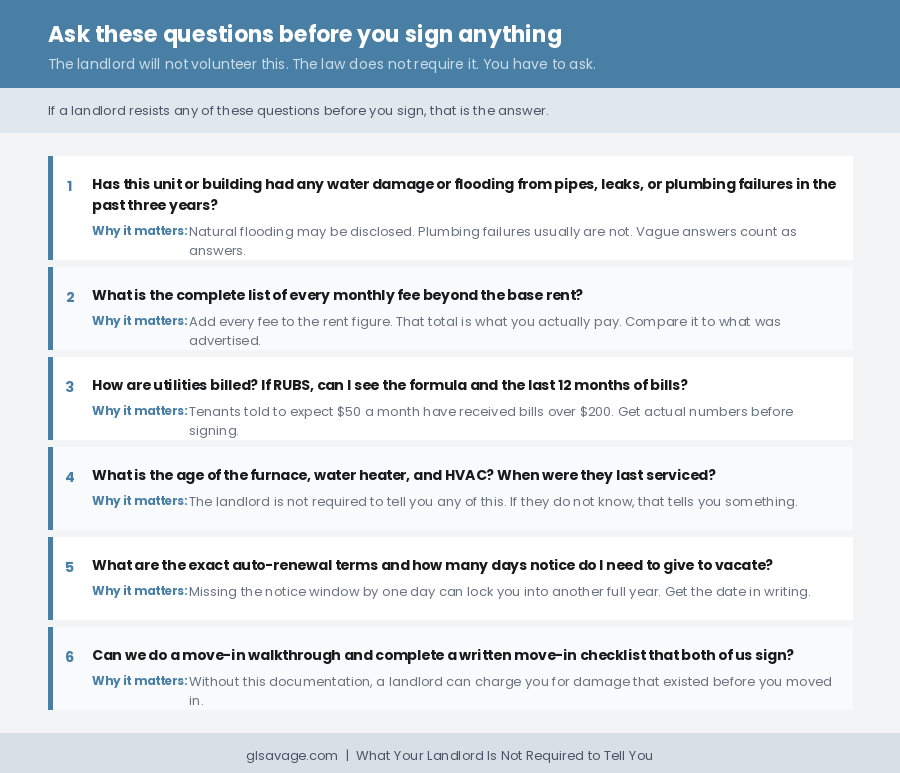
Ask about flooding and water intrusion history. Ask specifically about both natural flooding and plumbing or mechanical failures. Ask whether any units in the building have experienced water damage in the past three years. A vague answer is itself an answer.
Ask what utilities are included and exactly how non-included utilities are billed. If the building uses RUBS, ask to see the formula in writing and the last twelve months of actual utility bills so you have a realistic picture of what you will pay. If the landlord cannot or will not provide this, that is worth knowing before you sign.
Ask about all fees, not just the rent. Ask for a complete list of every monthly charge that will appear on your bill, including any administrative fees, amenity fees, utility administration fees, pest control fees, and package delivery fees. Ask which fees are optional and which are mandatory. Then add them up and compare that number to the advertised rent. That gap is your real cost.
Ask about the condition and age of major systems: the furnace, the water heater, the HVAC. Ask when they were last serviced. How the landlord answers tells you something about how the building is maintained.
Ask about the notice-to-vacate requirement and auto-renewal terms. Get the specific number of days required and the specific deadline relative to your lease end date. Write it in your calendar the day you move in.
Ask to do a move-in walkthrough and request a written move-in checklist. This protects both you and the landlord, and any landlord running a legitimate operation should have no objection to it.
If a landlord tells you the apartment will go to someone else if you do not sign today, understand that pressure for what it is. It is a negotiating tactic. Apartments do not typically disappear in the time it takes to ask a few basic questions. And how a landlord responds to questions before you sign tells you how they will respond when something goes wrong after you do.
Where to Find Help If Something Goes Wrong
If a landlord has violated a disclosure requirement, illegally withheld your security deposit, or charged fees not authorized by your lease, you have options beyond absorbing the loss.
Your state’s attorney general office often has a consumer protection division that handles landlord-tenant complaints. Many state attorneys general have direct consumer hotlines specifically for housing disputes.
Local tenant advocacy organizations know the specific laws in your jurisdiction and often provide free advice or referrals. The HUD website maintains a directory of tenant rights groups by state at hud.gov.
Small claims court is the right venue for security deposit disputes in most states. The process is designed for people without attorneys. Filing fees are low. If your landlord violated the deadline for returning your deposit, many states entitle you to double or triple damages plus court costs. The amount at stake is often worth the time to file.
The Honest Takeaway
The information gap in a lease signing is structural. The landlord has the lease, the legal template, and the experience. You have the pressure of needing a place to live and a clock running on the decision. Knowing what landlords are not required to disclose does not eliminate that asymmetry. It changes your position in it. You know what questions to ask. You know that the lease they handed you was written to serve them, and that your job is to read it like the legal document it is before you agree to be bound by it.
Ask every question on that list. Document everything before you move in. The time you spend before signing is worth more than the time you spend fighting over it after.
Frequently Asked Questions
The only federal requirement is lead-based paint disclosure for properties built before 1978. Everything else is governed by state and local law. Most states require disclosure of the landlord’s identity, security deposit terms, and known mold that poses a health risk. Some states require flooding history, death in the unit, radon, asbestos, or foreclosure status. Seven states have no state-level disclosure requirements at all beyond the federal lead paint rule.
In most states, what landlords are not required to disclose includes flooding from plumbing or mechanical failures, the previous tenant’s rent, neighbor complaints or building history, that the property is about to be sold, and the age and condition of major appliances and building systems. Disclosure laws set a floor, not a ceiling. The things that most directly affect your daily life and monthly costs are typically not required disclosures.
RUBS, or Ratio Utility Billing System, divides a building’s total utility costs among all tenants using a formula based on square footage, occupancy, or both. Your bill is not based on your actual usage. There is no law in most jurisdictions dictating what formula must be used. Ask to see the formula and the last twelve months of actual bills before signing any lease that uses RUBS billing.
Junk fees are charges layered onto rent beyond the base amount, including amenity fees, trash removal fees, package delivery fees, pest control fees, and payment processing fees. Consumer advocates estimate renters pay around $3.7 billion annually in these fees. They are generally legal if disclosed in the lease, which is why reading every addendum matters. Some states require all mandatory fees to be included in the advertised rent price. Most states do not.
No. In most states, normal wear and tear, meaning the gradual deterioration from ordinary, reasonable use, cannot be deducted from a security deposit. Small scuffs on walls, worn carpet in traffic areas, and minor fading do not qualify as damage. The protection depends on documentation. Photograph the unit before you move in, complete a move-in checklist, and have the landlord sign it.
Most states require landlords to return the deposit within a set window after move-out, typically fourteen to thirty days, along with an itemized list of any deductions. A landlord who violates this deadline can owe you double or triple the deposit amount in many states. Send a written demand by certified mail if your landlord is late. Small claims court is the appropriate venue if they do not respond, and filing costs are low relative to what you may recover.
Ask about flooding and water intrusion history from both natural events and plumbing issues. Ask for a complete list of all monthly fees beyond the base rent. Ask how utilities are billed and request the last twelve months of actual bills if RUBS is used. Ask about the age and last service date of major systems. Ask about auto-renewal terms and the exact notice-to-vacate deadline. Ask to do a move-in walkthrough and get a signed written checklist.
Generally yes. Signing a lease means agreeing to its terms, even terms you did not read. Some clauses are illegal and unenforceable regardless, including clauses that waive your right to habitability, prohibit you from calling emergency services, or attempt to prevent you from exercising rights granted by state law. Legal clauses you missed, like auto-renewal terms or early termination fees, are typically binding.