The food industry figured out a long time ago that the easiest customer to sell to is someone who does not have options. When money is tight, the first place most people try to cut is food. It feels logical. Rent is fixed. Utilities are fixed. But the grocery cart looks adjustable, and the system is very good at showing you how to adjust it downward. The cheapest calories in any store are almost always the most processed ones, and they are priced that way on purpose. The receipt at the register looks like a win. The real bill arrives later, in pieces, in ways that are difficult to trace back to what you were eating cheap on when the money was shortest. This article is about what that bill actually contains, why the food system is built the way it is, and what you can actually do about it on a budget that does not have a lot of room for error.
The Price Gap Is Real and It Was Engineered
Ultra-processed foods average about 55 cents per 100 calories. Unprocessed whole foods average about $1.45 per 100 calories. That gap is real and it is not a market accident. The commodity crops that go into processed food, corn, wheat, sugar, soy, and vegetable oils, are produced at enormous industrial scale and receive significant federal subsidies. Fresh produce and minimally processed whole foods do not benefit from the same infrastructure or the same policy support. The price difference reflects a policy choice as much as a market one. Harvard School of Public Health research found that the healthiest diets cost about $1.50 more per day than the least healthy ones. That is $547 a year. Real money on a tight budget, and a number the food industry did not arrive at by accident.
Ultra-processed food did not get cheap by accident either. The modern food system was built around producing enormous volumes of shelf-stable, portable, highly palatable calories as efficiently as possible. The ingredients are cheap at scale. The manufacturing is automated. The product can sit on a shelf for months without spoiling. Fresh food cannot do any of that, and its price reflects those limitations. The United States leads the world in ultra-processed food consumption, with these products accounting for about 60 percent of caloric intake, compared to 14 to 44 percent in Europe. That gap is not explained by American preferences alone. It is explained by what the American food environment prices, subsidizes, and makes available. The Poverty Premium Explained: How to Fight Back covers the broader pattern of how the system charges the most to the people with the least. The food system is one of its clearest examples.
The Health Bill Nobody Sees at the Register
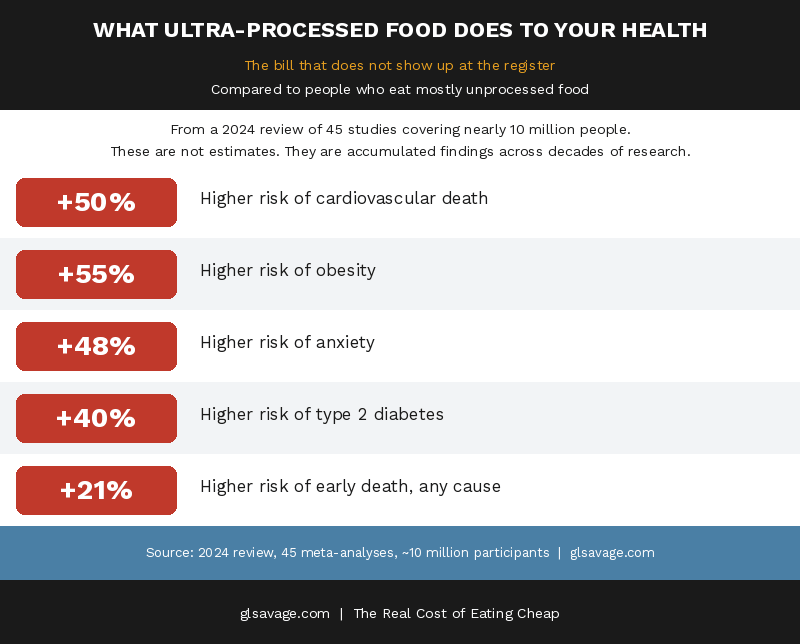
The second cost of eating cheap is the one that arrives slowly enough that most people never connect it to what was in the grocery cart. A 2024 review covering 45 separate analyses and nearly 10 million study participants found that a diet high in ultra-processed foods increases the risk of death from cardiovascular disease by 50 percent and the risk of anxiety by 48 percent. It found that greater consumption increases the risk of obesity by 55 percent, type 2 diabetes by 40 percent, depression by 20 percent, and early death from any cause by 21 percent.
Those numbers are not a scare tactic. They are the accumulated findings of research covering tens of millions of people over years. The diseases do not arrive overnight. They accumulate across hundreds of small decisions made under budget pressure, and by the time the medical bills appear, the grocery savings from years earlier are long gone. Type 2 diabetes, cardiovascular disease, and obesity each generate ongoing medical costs that dwarf any savings at the register. The food was never actually cheap. The cost was deferred, and the bill arrives with interest.
Why Cheap Food Makes You Eat More of It
There is a hidden cost that has nothing to do with disease risk. It has to do with how the food signals fullness, and it quietly erases part of the savings calculation before you even leave the table. In a controlled National Institutes of Health study, participants assigned to an ultra-processed diet ate about 500 more calories per day than those on an unprocessed diet, even when the meals were matched for nutrients like salt, sugar, fat, and fiber. The researchers found that ultra-processed food may be absorbed in a different part of the gut than the section that releases the fullness signal, meaning people are consuming calories faster than the body can register that it is done.
What this means practically: the person trying to save money by buying cheap food may end up eating more of it to feel satisfied. The food cost less per unit. It cost more per full stomach. That math does not appear on the receipt, but it chips away at the savings advantage that made cheap food feel like the smart choice.
The Convenience Trap Is Not a Character Flaw
Many of the cheapest whole foods require time that a lot of households do not have. Dry beans are one of the most nutritious and affordable foods on earth. They also take an hour to cook. Fresh vegetables are often affordable in season but they spoil quickly and need actual preparation. For households working multiple jobs, managing unpredictable schedules, or raising children alone, the argument for a frozen meal at 9 p.m. is not laziness. It is math. Why a Second Job Often Costs More Than It Pays covers why compressed schedules cost money in ways most people never add up, and the food piece of that equation is bigger than it looks.
The food industry understands this perfectly. Convenience is not an accident of product design. It is the central selling proposition of ultra-processed food, and it is aimed specifically at people whose time is the scarcest. The product is faster to prepare, cheaper per serving, and it does not go bad in three days. That is not a coincidence. That is a targeting strategy aimed at exactly the households with the least time and the least financial flexibility. The system knows its customer and built the product around them.
Location Is Part of the Problem and Nobody Talks About It Enough
In many lower-income neighborhoods, the choice between cheap processed food and fresh whole food is not a real choice because only one of them is actually available nearby. Convenience stores and fast food outlets cluster in areas where full-service grocery stores are absent or underserved. The produce that does appear is often lower quality and higher priced than what the same chains offer in wealthier ZIP codes. This is not a perception problem. It is a documented distribution pattern. When the food environment does not include affordable fresh food, the conversation about personal dietary choices becomes detached from reality. People are not failing to make better choices. They are choosing from the options in front of them, and those options were put there by an industry that mapped purchasing behavior, income levels, and store placement down to the block.
The Subsidy System Nobody Explains to You
Here is the curtain most people never get shown. The commodity crops that make ultra-processed food cheap are heavily supported by federal agricultural policy. Corn, soybeans, wheat, and cotton receive the majority of federal farm subsidies. These are the exact crops that get turned into high-fructose corn syrup, vegetable oil, refined flour, and the dozens of additives that make up ultra-processed food. Fruits and vegetables receive a fraction of that support. The price gap between a bag of chips and a head of broccoli is not a pure market signal. It is partly the result of decades of policy decisions about which kind of food production to fund and which to leave on its own. That is not a political opinion. It is agricultural history, and understanding it changes the frame from personal failure to structural reality. Research published in The Lancet in late 2025 documented that the food industry has used extensive marketing and political lobbying specifically to prevent effective public health policies on ultra-processed food. The product is cheap partly because the industry spent money making sure the rules stayed that way.
What You Can Actually Do on a Tight Budget
The solution is not pretending that everyone can suddenly afford a different grocery store or three more hours a week to cook from scratch. The solution is knowing where the real leverage points are, and some of them are more accessible than the broader food conversation makes them sound.
The most nutrient-dense cheap foods are not the ones most aggressively marketed. Dried or canned beans, lentils, eggs, oats, potatoes, sweet potatoes, cabbage, frozen vegetables, canned tomatoes, canned fish like sardines and tuna, and plain whole milk are consistently among the highest nutrition-per-dollar foods available. These are not obscure health food items. They are the cheap staples that built working-class diets for generations before the processed food industry reframed cheap eating entirely. Frozen vegetables deserve specific mention: they are picked and frozen at peak nutrition, last for months without spoilage risk, and are often cheaper than fresh. For broccoli, peas, spinach, and corn in particular, frozen is not a compromise. In many cases it is nutritionally equal or better than fresh produce that has been sitting in transit for days.
If there is a child under five, a pregnant woman, or a breastfeeding mother in the household, WIC is worth knowing about. The Special Supplemental Nutrition Program for Women, Infants, and Children provides specific food packages at no cost, including eggs, milk, beans, whole grains, and fresh produce, to eligible households. It is one of the most underused programs in the country relative to the number of people who qualify. Eligibility is income-based and broader than most people assume. Find your state WIC office at fns.usda.gov/wic.
Cooking in larger batches reduces both time cost and per-serving food cost. A pot of beans or a sheet pan of roasted vegetables takes the same active preparation time whether it feeds two meals or five. If that hour is available once during the week, it can reshape what the next several days of eating look like without adding daily cooking time.
Store brand and generic versions of staple foods are almost always produced by the same manufacturers as name brands, sometimes on the same production line with different labels. The markup on name brands pays for advertising, not for different food. For canned tomatoes, dried pasta, oats, canned beans, frozen vegetables, and most dairy products, the store brand is the same product at 20 to 40 percent lower cost. This is one of the most efficient ways to reduce the grocery bill without changing what you are eating at all.
If You Have SNAP Benefits, There Is a Program Most People Never Hear About
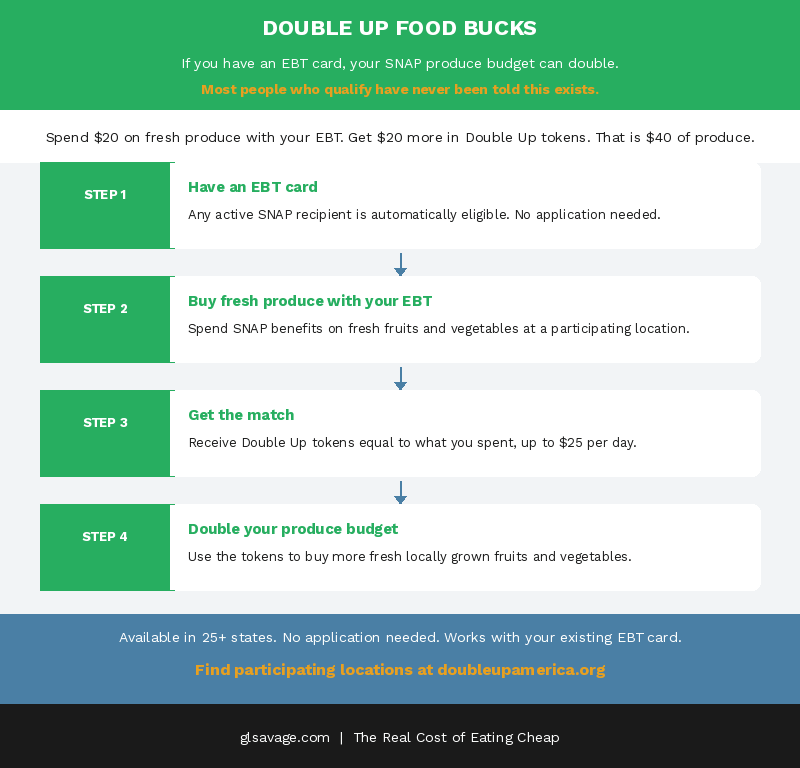
This is one of the most underused tools in the food budget conversation and almost no one outside of food advocacy circles knows it exists. The Double Up Food Bucks program matches SNAP benefits dollar for dollar when spent on fresh fruits and vegetables at participating farmers markets, farm stands, and in many states at participating grocery stores. If you spend $20 of your SNAP balance on produce, you get $20 more to spend on locally grown fruits and vegetables. The food budget for produce effectively doubles. There is no separate application. If you have an EBT card, you are automatically eligible anywhere the program operates.
The program operates in more than 25 states under the Double Up Food Bucks name and under different names in other states. The national network and a state-by-state directory is at doubleupamerica.org. If your state is not listed there, search your state name plus “SNAP produce matching” or “nutrition incentive program” because many states run their own versions under different names. This program exists specifically to close the gap between what SNAP benefits reach and what nutritious food actually costs. Most people who would benefit from it have never been told it exists.
The Food Pantry Conversation Nobody Wants to Have
Food pantries in the United States collectively distribute billions of pounds of food annually, and a significant portion of that inventory is underutilized because the households who need it most have not been through the door. The stigma around using a food pantry is real and it is also costing people money every week. Many food banks and pantries have shifted significantly toward fresh produce, dairy, and protein in recent years, particularly in urban areas with access to food bank supply chains. The inventory varies but it is worth knowing what is available locally before assuming it is only shelf-stable canned goods. Find food pantries near you at feedingamerica.org or by calling 211. Using a food pantry for even one category of food, just produce or just protein, can free up budget for other groceries that are harder to source there. Utility Bill Assistance Programs Nobody Tells You About covers the same principle applied to other household costs: the programs exist, most people who qualify have never been told about them, and using them is not weakness. It is information.
The Real Cost of Eating Cheap Is a System Cost, Not a Personal One
The food environment that makes ultra-processed food the default choice for tight budgets was built by an industry optimizing for profit, supported by agricultural policy optimizing for commodity output, and distributed through a retail infrastructure optimizing for margin. The person standing in the grocery store trying to feed a family on $150 a week did not design any of that. They are navigating it. The system is starting to get some pushback: in October 2025, California enacted the first U.S. law banning certain ultra-processed foods from more than a billion school meals served to children each year. That one state had to pass a law to keep engineered food products out of school cafeterias tells you something about how far the system drifted. Knowing the real cost of eating cheap does not change the grocery budget overnight. But it changes what the decision actually means, and it points toward where the real leverage is. The cheap food was never as cheap as the receipt said. The question is how much of the deferred cost you can intercept before it lands.
Frequently Asked Questions About the Cost of Eating Cheap
Why is unhealthy food cheaper than healthy food?
Because the food system was built to make it that way. The commodity crops at the base of ultra-processed food production, corn, wheat, soy, and sugar, receive substantial federal agricultural subsidies that reduce their cost at scale. Fresh fruits and vegetables receive far less support. The manufacturing infrastructure for ultra-processed food is also highly efficient, producing enormous volumes of shelf-stable calories cheaply. The price gap is not a pure market signal. It reflects decades of policy and investment choices about which kind of food production to back.
What are the cheapest healthy foods to buy?
The highest nutrition-per-dollar foods consistently available in most stores include dried or canned beans and lentils, eggs, oats, potatoes, sweet potatoes, cabbage, carrots, frozen vegetables of all kinds, canned tomatoes, canned sardines and tuna, and plain dairy products like whole milk and plain yogurt. Frozen produce deserves special mention: it is picked and frozen at peak nutrition, keeps for months with no waste, and is often cheaper than fresh. None of these require a specialty grocery store or a significant budget increase.
Does eating cheap food actually cost more in the long run?
The research suggests yes, though the timeline is long enough that most people never connect the dots. Harvard School of Public Health found healthier diets cost about $1.50 more per day, which is $547 a year. But diets high in ultra-processed foods are consistently linked to higher rates of obesity, type 2 diabetes, and cardiovascular disease, conditions that generate medical costs, lost productivity, and reduced quality of life that dwarf the grocery savings from years earlier. The food was inexpensive at the register. The deferred costs are not.
What is the Double Up Food Bucks program and who can use it?
Double Up Food Bucks is a program that matches SNAP benefits dollar for dollar when spent on fresh fruits and vegetables at participating farmers markets and, in many states, participating grocery stores. Anyone with an EBT card is automatically eligible wherever the program operates. There is no separate application. The match is typically up to $20 or $25 per day, meaning a $20 SNAP spend on produce yields $40 worth of purchasing power for fresh food. Find the national network and state-by-state directory at doubleupamerica.org.
Is it possible to eat healthy on a very tight budget?
Yes, but it requires knowing which foods offer the best nutrition per dollar and planning around them rather than around what is most aggressively marketed. Beans, eggs, oats, frozen vegetables, canned fish, and potatoes consistently provide more actual nutrition per dollar than most processed convenience foods. The constraint is usually time and knowledge rather than money alone. Batch cooking once a week, buying store brand staples, and using SNAP matching programs where available can significantly stretch a tight food budget toward better nutrition without requiring a larger grocery spend.
Why do I feel hungrier after eating processed food?
Controlled research from the National Institutes of Health found that ultra-processed food may be absorbed in a different part of the gut than the section that releases the fullness signal. Participants on an ultra-processed diet ate about 500 more calories per day than those on an unprocessed diet, even when both diets were matched for total nutrients. The food is energy dense and absorbed quickly, but the satiety signal lags behind. The practical result is that processed food often requires more of it to feel full, which reduces the savings advantage it appears to have at the register.
How do food deserts affect access to healthy food?
In many lower-income and rural areas, full-service grocery stores with fresh produce are scarce or absent, while convenience stores, dollar stores, and fast food outlets are plentiful. The produce that does appear in underserved neighborhoods is often lower quality and higher priced than equivalent items in wealthier areas. The result is that some households are not choosing between two equally accessible diets. They are choosing from what is physically available nearby. This is a distribution and investment problem, not a willpower problem, and it is well documented in food access research.
Are store brand foods as good as name brand?
For commodity staples, yes. Store brand canned beans, canned tomatoes, frozen vegetables, oats, dried pasta, and most dairy products are virtually identical to name brand versions, often produced by the same manufacturers. The price difference pays for advertising and packaging, not for meaningfully different food. Switching to store brands on staple items is one of the most efficient ways to reduce grocery spending without changing what you are eating. The exception is highly engineered processed products where the formula genuinely differs between brands, but those are not the foods a tight grocery budget should be centered around anyway.