There is a version of print on demand that gets sold everywhere right now. You make a design, you put it on a T-shirt, someone buys it, a company prints and ships it for you, and you collect money without ever touching a product. No warehouse. No upfront cost. No risk. The companies behind this model, Printify, Printful, Gelato, and a dozen others, are not making it up. The mechanics are real. What they are not telling you is what happens to your money on the way from the customer’s wallet to yours, how crowded this space has become, and what a single bad design choice can cost you legally. This is the version of print on demand the platforms have no financial incentive to explain.
What Print on Demand Actually Is, In Plain Terms
Print on demand means a product only gets made after someone orders it. You are not buying T-shirts in bulk and hoping they sell. You create a design, attach it to a product through a print on demand service, and list it for sale on a platform like Etsy, Amazon, or your own website. When someone buys, the order goes straight to the printing company. They print your design on the item, pack it, and ship it directly to your customer. You never see the product. You pay the printing company their cut, and whatever is left is yours.
The products go well beyond T-shirts. Hoodies, mugs, phone cases, tote bags, journals, posters, blankets, garden flags, socks, wall art. The catalog at most platforms now runs into the hundreds of products. You are essentially renting their printing equipment and shipping network. They handle the physical side. You handle the design and the selling. That division of labor is genuinely useful, and it is why print on demand has real appeal for people who want to sell products without the cash and logistics of traditional retail. It is also a form of dropshipping, and many of the same rules apply. If you want to understand that model in full, Is Dropshipping Worth it? The Pros and Cons Nobody Says Out Loud covers the mechanics and the realities side by side.
Research firms estimate the global print on demand market at somewhere between $10 and $13 billion in 2025, with projections for continued double-digit annual growth through the next decade. That is not a niche. It is a legitimate industry. The size of it is both the opportunity and the problem.
The Real Case for Print on Demand
This model has genuine advantages. They deserve to be said plainly before the complications arrive.
You can start for free. Not almost free. Actually free. A Printify account costs nothing. An Etsy shop costs $0.20 per listing. You can design using Canva’s free version. If nobody buys, you spend nothing on production. In most product businesses, you spend money before you make any. In print on demand, the customer pays first and then the item gets made. For someone with $50 to their name and a desire to build something, that structure removes a wall that would otherwise stop them entirely.
You carry no inventory. This sounds like a small thing until you have watched someone store 300 unsold T-shirts in their spare bedroom for two years. In print on demand that scenario does not happen. You test a design. If it sells, great. If it does not, you lost listing fees and time, not a purchase order worth thousands of dollars. The ability to test ideas cheaply and discard what does not work is a real structural advantage.
The logistics are handled for you. Printing, packing, postage, tracking numbers, all of it runs through the print on demand platform. You are not spending your evenings at the post office. That frees up real time to focus on the parts of the business that actually require you: creating designs and finding customers.
And the product variety now makes it possible to avoid the most crowded categories. The sellers doing well are often not selling T-shirts at all. Journals, car accessories, garden flags, embroidered items. These categories have less competition and often better profit per sale than the obvious stuff.
What Happens to Your $25 After the Sale
This is the part that print on demand platforms present in the most optimistic light possible, and it is the part you need to understand before you price a single product.
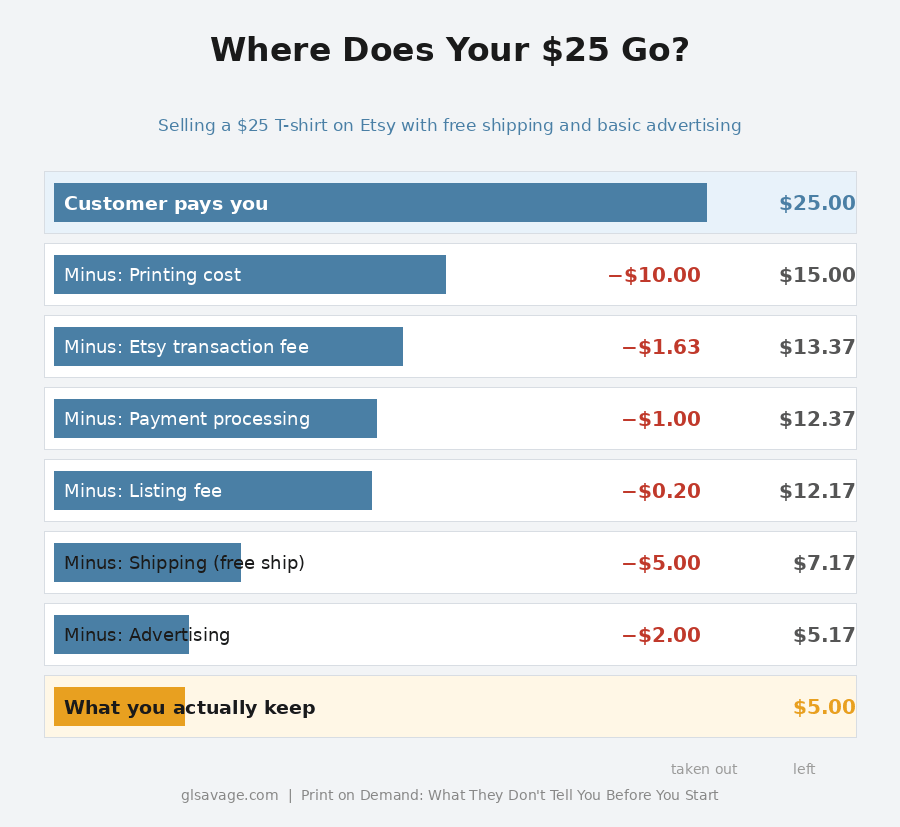
Say you sell a T-shirt for $25 on Etsy. Here is where that money actually goes.
The printing company takes their base cost first. On a standard T-shirt, that base cost including the blank shirt, the printing, and the handling runs roughly $8 to $12 depending on the platform and the print method used. Call it $10. You are now at $15 gross before anything else.
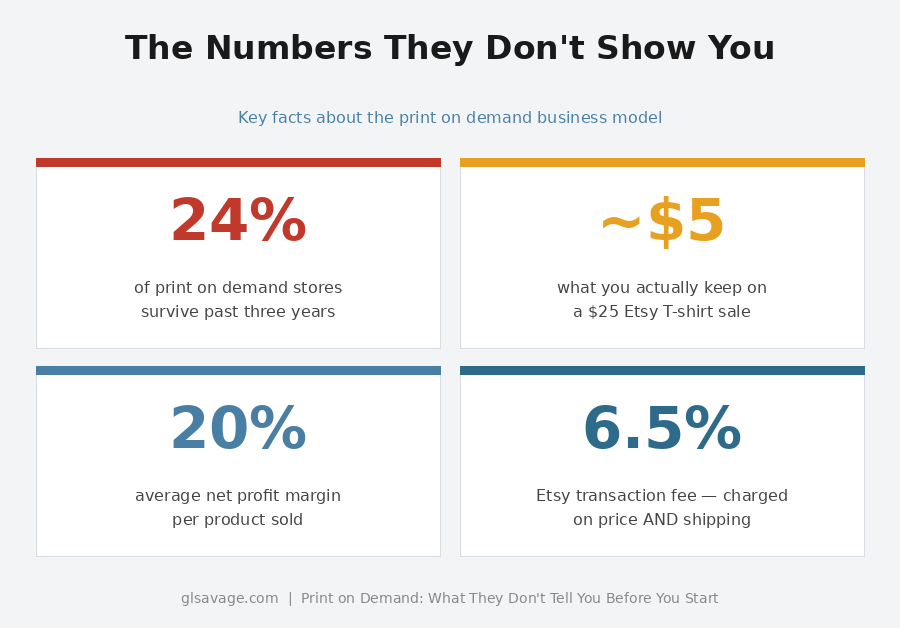
Etsy takes a 6.5 percent transaction fee on the full sale price, including whatever shipping cost is built into that $25. That is $1.63. Then a payment processing fee of 3 percent plus $0.25 per transaction, so another $1.00. Plus the $0.20 listing fee for that product slot. You are now at about $12.17.
Shipping. If you offered free shipping, which most competitive listings do because buyers filter for it, you baked that cost into your $25 price. Domestic shipping on a T-shirt typically runs $4 to $6. Call it $5. You are now at roughly $7.17.
Now add advertising. Getting found on Etsy without paying for ads in most categories is increasingly difficult. Etsy’s onsite ads run on a pay-per-click system, meaning you are charged every time someone clicks on your listing whether they buy or not, typically between $0.20 and $0.50 per click. On top of that, Etsy automatically enrolls all sellers in its Offsite Ads program, which promotes your listings on Google and social media and charges you 15 percent of the sale price every time one of those ads leads to a purchase. Sellers who hit $10,000 in annual sales cannot opt out of that program. If you spent $2 in clicks and ad fees to generate that sale, which is conservative for a new shop with no history, you are at about $5 in actual profit.
On a $25 sale. After doing everything right.
That is not a reason to walk away from print on demand. It is a reason to price correctly from the start, choose products where the base cost is lower relative to what customers will pay, and be very deliberate about where and how you spend on advertising. The sellers who treat this model like a vending machine, set it and check the balance, are the ones who end up with nothing. The ones who watch their numbers on every product and adjust accordingly are the ones who build something real.
The Printing Technology Problem Nobody Explains
Most people start a print on demand business without knowing that not all printing is the same, and that difference directly affects whether your customers come back or leave a bad review.
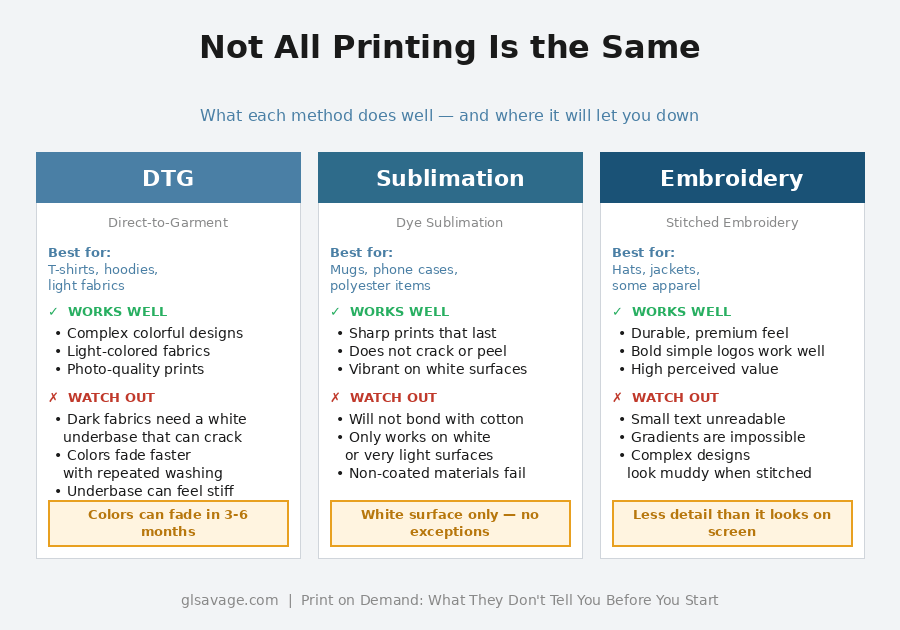
The most common method for T-shirts and apparel is called DTG, which stands for direct-to-garment. It works like a large inkjet printer that sprays ink directly onto the fabric. It handles complex, colorful designs well on light fabrics. The downside is that it performs poorly on dark fabrics unless a white underbase layer is applied first, and that underbase can feel stiff and crack over time. Colors also tend to fade faster with DTG than with other methods, especially after repeated washing. Customers who expected a vivid shirt and received a faded one three months later will not be quiet about it.
Sublimation printing, used for mugs, phone cases, and polyester fabrics, produces sharp, durable prints that do not crack or peel. Sublimation works by turning ink into a gas that bonds directly with the material, which is why the print lasts. But it only works on white or very light-colored surfaces and on synthetic materials like polyester. It will not bond with cotton. A design that looks great on a sublimation mug will not transfer the same way to a cotton shirt.
Embroidery, used for hats and some apparel, limits design detail significantly. Small text becomes unreadable. Gradients are impossible. A design that looks beautiful as a digital file can look muddy or unrecognizable when stitched.
None of this gets explained prominently on the platforms. You find out when customers complain. The fix is ordering samples before you list anything, washing them, and inspecting them in real light. What you see on a product mockup on your screen is not always what your customer will receive. Those two things can be meaningfully different, and your reviews are the ones that take the hit.
The Supplier Routing Problem
This one catches sellers who did their homework and still got burned.
Platforms like Printify do not have one printer. They have a network of printers around the world, and when an order comes in, it gets routed to whichever printer in that network can fulfill it based on location and available capacity. That printer may not be the one you ordered your sample from. Different printers in the same network use different equipment, different ink, and different quality standards. The same design can look noticeably different depending on which facility printed it, even though both orders came through the same platform under the same listing.
This means your sample may not represent what your customers actually receive. That gap widens during peak seasons like the holidays, when print capacity is strained and orders go to whoever has availability rather than whoever does the best work.
The fix is to lock your preferred print provider in the platform settings rather than leaving it on automatic routing. Most platforms allow this. Most beginners do not know to do it. Now you do.
The Returns Problem Nobody Warns You About
Most print on demand platforms will reprint or replace an item if there is a production defect. Wrong color, damaged in transit, print placement clearly off. That they will cover.
What they will not cover is a customer who simply changed their mind. Buyer’s remorse is not a defect. The wrong size because the customer did not check the size guide is not a defect. Does not match the listing photo because the customer had different expectations is not a defect. In all of those situations, most POD platforms leave the resolution entirely up to you. You decide whether to refund, replace at your own cost, or tell the customer no. That customer service burden lands on you, not the printing company.
On thin margins, even a small return rate matters. If you sell a T-shirt and net $5 in profit, one return on that product wipes out five sales. A 5 percent return rate on a store doing 200 orders a month is 10 returns. At $5 net each, that is $50 in profit gone before you pay yourself anything for the time you spent handling those customers. Most beginners never run this math before they start. The fix is clear, accurate product photography, honest size guides written in plain language, and a return policy stated upfront so customers know exactly what to expect before they buy.
The Copyright Trap
This is the part that ends businesses. Not slowly. Fast.
Print on demand sellers, especially beginners, have a habit of using designs, phrases, characters, or images they did not create and do not have legal permission to sell. Sometimes they know. More often they genuinely do not realize the risk. The outcome is the same either way.
Copyright law protects original creative work. Trademark law protects brand identifiers like logos and names. If you print a Disney character on a mug, there is a team looking for that. If you use a phrase from a song, the publisher may have a licensing department that files takedown requests as a routine part of their job. Sports team logos, movie titles, TV show references, famous brand names: all of it is protected and all of it is actively monitored.
When a rights holder files a complaint with Etsy, the listing comes down immediately. No warning. No grace period. Gone within hours. That counts as a strike on your shop. Multiple strikes, and in some cases even one serious violation, and Etsy closes the shop permanently. Every listing, every review, every search ranking you built goes with it. Starting over means starting from zero, and Etsy may not allow you back at all. Etsy’s own 2024 Transparency Report documented that enforcement increased significantly in 2024, with 22 percent more listings removed and 1.5 times more sellers suspended for policy violations compared to the year before.
The trap goes further than most people expect. Buying a stock image from Shutterstock or Adobe Stock with a standard license does not give you the right to put it on merchandise. Standard licenses cover personal or editorial use. Merchandise sales require an extended license that costs more and is purchased separately. Canva is a more complicated case: Canva generally allows its content to be used in merchandise designs, but there are specific limits. You cannot take a single Canva stock element, put it on a T-shirt as the whole design, and sell it. That crosses from using Canva as a design tool into reselling someone else’s content. Also, some print on demand platforms require sellers to certify they own the copyright to everything they upload, and since you only hold a license to Canva content rather than ownership, that certification would not be accurate. Always check what the platform you are selling on actually requires before uploading anything built with licensed elements.
AI-generated art creates its own risk. Many AI image tools were trained on copyrighted work, and rights holders are already filing complaints against outputs that closely resemble their protected material. The legal picture around AI and copyright is still developing, which means the risk is real even when the outcome is uncertain.
The protection is the same regardless of the source: create original work you actually own, or use sources that explicitly grant commercial merchandise rights and keep a record proving it. If you cannot confirm something is clear, treat it as protected. A legal fight over a $25 mug is not worth having.
The Platform Problem
When you build a print on demand business on Etsy or any marketplace you do not control, you are building on land you do not own. The platform sets the rules. It changes the algorithm. It decides what gets shown to buyers and what gets buried. It can remove your store without notice for reasons that may never be fully explained to you.
On June 10, 2025, Etsy quietly updated its Creativity Standards policy, removing seven words that had previously allowed sellers to use templates and purchased designs. No announcement. No email to sellers. No grace period. One day template-based designs were allowed. The next day they were not. Sellers who had built shops on purchased design bundles and licensed templates found their listings pulled and traffic drop overnight. They had no recourse.
Separately, multiple sellers reported significant drops in search visibility starting in mid-2024 tied to algorithm changes Etsy did not publicly explain. Some recovered. Many did not.
None of this means avoid marketplaces. They bring buyers to you, and that is worth something real, especially early on. It means build something you own alongside them. An email list. A social media following that drives traffic on its own. A direct website. The sellers who had built those other channels were resilient when the platform shifted. The ones who only had their Etsy traffic had nothing to fall back on.
The Courses Selling You the Dream
There is a whole industry sitting on top of print on demand that rarely gets mentioned in the guides the industry publishes. Hundreds of courses, coaching programs, and membership communities exist specifically to teach people how to build a print on demand business. They range from $27 PDF guides to $2,000 video programs. Some of them are genuinely useful. Some of them are not. And the people selling them have a financial incentive to make the model sound achievable regardless of where you are starting from.
The way to evaluate any print on demand course is the same way you evaluate the model itself: ask what it actually costs, what it actually delivers, and who is actually succeeding after completing it. Testimonials from people who made money are not the same as data on what percentage of students build a real income. If a course sells you on the passive income version of print on demand without being honest about the marketing work, the platform risk, the copyright landscape, and the margin math, it is selling you an incomplete picture. Side Hustle Courses: What They Teach, What They Skip, and Whether They Are Worth It breaks down what to look for before you pay for one.
Why Most Print on Demand Stores Fail
Industry research puts the three-year survival rate for print on demand stores at around 24 percent. Most start, list a few products, see nothing happen, and quietly stop.
The reason is almost never bad designs. It is a misunderstanding of what this actually requires.
People start print on demand stores because the pitch says passive income. They upload a few designs and wait. Six weeks later they have made zero sales. They never did keyword research to find out what buyers are actually searching for. They listed in the most crowded categories with no sales history and no reviews. They priced without understanding their actual costs. They did no marketing because they assumed the platform would handle that. It does not.
The sellers who succeed treat this like a business. They research before they design. They identify a specific group of people, nurses who like dark humor, owners of a particular dog breed, fans of a specific hobby or subculture, and they build a product line that speaks directly to that group. That specificity is how you avoid competing on price with a thousand other stores selling essentially the same thing. A passionate niche will pay more for something that feels made specifically for them. A generic audience will buy from whoever is cheapest.
They also check their numbers. Revenue is not profit. A store that brings in $8,000 a month and spends $6,500 on production, fees, and ads made $1,500. That is a very different number and a very different business than what the revenue figure suggests. The sellers who track actual profit per product and adjust accordingly are the ones still operating a year later.
What Print on Demand Actually Takes
It takes real design skill or the budget to hire it. Not dragging text onto a template. The ability to create something a specific person sees and thinks: that is exactly for me. That skill matters more as the market gets more competitive.
It takes pricing discipline. Build a complete cost sheet for every product before you list it: base production cost, shipping, Etsy’s transaction fee, the payment processing fee, listing fee, and a realistic advertising allowance. Know your actual net on every sale before you set the price. Most beginners price based on what feels competitive and discover too late that competitive pricing in their category leaves almost nothing per sale.
It takes patience. Most print on demand stores take months to see consistent sales. Etsy’s search system builds trust in a shop over time based on sales history, how often people who see a listing actually buy from it, and review count. A new shop starts at a disadvantage. That disadvantage shrinks as you build the record. It does not shrink overnight.
And it takes building something beyond the platform. An email list. A social media presence that drives its own traffic. A website you control. These are the assets that protect you when the platform changes its rules. It will change its rules.
Is Print on Demand Worth It?
That depends on which version of it you are walking into.
The passive income version is not real for most people. The data is clear. The majority of people who start print on demand stores do not build them into meaningful income, not because the model is broken, but because they were sold a version of it that required almost nothing from them. That version does not exist.
The business version is real. Low starting cost. No inventory. No warehouse. The ability to test ideas without losing money on stock that never moves. A model that scales with effort rather than cash. If you go in knowing the fee structure, understanding the legal risks, creating original work, pricing for actual profit, and marketing like it is your job rather than your lottery ticket, print on demand is a legitimate option. It is not the easiest path. But for someone who cannot afford the cash to start a traditional product business, it has a lower barrier to entry than almost anything else that actually works.
The sign-up page will not tell you any of that. That is exactly why the people who succeed already knew it.
Frequently Asked Questions About Print on Demand
It varies widely. Many sellers earn a few hundred dollars a month as a side income. Some who have built strong niches, original designs, and consistent marketing earn several thousand dollars a month in actual profit. Six-figure annual income exists in this space but belongs to a small group of sellers who have operated it as a real business for years. The average net profit margin per sale runs around 20 percent, which means both volume and pricing discipline matter far more than most beginners expect going in.
You create a design and upload it to a print on demand platform like Printify or Printful. You attach it to a product and list that product on a marketplace like Etsy or your own Shopify store. When someone buys, the order goes automatically to the printing company, which makes the product, packs it, and ships it directly to your customer. You receive the sale price your customer paid. The printing company deducts their production and shipping cost, the platform takes its fees, and whatever remains is your profit.
Not at the start and not for most sellers. Getting a store to the point where established listings generate consistent sales with less daily effort takes months of active work: keyword research, design creation, listing optimization, customer service, and marketing. These are ongoing requirements, not one-time setup tasks. Sellers who approach print on demand as passive income from the beginning are almost always the ones who quit within a few months with very little to show for the time they put in.
The biggest ones are the fully-loaded shipping cost when free shipping is offered, Etsy’s 6.5 percent transaction fee on the total sale price including shipping, a payment processing fee of 3 percent plus $0.25 per transaction, listing fees, and advertising spend. Together these can easily consume $8 to $10 on a $25 sale before production costs are even counted. Beginners also underestimate the cost of sample orders, which are necessary before listing any product, and the cost of handling returns and customer issues on top of everything else.
Yes, and it happens more often than most people realize. Using copyrighted characters, trademarked logos or names, song lyrics, or designs you did not create and do not hold a license to sell can result in your listings being removed and your Etsy shop being permanently closed. Rights holders actively monitor platforms and file formal complaints. Etsy’s 2024 Transparency Report documented a major increase in enforcement, with 22 percent more listings removed and 1.5 times more sellers suspended for policy violations compared to 2023. The only safe path is original designs or assets that explicitly include commercial merchandise rights under terms that match what your selling platform actually requires.
The broad, generic categories are saturated. T-shirts with wide appeal, standard mug designs, motivational quotes on anything: these face competition from established sellers with years of sales history and search ranking that a new store cannot quickly overcome. Narrow, specific niches with dedicated audiences still have real room. The low barrier to entry means high competition overall, but most of that competition is generic and undifferentiated. Specific, original, audience-focused work still has a path forward.
Printify and Printful are the two most widely used and both connect directly to Etsy and Shopify. Printify generally offers lower base costs through its supplier network, which protects your margin. Printful is known for more consistent print quality and better branding options like custom packaging. Whichever platform you use, order samples of every product before you list it, and lock your preferred supplier in the platform settings rather than leaving orders on automatic routing. The printer your sample came from may not be the one that fulfills your customer’s order unless you specify it.