
Selling digital products is one of the most aggressively marketed side hustles on the internet right now. Make a file once. Let it sell forever. Wake up to notifications. The pitch is everywhere because it works on paper, and because the people selling courses about it need you to believe it before they can sell you the course. The actual model is legitimate. Real people build real income from it. But the gap between the pitch and what happens to most beginners is wide enough that the majority quit before they see a dollar. This article covers that gap, including the parts the passive income crowd leaves out entirely.
What You Are Actually Selling
Most people entering this space are talking about four types of products: printables, templates, planners, and ebooks. The tutorials treat them as interchangeable. They are not. Each one has a different skill floor, a different price ceiling, a different buyer, and a different amount of time between you making the thing and it making money.
A printable is a PDF the buyer downloads and prints at home. Chore charts, budget worksheets, wall art, habit trackers. The lowest barrier to entry in the category. If you can use Canva, you can build one in an afternoon. What the tutorials skip: making a printable is easy. Making one people actually want to buy is harder than it looks. It has to work on a standard home printer, which means no rich colors that go muddy on paper. It has to fit standard paper sizes, which is US Letter in America and A4 most everywhere else. It has to have enough blank space to be useful with a pen, which first-time designers routinely forget. And it has to solve a specific enough problem that someone searching Etsy stops scrolling and thinks that is the one. The time to build a basic printable is one to three hours. The time to build one that is well designed, printer-tested, photographed with a real mockup, and listed with the right keywords is closer to a full day for your first product.
A template is an editable file the buyer modifies for their own use. A Canva social media template. A resume kit in Google Docs. A budget spreadsheet. A wedding invitation the couple personalizes with their own names. Templates command higher prices than printables because they give buyers control. They also require more skill to build, because a template has to work correctly for someone who has never spoken to you. A Canva template using fonts the buyer does not have access to breaks the moment they open it. A spreadsheet with broken formulas generates angry one-star reviews. You are not just designing something pretty. You are building something functional for a stranger. Testing is not optional.
An ebook is a written guide, usually PDF, that teaches something from beginning to end with enough depth that the buyer learns something they could not find in five minutes of searching. A 15-page PDF with bullet points and stock photos is not an ebook. It is a blog post with ambitions. The buyer who opens it, realizes it contains nothing they did not already know, and asks for a refund is not being difficult. They were right. A solid ebook takes 10 to 30 hours to research, write, edit, and format. The niche is everything. A general guide on saving money competes with every personal finance book ever written. An ebook called “How to Stretch Your Grocery Budget When Your Income Changes Every Month” is a specific product for a specific person who will recognize themselves in the title immediately.
Planners exist in both printable and digital formats. A printable planner you print and fill with a pen. A digital planner designed for iPad apps like GoodNotes, where the buyer writes directly on screen. Both are deeply saturated in their generic versions. A comprehensive printable planner system with yearly, monthly, weekly, and daily layouts takes a week or more of focused work to build. A digital GoodNotes planner with working hyperlinked navigation takes 10 hours to several days. The difference in sales between an elaborate planner system and a well-designed single-page tracker for the right niche is often zero, or favors the simpler product, because the buyer with a specific problem needs the specific solution, not the impressive-looking system.
The Real Math on a $10 Sale
Selling digital products has genuinely high margins. The math still matters, and most beginners get it wrong in one specific direction.
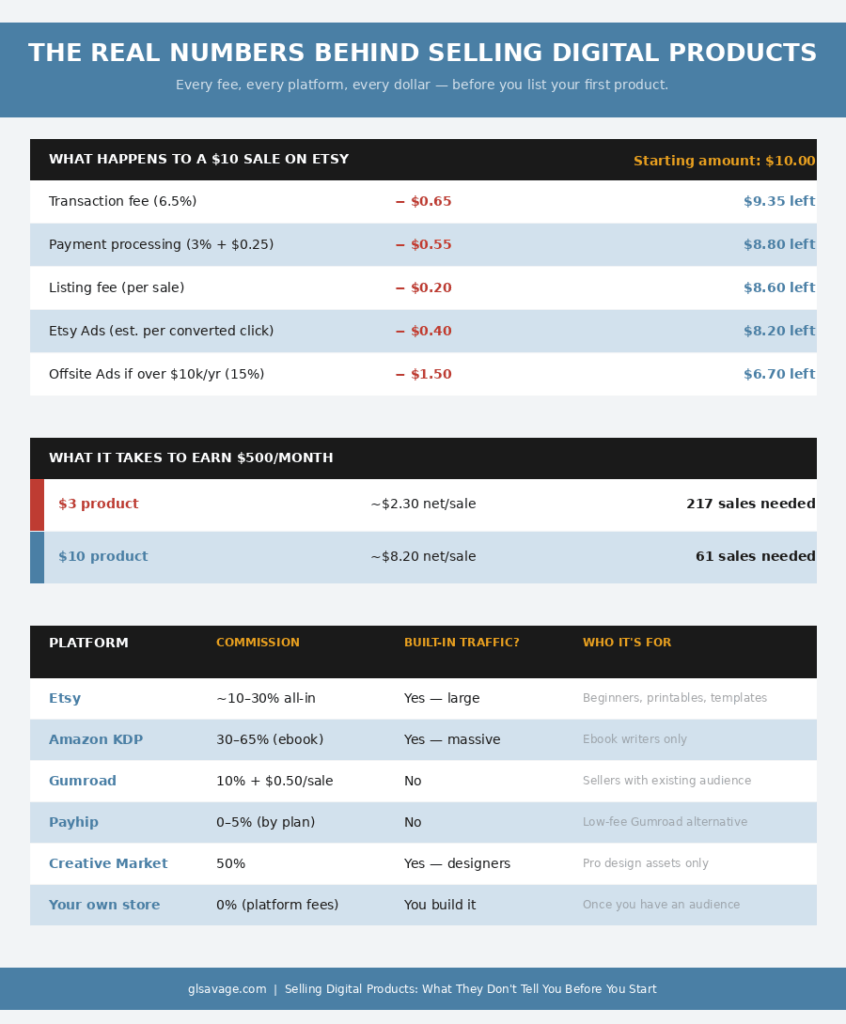
On a $10 sale on Etsy, the platform takes a 6.5 percent transaction fee ($0.65), a payment processing fee of 3 percent plus $0.25 ($0.55), and a $0.20 listing fee each time the product sells. Before advertising you are at $8.60. Add Etsy Ads, which are increasingly necessary in competitive categories, at an average of $0.20 to $0.50 per click, and a converted click might cost you $0.40, leaving $8.20. If you hit $10,000 in annual sales, Etsy’s Offsite Ads program becomes mandatory and permanent at 15 percent on any sale that comes through their external advertising, dropping a $10 sale to $6.70 before anything else.
That is still excellent margin. The problem is $3 products. A hundred sales at $3 with typical Etsy fees leaves you with roughly $200 to $230 in actual income. A hundred sales at $10 is $700 to $860. Same effort to acquire the customer. Massively different result. Most beginners price at $3 because it feels safer to compete on price. The only thing $3 pricing actually competes for is the category of buyer most likely to ask for a refund, leave a frustrated review, and message you when the colors look different than they expected on their printer.
Research what successful shops in your niche actually charge. Price at the midpoint of that range or above it. Invest in the design quality and listing photography that justifies the price. The goal is to be the obvious choice for the right buyer, not the cheapest option for everyone.
The Generic Product Problem
The most common reason digital product shops fail has nothing to do with the platform, the fees, or the marketing. It is the product itself.
A search for “budget tracker printable” on Etsy returns over 200,000 results. A new seller with a generic budget tracker is not entering that market. They are invisible in it. The algorithm gives new shops almost no organic search visibility until they have reviews, sales history, and completed listings with strong keywords. A new shop with generic products in a saturated category is starting behind and getting more behind with every day the algorithm ignores them.
The solution is specificity sharp enough that it almost feels too narrow. A budget tracker for gig workers with irregular weekly income is not a niche. It is a product. A meal plan template for households managing a Type 2 diabetes diagnosis on a fixed income is a product with a buyer who has been looking for exactly that and will pay real money for something made for their situation. A printable homework planner for kids with ADHD that uses visual timers and color coding is a product for a specific parent with a specific problem who will recognize it immediately.
The fear with going narrow is that the audience is too small. The reality is that a highly specific product with 50 ideal buyers converts at a far higher rate than a generic product with 50,000 casual browsers. Specific products also face almost no competition from the PLR and bulk-resell flood, which we will get to shortly, because nobody mass-produces resellable files for highly specific audiences. A seller with 20 specific products in a defined niche consistently outperforms a seller with 50 generic products competing on price.
How Long Before You See Real Money
Almost no one answers this honestly. A new Etsy shop with a handful of products typically takes 60 to 90 days to make its first consistent sales. Most new sellers list five products, wait two weeks, see nothing, and decide the model does not work. The model did not fail. The shop had not existed long enough to earn any search visibility.
Shops generating $500 or more monthly in profit typically have 20 to 50 listings, a few dozen reviews, and six months or more of search history. Shops doing $2,000 or more monthly usually have 50 or more products, strong review counts, and often a Pinterest presence or other external traffic source on top of Etsy’s algorithm. Seller data and community research consistently show that the majority of Etsy shops have made very few total sales, meaning most people who open a shop never build meaningful income from it. This is not a model where you make three products and check your bank account in a week. It is a model where you build steadily and income compounds as your catalog and reputation grow.
The first three to six months are investment, not return. That is the honest timeline. Anyone selling you the story of a shop that went from zero to meaningful income in 30 days is selling you the exception, usually the one in ten thousand, usually with an existing audience, and usually leaving out the part where they worked on it full time. Nobody tells you the typical path is slow. That does not make it wrong, if you treat it like a business instead of a lottery ticket.
The PLR and MRR Trap: The Part Nobody Explains Clearly
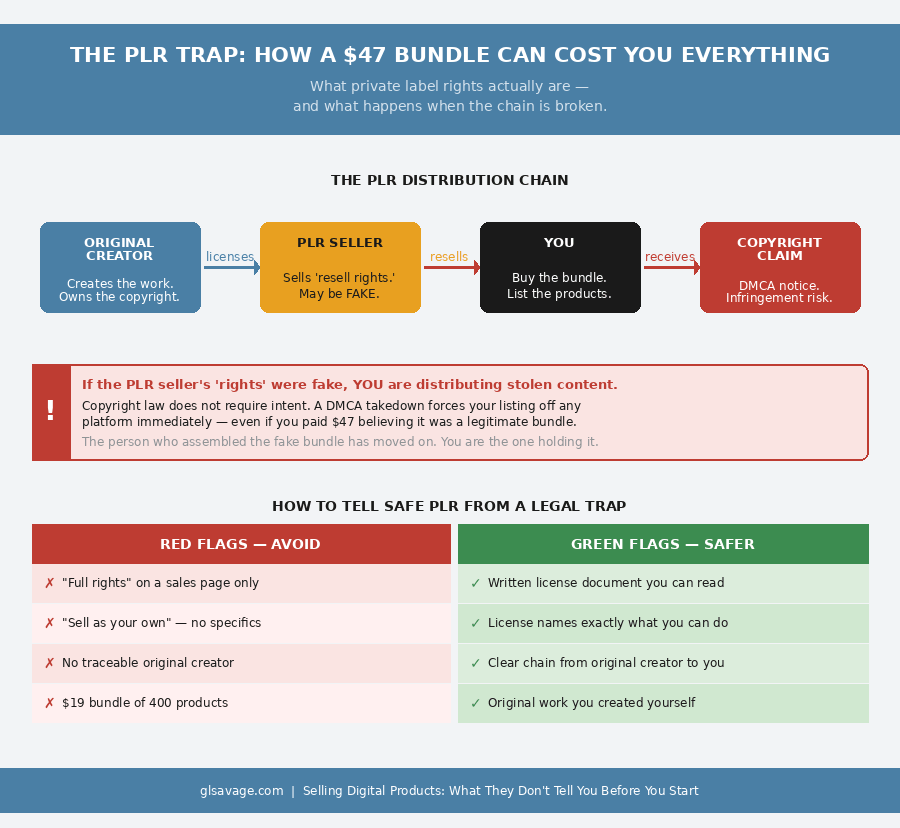
PLR stands for Private Label Rights. When you buy a PLR product, you get a digital file, usually an ebook, template, or course, along with permission to edit, rebrand, and resell it as your own. MRR stands for Master Resell Rights. MRR lets you sell the product and also pass the resell rights to your buyer, who can then sell it to someone else, who can sell it to someone else. The chain has no natural end.
The pitch on both is that you skip the creation work. Buy a $47 bundle, list the products, collect the income. The immediate problem is market saturation. The same PLR ebook on budgeting is listed by hundreds of sellers at different prices. You are not competing with one person who made a better product. You are competing with an identical product at $2.99 from someone who does not care about margins because they bought a bundle of 400 files for $19. Your original ebook, which took you three weeks to write, gets buried under a pile of the same content repriced by people who created none of it.
That is the visible problem. The invisible problem is worse.
A significant portion of PLR and MRR content circulating online was never legitimately licensed in the first place. Someone takes a copyrighted ebook, a copyrighted template pack, or copyrighted course content, attaches fake “private label rights” to it, and sells those fake rights to buyers who have no idea they just purchased stolen material. The original creator never agreed to any of this. No rights were theirs to sell.
Here is what that means for you specifically. If you buy a PLR or MRR bundle and sell those products, and those products contain stolen copyrighted material, you are now distributing stolen content. Not the original thief. A distributor. Copyright law does not require intent. The original creator can come after you with a DMCA takedown, which is a legal notice that forces the platform to remove your listing immediately, demand the removal of the products and any income from them, and potentially pursue an infringement claim. The fact that you paid $47 for something you genuinely believed was legitimate is not a legal defense against the copyright holder.
This happens more than most people in this space will admit. Canva templates containing elements licensed only for personal use get packaged into MRR bundles and sold commercially. Ebooks with lifted text from other published works get PLR rights attached and distributed to thousands of sellers. Stock photos with restrictive licenses end up in template packs sold as fully commercial. The person who assembled the bundle and attached the fake rights has usually moved on. The person actively selling the product when a takedown lands is the one who gets the notice.
The only safe PLR is PLR you can verify with a traceable chain from creator to license. That means a clear, specific written license document, not a sales page claim of “full rights.” It means reading exactly what you are and are not permitted to do with the product. Vague language like “sell as your own” without a specific written agreement is not protection. When in doubt, create original work. You cannot infringe on a copyright you hold, and original work is the only thing that competes in the long run anyway. Amazon KDP explicitly prohibits PLR books, and its content detection systems actively flag duplicate content, meaning anyone trying to sell PLR ebooks through KDP risks removal and account action. Etsy’s updated Creativity Standards, effective June 2025, also tightened enforcement on reselling and template-based designs, with inconsistent but real consequences for sellers in that space.
The Platform Situation: What Every Marketplace Does Not Advertise
Every platform that benefits from your success has an incentive to present itself well. Here is the full picture on the ones that matter most for selling digital products.
Etsy is where most people start, and it earns that position. Over 90 million active buyers search for downloadable products there. It handles payment processing, file delivery, and sales tax automatically. You do not need a website, an audience, or any marketing knowledge to make your first sale. Those advantages are real.
Here is what Etsy does not advertise. Its fees stack in ways that surprise new sellers, adding up to 10 to 12 percent of every sale before advertising costs, and up to 25 to 30 percent once Offsite Ads are factored in on higher-volume shops. Etsy’s algorithm updates have tanked previously successful shops without notice. New sellers are regularly suspended without warning, sometimes within hours of opening, by automated systems with no human review available. Sellers have reported appeals denied in four minutes, which means a bot reviewed it. One well-documented case in early 2025 involved a seller whose appeal was denied that fast, whose shop was suspended, and who had $5,000 in income reported to the IRS that they never actually received because it was frozen with the account. That is not an edge case. Etsy’s own community forums document this pattern constantly.
More specifically: Etsy can issue a refund to a buyer from your account without requiring your permission. Its case system allows buyers to open disputes, and Etsy “may include, but is not limited to, automatically closing the case and issuing a refund.” For digital products, the stated policy is that items are not eligible for returns. Etsy can still issue a refund at its discretion and pull the funds from your payment account. You have no contractual claim against that. Sellers have lost money on digital product refunds for buyers who had already downloaded the file.
Gumroad’s main appeal is simplicity. No monthly fee. You pay 10 percent plus $0.50 per transaction. Since January 2025 Gumroad operates as a Merchant of Record, meaning it handles the tax paperwork for sales to customers in different countries so you do not have to figure out international VAT rules yourself. For a seller with an existing audience who wants a simple checkout link, it is functional.
The problems are significant. Gumroad’s AI moderation system has permanently banned accounts with years of clean sales history, sometimes with no warning and no meaningful appeal. Sellers report being suspended, reinstated, then permanently banned, with no clear explanation of what rule they violated. Customer support is minimal, with no phone, no live chat, and documented cases of emails going unanswered for weeks while money was held. Payouts hold funds for a minimum of seven days and sometimes up to three weeks. If your account is banned, you lose access to your customer email list and purchase history. Export it regularly. Everything your buyers built on Gumroad belongs to Gumroad until you do.
Amazon KDP gives ebook writers access to the largest ebook marketplace in the world. The 70 percent royalty on books priced between $2.99 and $9.99 is real. Books outside that price range earn 35 percent.
Amazon is a channel, not a partner. Account terminations happen without warning, frequently triggered by automated systems with no human escalation path. Seller communities documented a significant increase in book removals and account actions in 2025, driven by tightened enforcement around AI-generated content, duplicate content, and metadata violations. PLR books are explicitly prohibited on KDP entirely, and Amazon’s content detection systems actively flag them. A 90-day KDP Select exclusivity lock means you cannot sell that ebook anywhere else during that period. Amazon’s review removal sweeps have caught legitimate reviews from real readers in the same net as suspected fake ones, with no meaningful recourse for affected sellers.
Payhip charges 5 percent on the free plan, 2 percent on the $29 per month Plus plan, and zero percent on the $99 per month Pro plan. It includes PDF stamping, which embeds buyer information into each downloaded PDF to deter casual sharing. It handles VAT automatically and includes affiliate tools. It does not bring buyers to you, which means it works best once you have an audience. The fee structure is transparent and it has fewer documented horror stories than the other platforms on this list. The main risk is the same as any smaller platform: less financial backing, less ability to absorb a major policy change or shutdown without consequence to sellers.
Creative Market takes 50 percent of every sale. Half of every dollar you earn goes to the platform. It has a real audience of professional designers and creatives, which is the argument for using it. The 50 percent commission is among the highest of any digital product platform that exists, and rates have risen over the years. Creative Market reserves the right to discount your products without your permission and requires that you not sell the same product elsewhere at a higher price. If you sell professional-grade design assets and can accept keeping half of each sale, the audience is real. If you sell printables or planners, this is not the right platform.
Teachers Pay Teachers has a real audience of teachers spending their own money on classroom materials. Sellers keep 55 to 80 percent depending on plan level. It functions more like Etsy than Gumroad for organic discovery. It also has a documented copyright theft problem, where other educators’ curriculum has ended up as listings from unrelated sellers, with TPT placing the burden of enforcement on the original creator. Algorithm changes have dropped income for established sellers with no explanation. Account closures have happened without warning. The platform has real income potential for original educational material. Know you are building on ground you do not own, same as every other marketplace.
Your own storefront, whether on Shopify, WooCommerce, or a Payhip store on a custom domain, is the only option where you own the relationship. You keep the largest share of every sale. No platform can change its rules overnight and take what you built. The cost is that you have to generate your own traffic through an email list, Pinterest, social media, or some combination. This is the end goal, not the starting point. Build on the marketplaces first, collect buyer emails from day one, and move toward owning the customer relationship as your catalog and audience grow.
Every platform takes a meaningful cut, changes its rules, and can remove your income without notice. The difference between a fragile business and a resilient one is whether you own anything outside the platform. An email list. A direct customer relationship. A following that lives somewhere you control. Every sale on any marketplace is an opportunity to collect something that belongs to you. Most sellers never do it until a platform takes something away.
The Piracy Problem Nobody Warns You About
When someone buys your digital file, they have a copy. Nothing stops them from sharing it in a Facebook group, a Discord server, or a file-sharing site where others download it for free. For a $7 printable this tends to happen casually and infrequently. For a $40 template kit it can happen deliberately and repeatedly.
There is no perfect fix. PDF stamping tools embed the buyer’s name and email into every page of the file, which deters casual sharing because the buyer’s personal information travels with it. Platforms like Payhip let you cap the number of download attempts per purchase, so a buyer cannot distribute an unlimited download link. Neither of these stops someone determined. What actually limits unauthorized sharing more than anything else is pricing your product low enough that most buyers find it faster to pay than to hunt for a copy, and building enough of a reputation that buyers want to support you directly. Some level of unauthorized distribution is the cost of operating in digital products. It does not have to be catastrophic, and it is not a reason to avoid the model. It is just a reality to plan around rather than be surprised by.
The Customer Service You Did Not Sign Up For
Digital products are delivered automatically. The customer service is not. Messages will arrive asking why the file will not open, why the colors look wrong when printed, how to edit the template, whether you can customize it for them personally, and whether they can get a refund after downloading.
The file will not open problem is usually a PDF viewer issue. Buyers try to open PDFs in their browser, colors render differently, or they do not have the required software. A short PDF guide included with every purchase explaining how to open, edit, and print the file prevents most of these messages before they happen.
The color problem is structural. Screens display in RGB. Printers use CMYK. A deep teal that looks vibrant on your monitor can print as muddy green on a standard home printer. Test every printable on an actual printer before listing. Note in your listing description that colors may vary based on the buyer’s printer settings.
Custom request messages are a boundary issue. When a buyer wants you to change their name, swap colors, or redesign the product for their specific situation, they are asking for freelance work. A listing description that specifies exactly what is and is not editable, and a firm but polite response policy for custom requests, handles this without drama.
Refund requests on digital downloads are a gray area on Etsy. The stated policy does not allow returns, but Etsy encourages case-by-case handling and can override you. Some sellers refund without argument to protect their review count. Others hold the policy. There is no universal right answer. Having a written policy in your listing description is your best protection when you need to say no.
Is Selling Digital Products Worth It
For the right person with the right approach, yes. Zero cost per additional sale is real. Passive income from listings that continue to sell for years is real. High margins and low startup cost are real. The people who do it right build something that genuinely earns while they are not working. That is not a myth. It is just rarer and slower than the pitch, and it requires the same things any real business requires: a product worth buying, a price that makes the math work, and enough patience to let the platform learn you exist.
The conditions: you are willing to do original work. You will make products specific enough that buyers feel they were made for their exact situation. You will price for actual income instead of for the lowest position on the page. You understand the first three to six months are investment and not return. You will handle customer service as part of the work.
The people who fail at selling digital products share almost the same story every time. They made generic products at $3 because that felt safe, listed them on Etsy, waited, saw nothing, and decided the model does not work. The model works. That version of it does not. Selling digital products is one of the most accessible low-capital business models that exists. Which end of the income range you end up at depends almost entirely on whether you treated it like a real business or like a slot machine.
Frequently Asked Questions
Yes, but not the way the tutorials describe it. A new shop with generic products in a saturated category typically generates little to nothing. A shop with specific products targeting a clearly defined audience, built over six or more months, can generate consistent income. A study of over 164,000 Etsy shops found digital product shops average around $489 in monthly profit, but that figure comes from established shops with years of history and large catalogs. New sellers start far below that. The variable is product specificity, pricing, and time in the market, not whether the model works.
The honest answer is three to six months before consistent sales in a new shop. Etsy’s algorithm gives almost no organic search visibility to new shops until they have reviews, sales history, and fully optimized listings. Most beginners quit before the algorithm has had enough time to work. Shops that reach $500 or more monthly in profit typically have 20 to 50 listings and at least six months of search history. Shops doing $2,000 or more usually have 50-plus products and external traffic sources beyond Etsy.
Products that solve a specific, named problem for a specific audience. A sobriety milestone tracker with daily reflection prompts. A budget template for households with variable income. A planner designed for teachers tracking IEP deadlines. Specificity determines what sells. The category matters far less than how precisely the product speaks to the person searching for it. Generic versions of any product category are the most crowded, the most price-compressed, and the hardest to make real income from.
The generic lane is brutally saturated. A search for “weekly planner printable” returns hundreds of thousands of results. A search for a printable designed for a specific type of person with a specific problem returns far fewer. The opportunity is real in narrow niches with specific audiences. The race to the bottom on price has made generic printables close to worthless as an income source, but niche-specific printables priced at $10 to $15 in categories with low PLR competition still convert well for sellers who build a catalog over time.
PLR (Private Label Rights) lets you edit, rebrand, and resell a product as your own. MRR (Master Resell Rights) lets you sell the product and pass the resell rights to your buyer, who can then do the same. Both are legal when the license is legitimate and the original creator actually holds the rights they are licensing. The problem is that a significant portion of PLR and MRR content in circulation was never legitimately licensed. Someone took copyrighted material, attached fake resell rights, and sold it. If you buy one of those bundles and sell the products, you are distributing stolen content. Copyright law does not require intent. The original creator can pursue a DMCA takedown, a legal notice that forces the platform to pull your listing immediately, and an infringement claim even if you paid for what you believed was a legitimate license. Verify the license chain before selling anything under PLR or MRR rights. When in doubt, create original work.
It depends on what you sell and whether you have an existing audience. Etsy is the starting point for printables, planners, and templates when you need built-in search traffic and have no following. Amazon KDP works specifically for ebooks at the 70 percent royalty tier, priced between $2.99 and $9.99. Gumroad works for sellers who already have an email list or social media audience and want simplicity without a monthly fee, at 10 percent per transaction. Payhip is a lower-fee alternative at 5 percent on the free plan, dropping to zero on the $99 per month Pro plan, with built-in PDF stamping and VAT handling. Creative Market works for professional design assets with a 50 percent commission and a real built-in buyer audience. Your own storefront gives you maximum control and the highest per-sale income once you have an audience to send there. Every marketplace can change its rules and remove your income without warning. Build an email list from day one regardless of which platform you start on.
A study analyzing over 164,000 Etsy shops found that digital product shops average around $489 in monthly profit. That figure comes from established shops, many of them years old with large catalogs. New sellers start well below that. The median new Etsy seller earns roughly $37 a month in profit in their first year. The sellers making $5,000 or more monthly are almost always two or more years in with 50-plus products, strong review histories, and traffic coming from outside Etsy as well as inside it. The ceiling is real. So is the time it takes to get there.
It depends on the product and the price point. For printables and basic Canva templates, Canva’s free version is functional if you develop an eye for what looks clean versus cluttered. For spreadsheet templates, you need to know how to build formulas that work correctly for someone who has never spoken to you. For digital planners with hyperlinked navigation, you need to understand how PDF linking works. For ebooks, you need to write clearly and format for readability. The skill floor rises with the price ceiling. The market notices the difference between something built in an hour and something built with care, and prices accordingly.