
Selling online courses sounds like the cleanest money on the internet. Record what you know. Upload it. Get paid while you sleep. That pitch is everywhere, and the people running it have turned it into a very profitable business. The problem is that their business is not selling courses about cooking or coding or project management. Their business is selling you the idea that you can sell courses. The most reliably profitable niche in the online course world is teaching other people how to sell online courses. Once you see that, the whole industry looks different. This article is going to walk through what selling online courses actually involves, what the platforms really take, what the income numbers honestly look like, and what conditions have to be in place before any of it makes sense. Both sides. No fantasy.
The Meta-Course Machine: How the Industry Actually Makes Its Money
Here is the structure nobody in the industry wants to explain plainly. A large portion of the money circulating in the online course world does not come from teaching people how to cook, or code, or manage their money. It comes from teaching people how to sell online courses. And the people teaching that are, themselves, mostly making their money by teaching people how to sell online courses. It is a loop. The product is the dream of the product.
The mechanics work like this. Someone builds an audience, usually by giving away useful content for free over a long period of time. Eventually they launch a course. The course does well because the audience was already there. Now they have a success story. They turn that success story into a new product: a course about how they did it. The new course costs more than the original because it promises a bigger outcome. It gets marketed through the same audience, plus webinars, free trainings, and email sequences designed to lead people toward a purchase. The “free training” is not actually free. It is the top of a funnel, meaning a series of steps designed to move someone from curious stranger to paying customer. The free part exists to warm you up for the pitch at the end.
None of that is illegal. Some of it is genuinely useful. But it creates a wildly distorted picture of what is normal. The people making the most noise about course income are almost entirely people whose course income comes from selling the idea of course income. The income screenshots are real. The context is missing. When you see someone claiming they made $100,000 launching a course, the question worth asking is: what was the course about? If the answer is entrepreneurship, passive income, building a course business, or any variation on making money online, you are looking at someone inside the loop, not someone who built a sustainable business teaching a real-world skill.
The people who make money selling online courses about genuinely useful things, specific software skills, professional trades, niche technical knowledge, real subject matter expertise, do exist and the model does work for them. But they are quieter. They are not the ones running ads about it. If you are evaluating this path, the first question to ask is not whether courses can work. They can. The question is whether the person selling you on the idea of selling courses is making their money from courses, or from selling you on the idea. Those are different businesses with very different odds. See Side Hustle Courses: How to Tell the Ones Worth Buying from the Ones Selling You a Dream before you spend money on any course about how to build a course business.
The Part of the Success Story That Gets Cut Out
When someone with a giant following tells you they made six figures selling online courses, they are usually telling the truth. What they leave out is the three years they spent building an audience before they sold anything. The email list they grew to 50,000 people. The YouTube channel with 200,000 subscribers. The podcast they published every week for two years before anyone paid them a dollar.
When they launched their course, they already had buyers lined up. The course did not create the income. The audience created the income. The course was just how they collected it.
That part does not make the ad. It does not fit the passive income story. But it is the entire mechanism, and if you skip it, you are not building a course business. You are building a course that nobody finds.
You Cannot Sell Online Courses Without an Audience. Period.
This is the single most important thing in this article, so it goes near the top.
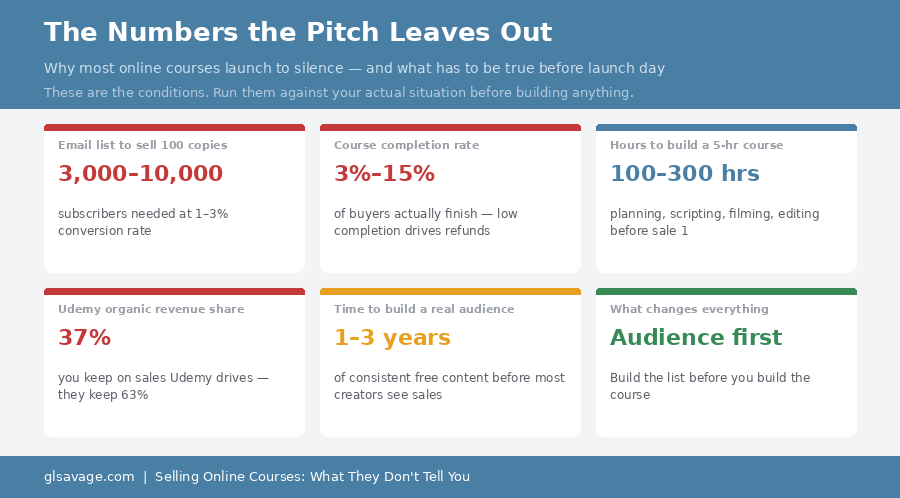
A realistic conversion rate for a course launch, meaning the percentage of people on your email list who actually buy, is 1% to 3%. That is an industry benchmark, not a pessimistic guess. Run the math: if you want to sell your course to 100 people, you need between 3,000 and 10,000 people on your list who genuinely know who you are and trust what you say. If you want 500 sales at launch, you need 15,000 to 50,000 engaged subscribers.
An email list is not the same as social media followers. Follower counts look big and convert to almost nothing on their own. Someone who follows you on Instagram because they liked one post is not the same as someone who signed up for your emails because they wanted more of what you teach. The relationship that produces sales is built over time, through free content, through showing up consistently, through earning a level of trust that makes someone comfortable handing over money. That takes one to three years for most people who do it seriously.
If you already have an audience, whether from years in an industry, a newsletter you have been writing, a YouTube channel, professional credentials that draw people to you, or a community you built around something you know deeply, the course model can work well for you. If you do not have any of those things yet, the course is not your first problem. Building the audience is. And that work comes before the course, not after.
What It Actually Costs to Build a Course Before You Make a Cent
The “start for free” framing is technically possible and practically useless. Yes, you can record on your phone and upload to a free platform tier. You can also furnish an apartment from a dumpster. The question is whether what you build competes with what is already out there.
A real DIY course with decent video quality, a legitimate platform, and a basic launch effort runs $500 to $2,500 before you make your first sale. That covers recording gear or screen capture software, basic editing, a platform subscription, and something resembling a launch strategy. For every finished hour of course video, budget 20 to 60 hours of planning, scripting, filming, and editing. A five-hour course is not a weekend project. It is closer to 100 to 300 hours of your time before the first student sees lesson one.
Platform fees run $0 to $399 per month depending on what you choose, and that clock ticks whether you are selling or not. If you bring in anyone to help, instructional designers, meaning people who specialize in structuring educational content, charge $38 to $100 an hour. Video editors on freelance sites run $25 to $150 an hour. A professionally built course from scratch runs $5,000 to $25,000. None of that money comes back if the course does not sell.
Then there is marketing. Most people build the course and assume discovery will happen. It will not. Marketing a course costs roughly as much as building it, and the people who skip that part are the people who end up with a course that sold 11 copies and then nothing. Discovery is the hardest part of this business. Build it into the budget from day one.
If you are weighing courses against other digital income paths, see how the numbers compare in Selling Digital Products Sounds Like Free Money. Here Is What Actually Happens.
What the Platforms Actually Take: The Real Math Before You Launch
Every platform takes a cut. The cut varies so much by platform and by how your students find you that it changes whether the business works at all. Most people do not run these numbers before they build anything.
Udemy is the biggest course marketplace in the world, with over 70 million registered learners. Being on Udemy means instant access to people who are already looking for courses. That is genuinely valuable. Here is what it costs.
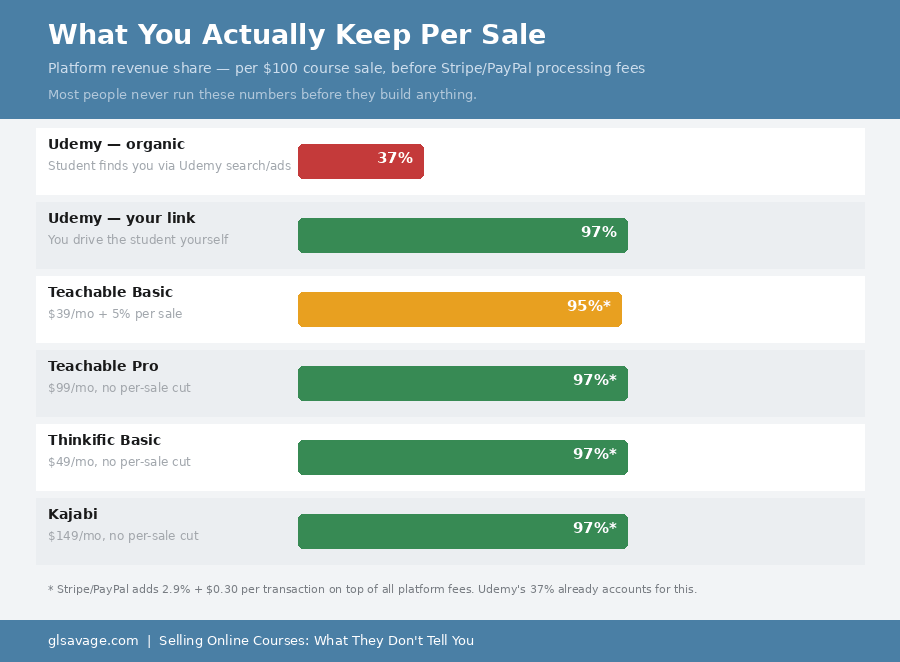
When a student finds your course through Udemy’s own platform, through search, recommendations, or Udemy’s advertising, you keep 37% of the sale price. Udemy keeps 63%. On a $50 course, you take home $18.50. On top of that, Udemy runs frequent site-wide promotions where courses get discounted to $9.99, sometimes from prices you originally set at $100 or more. You cannot opt out of those promotions without pulling your course from the marketplace entirely. Your only path to a better cut is driving students through your own personal referral link, in which case you keep 97%. But you have to bring those buyers yourself, which means you need the audience you just learned you need first.
There is a second layer on top of that. Udemy has a subscription product called Udemy Business where companies pay for employee access to courses. Instructors who participate share a revenue pool based on how many minutes students spend watching their content. As of January 2026, that instructor pool was cut to 15% of subscription revenue, reduced from 25% over the past few years. Udemy announced those cuts in advance. The stock price jumped on the announcement. Instructors got less.
And a third. In August 2024, Udemy automatically enrolled all instructors in a program to use their course content to train generative AI. Instructors were given a three-week window to opt out. When that window closed, the option grayed out in account settings. Some instructors report the opt-out never appeared for them at all. Udemy’s policy states that if you opt out, you lose access to Udemy’s AI tools and may miss out on future revenue streams tied to those features. The choice they built: let them train AI on your content, or opt out and potentially reduce your course visibility. Several instructors left the platform entirely over it.
Self-hosted platforms give you more control but come with their own costs. Teachable’s entry plan is $39 per month and takes a 5% cut of every sale on top of that. To eliminate the per-sale cut you move to the $99 per month plan. Thinkific, another self-hosting option, starts at $49 per month with no per-sale cut on paid plans. Kajabi, the all-in-one option that includes email marketing, automated email sequences, and sales pages built in, starts at $149 per month. None of those monthly fees stop when sales slow down.
Payment processing adds 2.9% plus $0.30 per transaction regardless of which platform you use. Every platform routes payments through Stripe or PayPal and there is no workaround. Run the real numbers on your own course price: on a $200 course through Teachable’s entry plan, Teachable takes $10 in per-sale fees, Stripe takes $6.10, and your $39 monthly subscription spread across five sales adds $7.80 per sale. You are netting around $137 per sale. Not $200. Before taxes. Before a single dollar of marketing.
Speaking of taxes: course income is self-employment income. No employer withholds taxes on your behalf. The platforms pay you and send the IRS a 1099 form at year end showing what you earned. You owe both the employee and employer share of Social Security and Medicare taxes, which comes to 15.3% of net self-employment earnings on top of regular income tax. If you expect to owe more than $1,000 in federal taxes for the year, the IRS requires quarterly estimated payments in April, June, September, and January. Miss those and you face penalties even if you settle the full balance when you file. Most first-time course creators do not know this is coming until the first tax season lands. Set aside 25% to 30% of every payout from day one and it will not blindside you.
The Refund Window Nobody Warns You About
Udemy gives every student a no-questions-asked 30-day refund on every course. No exceptions for content consumed. No instructor control over the policy. Students can work through a significant portion of a course and request a refund before the window closes. Instructors in Udemy’s community have reported losing 5% to over 20% of monthly revenue to refunds, with some describing months where refunds ate most of what the platform paid out.
Udemy says it monitors for abuse and can block serial refunders. Instructors cannot set their own terms or appeal individual refund decisions. That is the trade-off of the marketplace model: you get Udemy’s traffic and you live by Udemy’s rules.
On self-hosted platforms like Teachable or Thinkific, you write your own refund policy. You decide the window, the conditions, the exceptions. That control is one of the most practical differences between selling on a marketplace and selling on a platform you own, and it is rarely mentioned in the comparison guides because those guides are mostly written by people with affiliate commissions on platform sign-ups.
Most People Who Buy Online Courses Never Finish Them
The average completion rate for online courses is 12% to 15%. On large open platforms like Coursera and edX it drops to 3% to 5%. That means for every 100 people who buy your course, somewhere between 3 and 15 of them will actually reach the end.
This matters for your business in two direct ways. First, students who abandon a course early are more likely to request a refund. Second, students who complete a course and get a real result from it are the ones who tell other people. Word of mouth is your cheapest and most powerful marketing channel. A student who finishes your course and changes something in their life or their work will mention it. A student who opened lesson one and never came back will not.
Completion rates improve when courses are built around specific, achievable outcomes rather than broad topics. When modules are short and each one delivers something useful on its own. When the course costs enough that buyers feel motivated to use what they paid for. And when there is some form of community or accountability built in: live cohorts, group coaching calls, a private forum. Cohort-based courses with community built in can hit completion rates above 70%. That is a very different product from a self-paced video library, and it requires ongoing time from you after every sale.
Marketplace vs. Platform You Own: What You Are Actually Choosing
The choice between Udemy and a self-hosted platform like Teachable or Kajabi is not about quality. It is about which business model fits where you actually are right now.
A marketplace brings the traffic. You borrow Udemy’s audience instead of building your own. That is the entire value. In exchange, Udemy owns the student relationship. Udemy has their email address, not you. Udemy can show your students competing courses. Udemy controls the pricing, the promotions, and the terms. If Udemy changes its algorithm, cuts its revenue share again, or shifts its business model toward corporate subscriptions and away from individual purchases, your income moves with those decisions. You are renting shelf space in a store where someone else makes all the rules.
A self-hosted platform means you own every student from the first sale. Their email address is yours. You can follow up, build loyalty, sell them your next course, and develop a real customer relationship. The cost is that every student who finds you finds you because of something you did to bring them there. There is no Udemy traffic. You are the marketing department.
Many experienced course creators use both. Start on Udemy to generate early reviews, credibility, and cash flow without needing a large audience first. Use that proof to build a self-hosted presence where the margins are better and the relationships belong to you. The transition requires careful execution because Udemy restricts how you communicate with students off-platform. But it uses each option for what it is actually good for.
What Course Creators Actually Earn
The income numbers that circulate in the online course industry come almost entirely from people at the top of the distribution. The thousands of instructors who built courses that earned almost nothing are not publishing income reports.
Udemy has over 230,000 instructors. The average course on the platform earns under $100 in total revenue. The top earners are real, and their numbers are real, but they sit at one end of a distribution that most people on the platform never get close to. An individual Udemy instructor can earn anywhere from $0 to over $3 million in lifetime earnings. That range is not informative. It is the entire point: there is no typical outcome, and the people selling the dream of selling online courses are not drawing from the middle of that distribution.
For self-hosted creators, income is private and harder to measure. The data that exists suggests that course creators generating meaningful revenue earn between $1,000 and $10,000 per month. That figure excludes everyone who built a course and made essentially nothing, which is the majority of people who try. The conditions that produce consistent income are the same across everyone who achieves it: an audience built before launch, a specific topic with real demand, a price that reflects genuine value, and sustained marketing after the course goes live. Remove any one of those and the income collapses.
For the full picture on how this compares to other income options when money is already stretched, see The Side Hustle Scam Machine: Who Is Actually Making Money and How and Gig Work Real Pay: What the Apps Show You vs. What You Actually Keep.
The Conditions Where Selling Online Courses Actually Works
Selling online courses is not a scam. It is a real business model with a specific set of requirements. Here is what has to be true.
You have a skill people are actively searching for and willing to pay to learn. Not just something you are good at. Something where documented demand exists and the free alternatives do not already dominate. Technical skills, software tools, professional certifications, and niche trades work. General life improvement, broad productivity, and generic business advice are the most crowded categories online. Getting a course to sell in those categories requires an audience large enough to outrun the free competition, which brings you back to the audience problem.
You have a real audience or a credible path to one that does not depend on the course existing first. An engaged email list of 2,000 people in the right niche will outperform a social following of 50,000 strangers. A professional network from years in an industry counts. A YouTube channel with 5,000 engaged subscribers counts. A plan to build the audience after the course launches does not count.
You are treating this as a business with a real cost structure, a real timeline, and a real plan for the period before it makes serious money. The course creators who make this work launched, got feedback, revised the course, revised the marketing, and stayed at it through a period where the numbers were not impressive. The ones who quit after a slow launch are everywhere. The ones who treated the slow launch as information rather than failure are the ones you hear about.
To make the other side concrete: one instructor on Udemy documented his full earnings from 2019 to 2024 teaching a subject he had years of professional experience in. His total startup cost was under $900. He worked on it part-time, under ten hours a week. He did not have a pre-existing large following. By 2024 his courses were generating consistent income each month from a back catalog he largely built and then maintained. The subject mattered. The niche had real demand and limited free competition. The consistency mattered. He kept publishing instead of waiting to see if the first course took off. That path is available to people who actually have the expertise and the patience to build it properly.
You ran the real math before you started building. Course price minus platform fees, payment processing, monthly subscription cost, and marketing spend equals actual profit per sale. If that number does not work at a sales volume you can realistically reach with the audience you actually have, the price needs to go up, the platform needs to change, or the idea needs to change before you spend six months building something that cannot pay.
How to Start If You Are Serious About This
Validate before you build. Put up a simple page describing the course and ask people to buy it before it exists. Pre-selling, meaning taking actual money before a single lesson is recorded, is how experienced creators avoid building something nobody wants. No buyers means you just saved yourself three months of work. Buyers before content exists means you have revenue before you have costs, and real information about what your students need.
Run a live version first. Deliver the course over a few weeks through video calls, a group chat, or a simple email series before you record anything for permanent sale. It is messier. It is not scalable. It is also how you find out what your students actually struggle with, what needs to be explained twice, what examples land and what fall flat. The recorded course you build after running it live will be better than anything you could have scripted from scratch. You will have real testimonials and real completion data before a production dollar gets spent.
Choose your platform for where you are, not where you hope to be. No audience means start on Udemy. An existing audience means start on a self-hosted platform and own the relationship from day one. Do not pay $149 a month for Kajabi before your course is generating enough to cover it. The all-in-one platforms make sense when you have consistent revenue that justifies the cost. Before that they are a monthly drain on a business that is not yet off the ground.
Build an email list before the course exists. A lead magnet, meaning a free resource like a checklist, a short guide, or a video series that gives people a real reason to hand over their email address, is the foundation of every course launch that actually works. Build it before you finish the course. The list compounds over time. Show up before you have anything to sell, and by the time you launch you will have people who are ready to buy instead of a finished course and nobody to sell it to.
Selling online courses is a real path to income for people who approach it honestly. The audience work is real. The timeline is real. The platform math is real. None of that makes it impossible. It makes it a business with actual requirements, and it rewards the people who take it seriously enough to run the honest numbers before they start building.
Frequently Asked Questions
The range is enormous and most public numbers are skewed by top earners. Creators with existing audiences in the right niches earn $1,000 to $10,000 per month and sometimes significantly more. Creators who launch without an audience typically earn very little in the first year. There is no reliable typical figure because the outcome depends almost entirely on your audience size and engagement before you launch, not on the quality of the course itself.
It depends on whether the conditions are in place. If you have an existing audience, a specific skill with real demand, and you are willing to treat this as a business with a real cost structure and a real timeline, it can absolutely be worth it. If you are starting from zero and expecting income within a few months, the more valuable investment is building the audience first. No course strategy survives without one.
You need a real audience of some kind, but size matters less than trust and relevance. An email list of 2,000 people who genuinely follow your work in a specific niche will outperform a social following of 50,000 general followers every time. What drives sales is a direct relationship with people who trust your expertise, and building that takes time regardless of which platform you are on.
A solid DIY course runs $500 to $2,500 before you make a single sale. A professionally produced course runs $5,000 to $25,000 or more. Platform fees add $0 to $399 per month as an ongoing cost that continues whether you are selling or not. Marketing is separate and should be treated as a real line item from the beginning, not something you figure out after the course is built.
When students find your course through Udemy’s platform, you keep 37% and Udemy keeps 63%. When students buy through your personal referral link, you keep 97%. Udemy also runs site-wide promotions that discount courses to $9.99 without requiring instructor approval. For instructors in the Udemy Business subscription program, the instructor revenue pool was reduced to 15% as of January 2026, down from 25% in prior years. Udemy has cut that subscription share multiple times and announced each reduction in advance.
Udemy offers all students a no-questions-asked 30-day refund on every course. Instructors cannot change this policy or opt out of it. Students can consume a significant portion of a course and still request a refund within the window. Instructors in Udemy’s community report refund rates of 5% to over 20% on higher-priced courses. On self-hosted platforms like Teachable or Thinkific, you write your own refund policy and set your own terms.
Udemy is a marketplace that brings traffic but owns the student relationship and takes a large cut of sales. Teachable is a platform you control where you keep more revenue and own every student’s email address, but you have to bring all your own traffic. Udemy makes sense if you have no existing audience. Teachable or a similar self-hosted platform makes sense if you do. Many experienced course creators start on Udemy for early traction and move buyers toward a self-hosted platform over time for better margins and more control.
Technical skills, software tools, professional certifications, and niche trades consistently outperform broad self-improvement content because the buyer has a specific and urgent need. Someone preparing for a professional certification or learning a specific software tool is a buyer with clear intent. Someone browsing general productivity or life coaching content is competing with an enormous amount of free alternatives. The best topic for selling online courses is one where you have genuine expertise, demand is documented, and the free competition has gaps your course can fill with something more specific and useful.