Somewhere between your job and your bills, someone figured out there was money to be made from your financial anxiety. Not by helping you earn more. By selling you the idea that you could. The side hustle scam is not one program or one fraudster. It is an entire industry, the YouTube channels, the courses, the gurus, the free webinars and the paid masterclasses and the affiliate links and the sponsored content, and it is itself one of the most profitable side hustles ever invented. Understanding how it works does not mean every side hustle is a fraud. It means knowing who is actually making money before you decide whether to try one yourself. This article is about the machine. Not to talk you out of anything. Because you deserve to see the wiring before you plug in.
The Money Does Not Flow Where You Think It Does
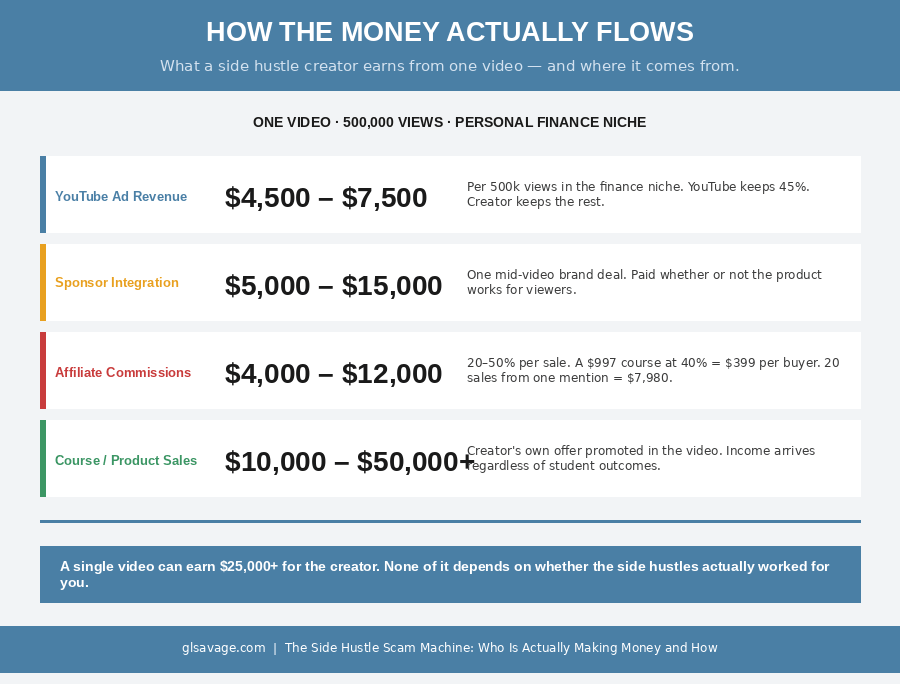
When a YouTube channel with 800,000 subscribers publishes a video called “10 Side Hustles That Made Me $10,000 a Month,” there are several possible sources of income for the creator. Ad revenue from YouTube itself, based on views. Sponsorship fees from companies that paid to be featured in or around the video. Affiliate commissions, meaning the creator gets a cut of every sale made by someone who clicked their link, typically 20% to 50% of the purchase price. And sales of the creator’s own courses or products, often promoted within the video itself.
The finance and personal finance niche on YouTube commands some of the highest advertising rates on the platform. Advertisers in financial services pay between $15 and $30 per 1,000 ad impressions to reach this audience, compared to $3 to $6 for entertainment content. After YouTube takes its 45% cut, creators in the finance and side hustle niche typically keep $9 to $15 per 1,000 views. A video with 500,000 views in this niche generates roughly $4,500 to $7,500 in ad revenue to the creator. Add a sponsor paying $5,000 to $15,000 for a mid-video integration, plus affiliate commissions from every tool, platform, or service mentioned in the description, and the creator’s income from a single video is substantial, consistent, and has nothing to do with whether the side hustles they recommended actually worked for viewers.
This is not illegal. It is not necessarily dishonest. The FTC requires disclosure of paid relationships, and many creators do disclose them. But a creator who recommends the most lucrative affiliate programs earns more than one who recommends what actually works. Those are often not the same list. The viewer who follows the recommendation is the one who finds out which it was.
The Course That Teaches You to Sell the Course
The most structurally circular part of the side hustle industry is the course sector, and it is worth understanding because the circularity is not obvious until you look directly at it.
Someone builds an audience, often by making content about how they made money. They then sell a course teaching others how to do what they did. The thing they did, in a growing number of cases, was build an audience and sell courses. The course teaches you to build an audience and sell courses. The students who succeed become the testimonials used to sell the course to the next round of students, who themselves learn to build an audience and sell courses about building audiences and selling courses.
This is not unique to any specific creator. It is a structural feature of the industry. The courses that earn the highest affiliate commissions are frequently courses about how to sell courses, how to build a dropshipping business, or how to do affiliate marketing. The affiliate commission on a $997 course at 40% is $399. A creator who recommends that course to 1,000 viewers who convert at 2% earns $7,980 from a single mention. The course itself may or may not deliver what it promises. The affiliate income arrives regardless.
Kajabi, one of the largest course-hosting platforms, reports that its creators earn an average of $37,000 per year. That figure is worth examining carefully. An average pulled from a distribution that includes a handful of creators earning millions and hundreds of thousands earning very little does not reflect what a typical new course creator earns. The more useful number, which Kajabi does not publish, is the median. Industry sources suggest that most individual course creators earn well under $10,000 per year, and a large share earn nothing meaningful at all.
What MLMs Look Like From the Inside of the Data
Multi-level marketing companies, where participants earn by selling products and by recruiting others who also sell, are a specific and well-documented category of the side hustle world, and the Federal Trade Commission has produced the most complete picture of what participants actually earn.
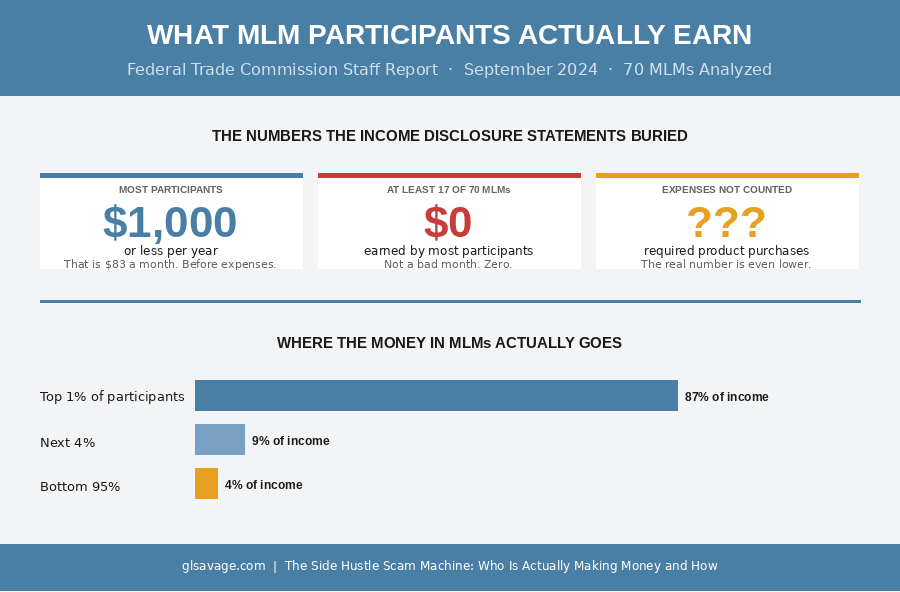
In September 2024, the FTC published a staff report analyzing income disclosure statements from 70 MLMs, ranging from large household names to smaller companies. The findings: in the MLMs reviewed, most participants made $1,000 or less per year. That is less than $84 per month. The report also noted that this figure may not account for the expenses participants incur, which in many MLMs include required product purchases to maintain eligibility for commissions. In at least 17 of the 70 MLMs examined, most participants made no money at all.
The report also documented how the income disclosure statements themselves were constructed. Most emphasized high earnings from a small number of top performers while leaving out or minimizing the percentage of participants who earned nothing. Most did not account for participant expenses. Most presented earnings data in ways the FTC described as potentially confusing or misleading.
The legal distinction between a legitimate MLM and a pyramid scheme is whether real products are being sold to real customers outside the organization. In practice, this line is difficult to assess from the outside. What the FTC’s data makes clear is that for most participants, regardless of legality, the financial outcome is the same: they do not make money, and they may lose it.
The Anatomy of a Side Hustle Scam
Not everything in the side hustle space is a scam. But the ones that are tend to share identifiable features, and the FTC has documented them consistently across enforcement actions. Understanding the pattern helps you see it before you pay for something.
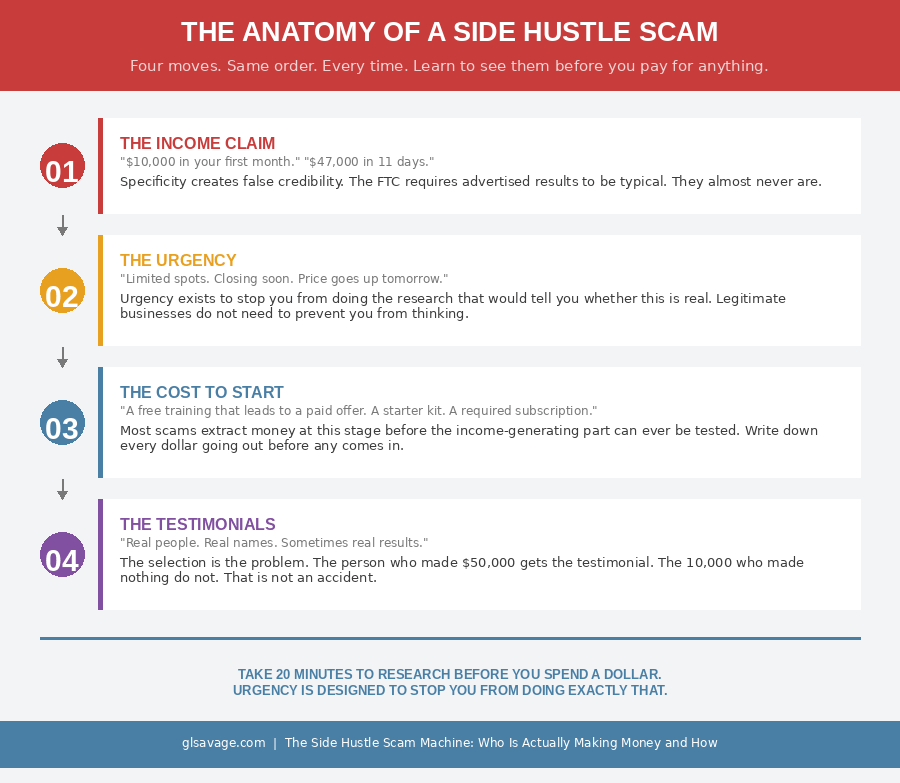
The income claim comes first and it is always specific. Not “you could earn more” but “$10,000 in your first month” or “I made $47,000 in 11 days.” Specificity creates credibility. It implies the number came from somewhere real. In most cases it did not, or it reflects an outcome so rare that using it as a representative example is itself a form of deception. The FTC’s rules on earnings claims require that advertised results be typical of what participants actually achieve. The FTC has brought a sustained series of enforcement actions in this space. In October 2024 it filed suit against an operation running e-commerce stores under names including Lunar Capital Ventures and Profitable Automation, alleging false promises of large profits that consumers never saw. In March 2025 it sued Click Profit, which promised Amazon storefronts generating passive income, charged consumers $45,000 to $75,000 upfront, and delivered results the FTC described as a total sham. Amazon suspended or blocked roughly 95% of the stores Click Profit set up. Permanent bans and asset forfeiture followed in both cases. These are not isolated incidents. They are documented examples of a structure the FTC encounters repeatedly.
The urgency follows the claim. Limited spots. Closing soon. The price goes up tomorrow. Price increases and enrollment deadlines are marketing mechanics. They exist to stop you from doing the research that would tell you whether the opportunity is real. Legitimate businesses do not need to prevent you from thinking.
Then the cost to get started. Sometimes explicit, sometimes buried. A free training that leads to a paid offer. A low-priced entry product that upsells to the real product. A business kit, a starter inventory, a platform subscription, a tool you must purchase to participate. The FTC’s report on job scams found that reports tripled and losses grew from $90 million in 2020 to $501 million in 2024. The defining feature of most of those scams was money flowing from the victim before any money could flow back.
The testimonials are the final piece. Real people, real names, sometimes real results. The selection is the problem. The person who made $50,000 gets the testimonial. The 10,000 who made nothing do not. The MLM income disclosure data makes this structural: the system is designed to surface exceptional outcomes and make them look typical. The person reading the testimonial has no way to know what percentage of participants achieved it.
What the Legitimate End of This Industry Actually Looks Like
Not everything with a side hustle label is a trap. The scam ecosystem is large and loud, but it does not occupy the whole space. The problem is that both the fraudulent and the legitimate versions of side income often use the same language, the same platforms, and the same promises. Knowing one from the other is not about cynicism. It is about looking at the information structure.
Gig work platforms like DoorDash, Uber, and Instacart are not scams. They are transparent about what they pay, the work is real, and the income is real if modest after expenses. The article Gig Work Real Pay: What You Actually Make After Expenses runs those numbers in detail. The problem with gig work is not fraud. It is that the math after taxes, vehicle costs, and the loss of employment benefits frequently surprises people who started based on the gross hourly figure.
Skills-based freelancing, offering a service someone will pay for directly, is real income with real demand. Copywriting, graphic design, web development, bookkeeping, tutoring, photography. These work when there is genuine skill to offer, the market has real demand, and the person is willing to do the work of finding clients. The failure rate is high not because of fraud but because building a client base takes longer than most people expect and requires more active selling than most people anticipated. Why a Second Job Often Costs More Than It Pays covers the hidden costs that apply to freelance income the same way they apply to a second job.
Renting assets you already own, a car on Turo, a parking space, a spare room, tools through rental platforms, generates real income with real limitations. The income is genuine. The insurance gaps, platform fees, and damage risks are real too and rarely appear in the promotional framing.
The difference between these and the scam ecosystem is not the income potential. It is the information structure. Gig platforms tell you what you earn per delivery. Turo shows you what comparable rentals earn in your area. The scam ecosystem tells you what the top 1% earned and implies you will join them.
How to Evaluate Any Side Hustle Before You Spend Money
The FTC publishes clear guidance on this, and none of it requires financial expertise. It requires three things before any money leaves your account.
First: find out how the person recommending it actually makes their money. This matters because someone who earns $30,000 from recommending a dropshipping course gets paid whether the course works for you or not. Their income does not depend on your outcome. It depends on your purchase. That is not a crime. It is how most of this content is built. But it means the recommendation is not the same as advice from someone who actually runs a dropshipping business and is sharing what worked. One person has skin in your game. The other has skin in your wallet. Knowing which you are dealing with changes how much weight you give the recommendation.
Second: map every dollar that goes out before any comes in. Course fees. Starter kits. Required product inventory. Platform subscriptions. Software licenses. Any opportunity that requires spending before earning is not automatically a scam. Building a real business usually requires some investment. But the upfront cost is a real cost, and most scams work by extracting money at that stage before the income-generating part can be tested. Write down the actual number before you decide anything.
Third: find out what typical participants earn, not what the top earners earned. For MLMs, the company is required to publish an income disclosure statement. Ask for it before joining. When you get it, look for the median, not the average, and look for the line that shows what percentage of participants earned nothing. That number is almost always in the document and almost always buried. For courses and programs the comparable data is often not published at all. The absence of typical outcome data is not an oversight. It is a choice. Search the program name alongside the words “complaint,” “review,” and “refund” and read what people who went through it actually say. The promotional materials surface winners. The review ecosystem surfaces everyone else.
The FTC recommends this exact search process before engaging with any unsolicited business opportunity. It takes twenty minutes. Most people skip it because the sales page created urgency and they were told the window was closing. That urgency is a designed feature. Take the twenty minutes anyway.
The Larger Picture
The side hustle industry exists because the need it claims to address is real. Wages have not kept pace with costs for most workers since the late 1970s. Depending on how it is measured, somewhere between a quarter and two-thirds of Americans describe themselves as living paycheck to paycheck. Bank of America’s spending data puts the figure around 25 to 30 percent, while self-reported surveys run as high as 65 percent. Whatever the precise number, a large share of households are not building financial margin. Among the roughly one in three adults who have a side hustle, more than a third use that income to cover regular living expenses like rent and groceries, and nearly a third say they think they will always need a side hustle to make ends meet. The financial pressure that makes people click on a video promising $10,000 a month is genuine, and the people who built the industry that sells solutions to that pressure understand this better than almost anyone.
The FTC received more than 6.5 million consumer reports in 2024. Business and job opportunity scams accounted for $750.6 million in reported losses, up nearly $250 million from 2023. These are reported losses. The actual losses are higher. Most people do not report.
None of this means the answer to financial pressure is to do nothing. It means the information environment around side hustles is structured by people who profit from your participation, and understanding that structure is the first piece of information you need. The rest of this series goes category by category: what the actual numbers look like, what works under what conditions, what the hidden costs are, and what the red flags are for each specific type. Start there. The side hustle scam is not any one program. It is an information ecosystem built around a financial need, and knowing how it works is the beginning of using it rather than being used by it.
Frequently Asked Questions
Is the side hustle industry a scam?
Not entirely, but a significant portion of it operates on misaligned incentives. The people recommending side hustles often earn money from the recommendation itself, through affiliate commissions, sponsorships, and course sales, regardless of whether the recommended opportunity works for the person following it. Some side hustles are legitimate and generate real income under the right conditions. Others are designed primarily to extract money from people who are looking for financial relief. The challenge is that both often look identical from the outside.
How do side hustle gurus actually make their money?
Typically through a combination of YouTube ad revenue, paid brand sponsorships, affiliate commissions on tools and platforms they recommend, and their own course and product sales. In the personal finance and side hustle YouTube niche, advertisers pay $15 to $30 per 1,000 ad impressions, among the highest on the platform, with creators keeping $9 to $15 per 1,000 views after YouTube’s share. A single sponsored integration in a video can pay $5,000 to $15,000. Affiliate commissions on courses and software subscriptions often run 20% to 50% per sale. A creator’s income from content about side hustles frequently has little connection to whether the side hustles they cover actually work.
What does the FTC say about side hustle scams?
The FTC tracks business and job opportunity fraud separately from other scams. In 2024, reported losses in this category reached $750.6 million, up nearly $250 million from 2023. Reports of job and employment scams tripled between 2020 and 2024. The FTC also published a staff report in September 2024 analyzing 70 MLM income disclosure statements, finding that most participants in those MLMs earned under $1,000 per year before expenses, and that most participants in at least 17 MLMs earned nothing at all.
How do I know if a side hustle course is legitimate?
Ask what typical students earn, not what the top students earned. Ask what the refund policy is. Search the program name alongside the words “complaint,” “review,” and “refund” before purchasing. Look at whether the course creator’s primary income comes from doing the thing the course teaches or from selling the course itself. A course that teaches dropshipping from someone whose main income is selling dropshipping courses is a different product from a course taught by someone whose main income is an active dropshipping business. The distinction is rarely made obvious in the marketing.
What side hustles are not scams?
Gig work platforms like DoorDash, Uber, and Instacart pay real money for real work, though the net after expenses is often smaller than the advertised hourly rate suggests. Skills-based freelancing generates real income when there is genuine skill and real market demand. Renting assets you already own through legitimate platforms produces real income with real platform fees and risk. None of these require upfront payment to participate and all of them have verifiable, publicly available income data. The distinction between these and the scam-adjacent parts of the industry is transparency about typical outcomes.
What are the red flags of a side hustle scam?
Specific and large income claims presented as typical results. Urgency tactics like limited spots, closing soon, or prices going up tomorrow. Money required upfront before any income can be tested. Testimonials from top earners presented without context about what percentage of participants achieved similar results. Difficulty finding independent reviews from people who did not succeed. An income disclosure statement, if one exists, that emphasizes top earners while omitting or minimizing the percentage who earned nothing. And a recommender whose own income comes primarily from the recommendation rather than the activity being recommended.
Can you make real money with a side hustle?
Yes. Side hustles generate real income for a real number of people under real conditions. Those conditions vary by the type of hustle, the person’s skills and situation, the time invested, and the market they are operating in. The problem is not that side income is impossible. It is that the information environment around side hustles is dominated by people who profit from making it sound easier and more universal than it is. The goal of this series is to go category by category with actual numbers, actual costs, and actual conditions, so the decision is based on information rather than marketing.