Dropshipping has produced real businesses. Wayfair was founded on the model in 2002, built proprietary logistics infrastructure on top of it, and grew to over $12 billion in annual revenue while still shipping roughly 95% of its products directly from suppliers to customers. Plenty of smaller operators run profitable stores right now. It has also produced an enormous content industry built around teaching people to dropship, where the business of teaching pays more reliably than the business of doing it. Most articles about dropshipping come from one side of that or the other. This one is neither. Is dropshipping worth it? That is a question with a real answer, and the answer depends almost entirely on information the promotional side of this industry tends to leave out. Here is what the full picture actually looks like.
What Dropshipping Actually Is, in Plain Terms
You build an online store. You list products you do not own and do not have. When someone buys, you place the order with a supplier who ships it directly to your customer. You keep the difference between what the customer paid you and what you paid the supplier, minus every fee in between.
You never see the product. You never touch it. You are the face of a business whose back end is run by someone else, somewhere else, that your customer will never know about. That arrangement is both the appeal and the source of every major problem the model has.
What the Numbers Actually Show
Between 80% and 90% of dropshipping stores fail within the first year. Only 10% to 20% ever reach consistent profitability. Only 1.5% ever cross $50,000 in monthly revenue. Those are the real dropshipping failure rate numbers, and they are worth sitting with before anything else.
Context matters here. High failure rates are not unique to dropshipping. Ecommerce broadly has a 70% first-year failure rate across all models. The distinction worth noting is that dropshipping is frequently positioned as the lowest-risk entry point into ecommerce, which makes understanding that failure rate important before you start rather than after.
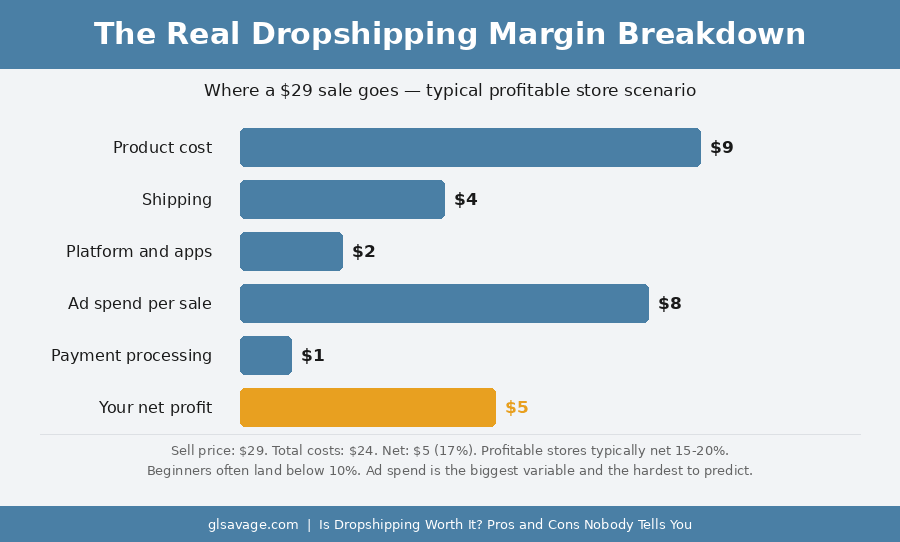
The profit margin picture is narrower than it looks on paper too. After product cost, international shipping, platform fees, advertising, apps, and payment processing, the stores that are actually profitable typically operate at 15% to 20% net margin. That means $1,500 to $2,000 in actual profit for every $10,000 in sales. Beginners frequently land below 10%. Getting to $10,000 in sales requires money you have not made yet, and most of it goes to advertising.
One thing worth understanding before reading any content about dropshipping, including this article, is who typically produces it and how they make money. YouTube channels covering dropshipping earn ad revenue, sponsorship fees, and affiliate commissions on tools they recommend regardless of whether those tools work for you. A single video with 500,000 views in the personal finance niche generates several thousand dollars in ad revenue, plus potentially $5,000 to $15,000 from a sponsor, plus commissions on every Shopify, app, or course link in the description. Dropshipping courses, often priced between $500 and $2,000, rarely publish data on what their students actually earn. None of this makes the information wrong automatically. It does mean the incentive is to present the upside prominently and the downside lightly, which is worth knowing when you are evaluating the dropshipping pros and cons from any source, including this one.
What It Actually Costs to Start
The low startup cost is the first thing most dropshipping content leads with, and it is true as far as it goes. What the number usually leaves out is advertising, which is where most of the real money goes before the business generates any. Understanding the full picture of dropshipping real costs before you start is the difference between a plan that holds and one that runs out of runway. Here is what actually leaves your account before a sale comes in.
Shopify runs $39 per month for the Basic plan, $105 per month for the mid-tier Grow plan. Those two cover what most dropshippers need. Apps for importing products, syncing inventory, and automating order routing add another $30 to $100 per month on top of that. Domain name, $10 to $20 per year. Any design work, product photography, or ad creative costs extra. None of this is optional if you want a store that converts.
Then comes advertising. Without an existing audience, dropshipping stores live or die on paid ads. Facebook and Instagram are the primary channel. The average cost to reach 1,000 people in the U.S. ecommerce audience on Meta was around $20 by 2024, up 14% year over year. Google Ads costs for ecommerce climbed roughly 25% between 2024 and 2025. What used to cost $10 to bring in one customer now frequently costs $30 or more.
Standard product testing on Facebook Ads requires $50 to $100 per day, per product. Most products you test will not convert at a profitable margin. Finding one that does usually takes testing several. Serious practitioners budget $2,000 to $5,000 minimum for the testing phase alone, before the business generates any profit. Many sources put the realistic startup number at $5,000 to $10,000 for anyone with a genuine shot at sustainability. That is a long way from free.
The Supplier Problem the Highlight Reel Skips Over
Your customer does not know your supplier exists. When the product arrives three weeks late, that is your problem. When it looks nothing like the photos, that is your problem. When it does not arrive at all, they email you, call you, leave a review about you. The supplier is invisible. You are not.
Most dropshipping beginners source from AliExpress or similar Chinese marketplaces. The selection is enormous and the prices leave enough room to work with. The shipping times from China traditionally ran two to six weeks on standard options, which is a significant problem in a world where Amazon has conditioned people to expect delivery in two days. Quality is entirely up to whichever supplier you picked, and two listings that look identical can deliver products that are completely different in material, sizing, and durability. You have no way to know until a customer tells you.
Returns in this model are a math problem with no good solution. The cost of shipping a $12 product back to China usually exceeds the product’s value. Most dropshippers just refund without requiring a return, which means every defective or lost item is a straight loss. Chargebacks, where a customer disputes the charge directly with their card company and the money is pulled back from your account, are a consistent hazard specifically because of the shipping delays and product inconsistency the model produces. On AliExpress, dispute outcomes favor the buyer in roughly 55% of cases. As the seller, you lose about half the time even when you think the claim is unfair.
There is one more piece here that almost nobody covers. Facebook tracks customer satisfaction scores from people who purchase through your ads. If that score falls below their threshold because products are arriving damaged or late, they restrict your ad account. If it keeps falling, they shut it down. Shopify terminates stores with chronic chargeback problems. PayPal freezes accounts when disputes pile up. There is often no meaningful appeal process. The people who build a store for six months and then have it wiped out by a wave of chargebacks from a bad supplier batch are not rare. They just do not make YouTube videos about it.
What 2025 Did to the China Dropshipping Model
If you researched dropshipping before 2025, you researched a different business than the one that exists right now. The dropshipping tariffs and trade changes of 2025 rewrote the cost structure that made the model work for a generation of beginners, and most content has not caught up to what actually happened.
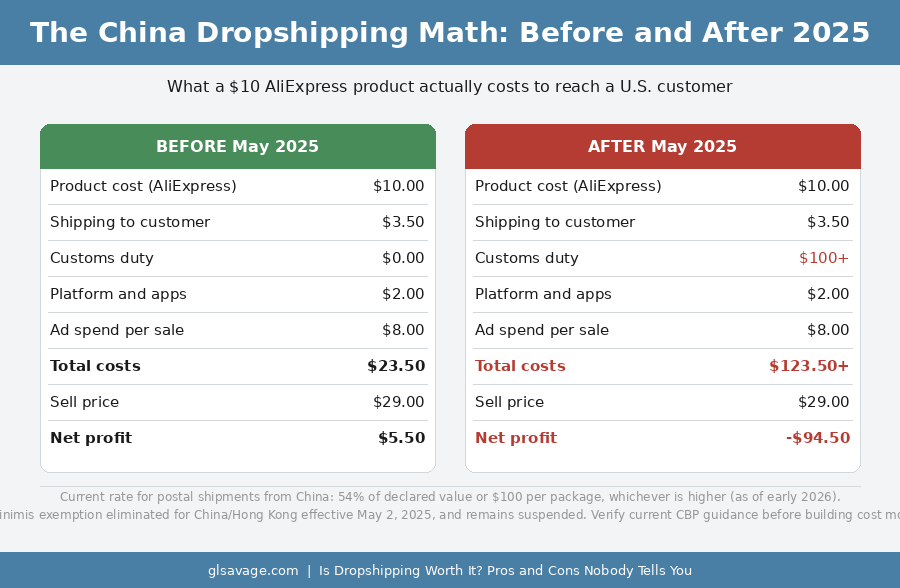
For years, a provision of U.S. customs law called the de minimis exemption let packages valued under $800 enter the country duty-free. This was the economic foundation of the cheap-Chinese-goods dropshipping model. AliExpress could ship a $9 phone case directly to a customer in Ohio with no customs charge attached. That is why the math worked at low price points.
In early 2025, the U.S. imposed escalating tariffs on Chinese goods under emergency powers, eventually reaching 145% at their peak. Then, effective May 2, 2025, the de minimis exemption for goods from China and Hong Kong was eliminated entirely. Every package from China, regardless of value, became subject to customs duties for the first time.
In May 2025, a temporary trade deal reduced the tariff rate from 145% to 30% for a 90-day period. Then in February 2026, the U.S. Supreme Court ruled that the emergency powers law used to impose those tariffs did not actually authorize tariffs, and the tariff structure was replaced with a 10% global import surcharge under a different legal authority. The situation has been moving fast and continues to move.
Here is what has not changed through any of this: the de minimis exemption remains suspended. The Trump administration issued a separate executive order on February 20, 2026, explicitly continuing the de minimis suspension under new legal authority, so duty-free entry for sub-$800 packages from China is gone regardless of what happens to the tariff rates themselves. For postal shipments from China, the rate as of early 2026 is 54% of the item’s value or $100 per package, whichever is higher, though the tariff landscape is still shifting and that number should be verified against current CBP guidance before building any cost model around it. U.S. Customs and Border Protection reported that daily de minimis shipments from China dropped by over 85% after the May 2025 changes took effect.
The practical result for dropshippers: the cost model that made low-ticket Chinese dropshipping accessible to beginners is broken. A $9 product you planned to sell for $29 now carries a minimum $100 customs charge on top of everything else before it reaches your customer. Anyone building a cost model on AliExpress economics without accounting for this is building a business that cannot work at the numbers they are imagining.
The Legal Exposure Nobody Mentions
When you source from overseas marketplaces, you frequently have no way to know whether a product copies a trademark or infringes a patent. The knock-off version of a branded item, the product that replicates a patented design, the logo that resembles something a large company owns. In many situations you are legally treated as the importer, meaning you are the one U.S. law holds responsible for what enters the country, not the factory that made it. If a brand’s legal team sends a complaint, you absorb it. Sellers have had their entire Shopify stores suspended, their ad accounts shut down, and their PayPal accounts frozen over products they sourced without knowing they were infringing. The supplier did not warn them. The supplier is not who loses the store.
If a product you sell injures someone, you carry product liability exposure as the retailer. You never touched the product. That does not matter legally. Standard business insurance does not automatically cover this. Most dropshippers are carrying a risk they do not know exists.
Once your store generates sales in a U.S. state above a certain dollar threshold, that state requires you to collect and send them their sales tax from those transactions. The threshold varies by state. The obligation is real whether or not you know it exists. The tools to automate this are not expensive. The point is that almost no beginner dropshipping content mentions it at all.
The Honest Case For It
The people who make dropshipping work are not anomalies. The inventory advantage is the foundational one: you do not buy stock until someone orders it. If a product stops selling, you stop listing it. A bad product decision does not leave you holding $8,000 in inventory you cannot move. That flexibility is structurally real and it does not exist in traditional retail. It means you can test ten different products in the time it takes a traditional retailer to commit to one.
The location independence is real. A functioning dropshipping business can be run from anywhere with internet access. Customer service, advertising, supplier communication, and order management can all happen from a laptop. For someone whose circumstances make a conventional job difficult, or whose goal is genuine geographic flexibility, this is an actual structural feature of the model.
The skills transfer whether or not the business works out. Someone who learns product research, paid advertising, customer acquisition, and figuring out what makes people buy inside a dropshipping business has built a skill set that applies across all of ecommerce and digital marketing. The specific store may close. That knowledge does not.
The startup capital requirement, while higher than advertised, is genuinely lower than almost any other retail business model. A traditional retailer buying inventory, leasing space, and building out a store faces capital requirements that most people simply do not have. Dropshipping’s real floor, while not free, is still low enough that it is accessible to people who could not fund a conventional retail operation.
The organic traffic opportunity has also expanded in ways that change the startup cost picture. TikTok Shop, Instagram, and YouTube Shorts have given dropshippers viable paths to customers that do not require a paid advertising budget on day one. Someone with the ability to create engaging short-form video content can build an audience and drive sales organically, which fundamentally changes the economics compared to pure Facebook Ads reliance. This is not a guarantee of success. It is a real alternative to the $30-per-customer acquisition cost problem that kills paid-ads-only stores.
The market is genuinely growing. The global dropshipping sector was valued at roughly $365 billion in 2024 and is projected to exceed $1.2 trillion by 2030. Demand for online retail is not going away. The model has a real structural role in how ecommerce functions. That is the market it is.
What the Working Version Looks Like Right Now
The version of dropshipping that relied on Chinese suppliers shipping cheap goods to U.S. customers duty-free is not viable at the economics that made it popular. What is actually working in 2026 looks different.
U.S.-based suppliers. Platforms like Spocket, Zendrop, and TopDawg connect stores with domestic suppliers. Products arrive in two to five days. No customs duty math to navigate. The product costs are higher than AliExpress, which means the margins per unit are tighter. This pushes the model toward higher-ticket items where the profit per sale is large enough to survive the advertising cost to acquire a customer.
Higher-ticket products. A $400 piece of furniture or a $300 piece of fitness equipment at a 20% margin generates $60 to $80 per sale. The cost to acquire a customer through paid advertising does not scale proportionally with ticket price. A $30 customer acquisition cost on a $25 product is fatal. On a $300 product it is survivable. This is why high-ticket dropshipping with domestic suppliers is the segment of the model that serious practitioners are actually running.
Organic traffic through short-form video. TikTok Shop represented nearly 20% of U.S. social commerce sales in 2025 and is forecast to exceed $20 billion in sales in 2026. Dropshippers who build organic audiences on TikTok, Instagram Reels, or YouTube Shorts are acquiring customers at a fraction of what paid advertising costs, sometimes for nothing. This requires a different skill set than running Facebook campaigns, but for people who can make content, it changes the startup math significantly.
AI tools for operations. The solo operator running a dropshipping store in 2026 has access to tools that did not exist three years ago. Ad copy generation, customer service automation, product description writing, real-time profit tracking, and pricing optimization can all be handled by software that costs a fraction of what hiring help would. A single person with the right tools can manage what used to require a small team. This is a genuine structural change in what is possible at the low end of the capital spectrum.
Brand identity over generic storefronts. The stores that survive multiple years do not look like dropshipping stores. They look like brands. A specific niche. A coherent visual identity. A product selection that reflects genuine knowledge of who the customer is and what they actually need. These stores compete on something other than ad spend against identical products from the same supplier. Building that takes longer. It produces something with actual staying power.
Before You Spend a Dollar: What Actually Needs an Answer
Is dropshipping worth it for you specifically depends on honest answers to a few things before any money moves. If you want to understand how the broader side hustle information ecosystem works before going further, The Side Hustle Scam Machine: Who Is Actually Making Money and How covers the mechanics of how that content is built and who it serves. For those ready to think through how to start dropshipping specifically, here is what actually needs an answer first.
Where do your products ship from and what does the current duty situation look like? If you are targeting U.S. customers and sourcing from China, the de minimis exemption is gone and duties apply to every package. Before you build a price model, add up the full cost to get a product from the supplier to the customer’s door: the product price, shipping, customs charges, and any platform fees. That total is your real cost per unit. Build your price from that, not from what the supplier charges alone.
What can you spend on advertising before you need to see a return? That number is your real runway. Under $1,000 and the testing phase may exhaust your budget before you find a product that converts profitably. That is not a reason not to try. It is a reason to go in clear-eyed about the odds.
Have you done product research before building the store? The store is not the business. The product is the business. Most people build the store first and discover the product does not work second. Search your candidate product on Amazon, Google Shopping, and Facebook’s Ad Library before you build anything. If stores with large budgets are already selling it everywhere you look, your ability to compete as a newcomer on advertising spend alone is limited. A low-competition niche with sustainable demand is worth more than whatever is trending this month.
Have you vetted a supplier in person? Order samples. Verify the actual shipping time to your country. Know the supplier’s dispute process before a dispute happens. For U.S.-based suppliers, confirm they are who they say they are before you route orders through them.
Is dropshipping worth it? For some people, with the right product, the right supplier, realistic capital, and the patience to treat the early testing phase as tuition rather than income, yes. For people who start from the napkin math without running the real numbers, no. The business works for people who know what it actually is before they start.
Frequently Asked Questions
Yes, under specific conditions. The low-ticket, China-sourced model that dominated the space is not viable for U.S. sellers right now. The de minimis exemption that let cheap Chinese goods enter duty-free is gone, and even with tariff rates fluctuating throughout 2025 and 2026, the exemption itself has stayed suspended through separate executive authority. What is working is higher-ticket products sourced from U.S.-based suppliers, where margins per unit are large enough to survive advertising costs and customers receive domestic delivery speeds. Whether it is worth it for a specific person depends on how much capital they have for testing, how realistic they are about the learning curve, and whether they are willing to treat early losses as education rather than evidence the model does not work.
The pros: no inventory risk, genuine location independence, transferable skills, low barrier to entry, and a market that is still growing. The cons: 80% to 90% failure rate within the first year, real startup costs of $2,000 to $10,000 once advertising is included, no control over product quality or shipping, chargeback and platform account termination risk, legal exposure on intellectual property and product liability, and for U.S. sellers sourcing from China, a duty structure that makes the traditional low-ticket model unworkable. Both columns are real. Neither cancels the other out.
The U.S. eliminated the de minimis exemption for goods from China and Hong Kong effective May 2, 2025, ending the duty-free entry that made cheap Chinese dropshipping viable. Tariff rates on Chinese goods escalated through much of 2025, reaching as high as 145% before a temporary trade deal in May 2025 reduced that rate. The Supreme Court struck down the emergency powers tariffs in February 2026, and they were replaced with a 10% global import surcharge. Through all of this, the de minimis exemption itself has remained suspended under separate executive orders and continues to be suspended as of today. For postal shipments from China, the rate as of early 2026 is 54% of the declared value or a flat $100 per package, whichever is higher. The tariff rates are still in flux and should be verified against current government guidance, but the end of duty-free entry is not in flux. The cost model that made low-ticket Chinese dropshipping work for beginners does not work under these conditions.
The honest minimum for a real attempt is $2,000 to $5,000. Many practitioners put the realistic number at $5,000 to $10,000. This covers a Shopify subscription ($39 to $105 per month depending on plan), apps for importing products and automating fulfillment ($30 to $100 per month), domain and basic branding, and the advertising budget required to test products until one converts profitably. Testing a single product on Facebook typically requires $50 to $100 per day before you have useful data, and most products tested will not produce profitable margins. The testing phase is where most startup capital goes. None of this includes the product cost itself, which does not come out of your pocket until an order is placed, but factor it into your margin math from the beginning.
Three. First, intellectual property exposure: sourcing from overseas marketplaces frequently means selling products that copy trademarks or infringe patents, which makes you the liable party even though you did not manufacture the product. Second, platform account termination: Facebook, Shopify, and PayPal all have thresholds for chargeback rates and customer satisfaction scores. When a bad supplier batch generates enough complaints, accounts get suspended with limited or no appeal, and months of work disappear with them. Third, sales tax compliance: once your sales in a given U.S. state cross certain dollar thresholds, that state requires you to collect and send them sales tax. Most beginners are not tracking this and most dropshipping content does not mention it.
Four things before committing to a product. Search it on Amazon to see pricing, competition, and review volume. High reviews with consistent complaints about a specific problem signal a real market with a gap to fill. Search it on Google Shopping to see which stores are already selling it at scale. Check the Facebook Ad Library to see how much existing ad creative there is in that space and how long those stores have been running ads. Long-running ads mean a product that converts. Finally, build out the actual cost model: the full cost to get the product from the supplier to the customer’s door including current duties and shipping, the realistic selling price given the competition you found, the expected advertising cost per customer based on how saturated that market is, and what margin is left after all of that. If the math works before you spend anything, then spend something small and test it in practice.