
Affiliate marketing works. Real people build real income from it, some of them full-time, some of them significantly more than full-time. The model is not broken. The information ecosystem surrounding it almost always is. Most of what you find when you search for affiliate marketing was produced by people doing affiliate marketing. They earn a commission when you click their link and buy a course about how to do affiliate marketing. That is not a conspiracy. It is just how the incentives work, and it means the information you find optimizes for your excitement rather than your success. This article is built differently. It covers how affiliate marketing actually functions, what the income numbers genuinely look like for most beginners, what the industry does not want you to know before you start, and what you need to understand before you put a year of your time into building something.
How Affiliate Marketing Actually Works
The structure is straightforward. A company sells a product or service and agrees to pay a commission to anyone who sends them a customer. You sign up for their affiliate program, get a unique tracking link, and publish that link somewhere your audience sees it. When someone clicks your link and makes a qualifying purchase within a set timeframe, you earn a percentage of the sale. You never touch the product, handle payment, or deal with customer service. The company does all of that. Your job is to get the right person in front of the right product and give them a reason to click.
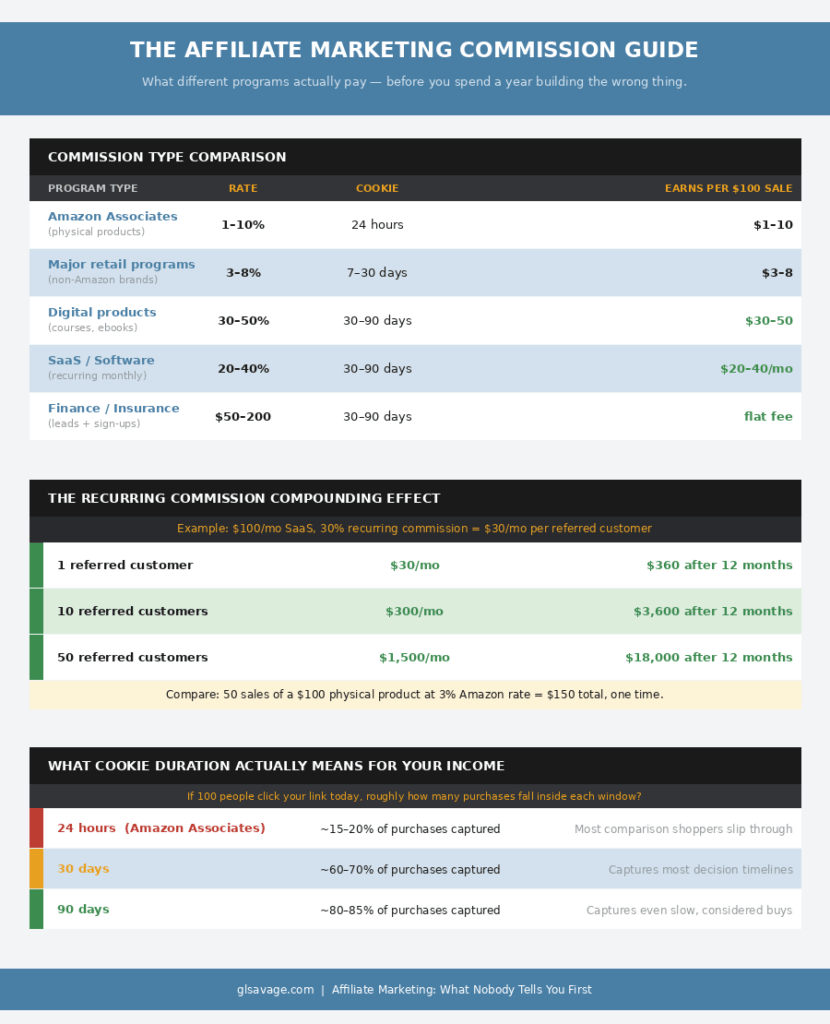
The tracking works through cookies. When someone clicks your affiliate link, a small file is stored in their browser. If they complete a purchase from that merchant within the cookie window, you get credit for the sale. Cookie windows vary by program. Amazon gives you 24 hours. Most software and subscription products give you 30 to 90 days. A few give lifetime attribution, meaning if that person ever buys from that merchant, you get the commission regardless of when it happens. Cookie duration matters more than most beginners realize because people almost never buy the moment they click a link. They compare options, read reviews, sleep on it, come back three days later. A 24-hour window loses credit for most of that behavior. A 30-day window captures the majority of it.
Commission rates vary enormously by product type. Physical products on Amazon pay 1 to 10 percent depending on category. Other retail programs run 3 to 8 percent with longer cookie windows. Digital products like courses and ebooks commonly pay 30 to 50 percent per sale. Software and subscription products, often called SaaS, pay 20 to 40 percent recurring, meaning you get paid every month the referred customer stays subscribed, not just when they first sign up. Financial products like credit cards, insurance, and investment platforms pay flat fees of $50 to $200 or more per qualified lead. The math on each is completely different. A 3 percent commission on a $25 product earns you $0.75. A 30 percent recurring commission on a $100 per month software subscription earns you $30 every month that customer stays. Ten customers like that is $300 per month from work you did once.
The Income Reality: What the Numbers Actually Show
The income figures that circulate in affiliate marketing content are almost always misleading in the same direction. They present an average that a small number of extremely high earners pull dramatically upward. Here is what the data looks like when you get past the headline.
The most commonly cited average monthly income for affiliate marketers runs around $8,000. The median, which is the number where half of working affiliates earn more and half earn less, sits between $1,200 and $2,500 per month. Those are two completely different pictures. The median is the honest one. Surveys of active affiliate marketers consistently show that roughly 41 percent earn under $1,000 per month, and around 23 percent earn essentially nothing. Most beginners earn between zero and $100 per month in their first six to twelve months. That is not failure. That is the normal timeline before an affiliate business has enough content, traffic, and trust to convert at any real scale.
The gap between year one and year three is stark. Affiliates with three or more years of experience earn roughly nine times more than affiliates with under a year of experience. That gap does not exist because experienced affiliates work harder. It exists because content and authority compound over time. A blog post or video you published two years ago can still be ranking in search and earning commissions today. An affiliate business built on search traffic is a long-term asset. It earns while you sleep, but only after you have put in months of work building it while it earns almost nothing.
The honest timeline for a beginner starting from zero is six to eighteen months before meaningful income arrives. Most people quit in the first three months because they created content, put up links, and saw almost nothing happen. That is the normal experience, not a signal the model does not work. The algorithm has not indexed enough content yet. The site does not have enough authority. The audience is not large enough yet. Patience is not optional in affiliate marketing. It is the cost of admission.
Three Things That Kill Most Affiliate Businesses Before They Start
Most beginners fail for one of three reasons, and the tutorials never cover any of them.
The first is promoting products they have never used to an audience that does not yet trust them. Affiliate marketing runs entirely on trust. When someone reads a recommendation and buys something based on it, they are taking the writer’s word for it. If that word has no track record behind it, it is worth very little. The affiliates who convert well have spent months or years giving their audience information that proved accurate and genuinely useful. A recommendation from them carries weight because it has been earned over time. You cannot shortcut that by publishing more links faster.
The second is picking a niche based entirely on commission rates rather than on whether they actually know anything about it or whether a real audience for their specific angle exists. High commission rates attract high competition. Personal finance, health and wellness, and software are three of the highest-paying affiliate categories and three of the most saturated. A beginner with no existing authority in those spaces is competing against sites with years of backlinks, thousands of pages of content, and full-time teams. The beginner who picks a genuinely specific audience they understand deeply almost always outperforms the beginner who chased the highest-paying category.
The third is building everything on a platform they do not own. A TikTok following. A Pinterest account. A YouTube channel. All of those can generate affiliate income and all of them can disappear overnight because the platform changed its algorithm, suspended the account, or shifted its policies. The affiliates who build durable income own their traffic in some form. Most often that means an email list. An email list belongs to you. No platform can take it. Every piece of content published anywhere should be working toward getting people onto a list you control. If it is not, you are building on ground someone else owns. This same risk applies across every digital income model. Selling Digital Products Sounds Like Free Money. Here Is What Actually Happens. covers how platform dependency plays out for digital product sellers specifically.
What the Passive Income Pitch Leaves Out
The passive income framing is not wrong. It is a description of what affiliate marketing looks like once it is built, not what building it looks like. A well-established affiliate site with strong search rankings does earn commissions from posts published years ago with minimal ongoing maintenance. That is real. What the pitch leaves out is everything that comes before that point.
Getting to where an affiliate business earns passively requires twelve to twenty-four months of active, consistent work building content, growing an audience, earning trust, and adjusting based on what you learn. The people who describe affiliate income as passive are describing their current situation. They are not describing the path they took to get there. The path looks like a part-time job, with the added uncertainty of not knowing whether it is working for months at a time. The people selling you the passive income version of the story are, in many cases, earning their income by selling that story. The Side Hustle Scam Machine: Who Is Actually Making Money and How breaks down exactly how that pattern works across the side hustle space.
Nothing stays passive indefinitely either. Google’s algorithm updates have wiped out affiliate sites earning reliably for years, overnight, because the update decided their content was thin or manipulative. Programs change their terms. Audiences shift. A site running itself for three years may need significant rebuilding in year four. The income is more durable than most side hustles, but calling it passive overstates both the ease of building it and the permanence of what gets built.
The Part Nobody Warns You About: Programs Control Everything
This is the most important thing in this article and the thing almost no beginner guide addresses clearly.
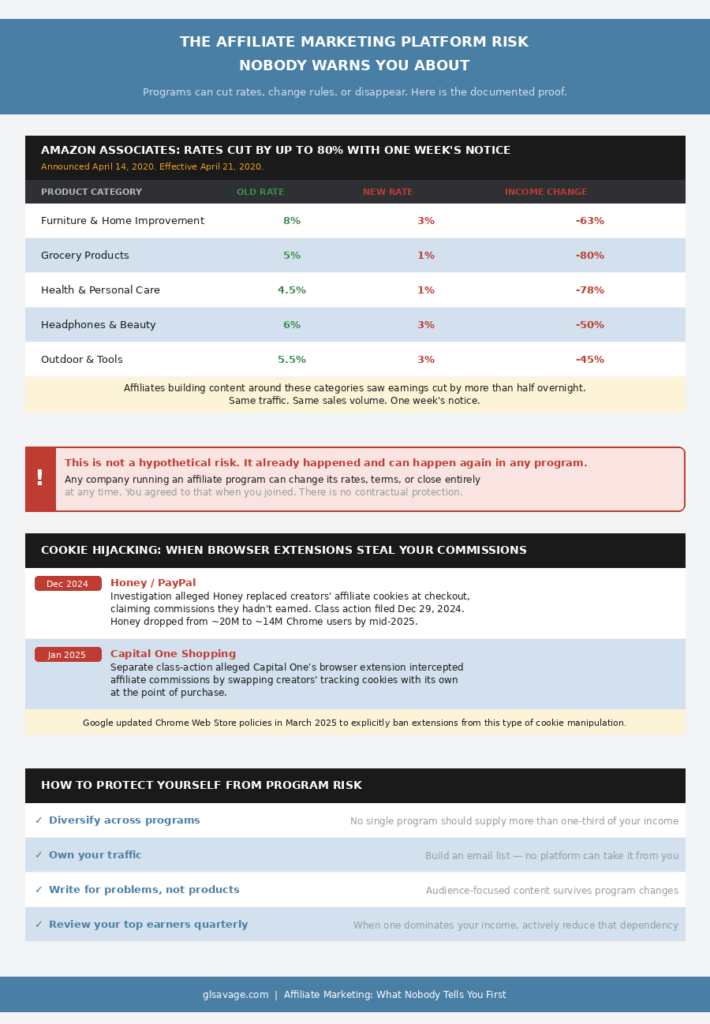
Every affiliate program is controlled entirely by the company running it. They set the commission rates. They define the cookie window. They determine what counts as a qualifying sale. They decide who stays in the program. At any time, with as little as a week’s notice, they can change any of those things. You have no contractual protection against that. When you joined their program, you agreed to their terms, and their terms include the right to revise the terms.
The most documented example of how damaging this can be happened in April 2020, when Amazon cut commission rates across major product categories with one week of notice. Furniture and home improvement dropped from 8 percent to 3 percent. Grocery products dropped from 5 percent to 1 percent. Health and personal care dropped from 4.5 percent to 1 percent. Affiliates who had spent years building content around Amazon links in those categories saw their income cut by more than half overnight. Same traffic. Same sales volume. Half the money. One week of warning. They had done nothing wrong. They had built exactly what the program encouraged them to build. Amazon simply decided the new rates worked better for Amazon.
This is not specific to Amazon. Any program can do it. Smaller programs carry additional risk because they can close entirely if the company hits financial trouble or decides to bring affiliate acquisition in-house. When a program closes, the links stop working. All the content built around those products stops earning. If you built an entire site around one program in one category, you may be rebuilding most of it from nothing.
The protection is deliberate diversification built from day one. Promote products from multiple programs in multiple categories. Never let a single program account for more than a third of your affiliate income. Build your content around your audience’s problems rather than specific products, so when a program changes or disappears, you can redirect links to a comparable alternative without losing the traffic that took years to build. For a direct look at how platform dependency failures play out in other online business models, Is Dropshipping Worth It? The Pros and Cons Nobody Says Out Loud covers the same structural risk in detail.
Cookie Hijacking: The Problem Costing Affiliates Commissions Right Now
There is a less-discussed problem that affects affiliate marketers at every level, and it became mainstream news in late 2024 when a YouTuber named MegaLag published an investigation into PayPal’s Honey browser extension.
The allegation: Honey was replacing content creators’ affiliate tracking cookies with its own at the checkout stage, claiming commission credit for sales it had not driven. The creator who built the content, grew the audience, and earned the click got nothing. Honey got the commission. According to reports tracking the fallout, Honey lost over six million users within months, dropping from around 20 million to 14 million Chrome users by mid-2025. A class action lawsuit was filed on December 29, 2024. A separate lawsuit filed in January 2025 alleged that Capital One’s shopping extension operated the same way, swapping creators’ cookies with its own at the point of purchase.
By March 2025, Google updated its Chrome Web Store policies specifically to ban extensions from this type of cookie manipulation. That is meaningful. It does not solve the problem for every browser, every extension, or every affiliate program. A percentage of the commissions you legitimately earn can be quietly redirected to browser extensions your reader installed without you ever knowing it. You see a click in your dashboard and no conversion. You assume the recommendation did not work. The reality may be that it worked and someone else collected the payment.
There is no complete defense. What you can do is prioritize programs with strong policies around who gets credit for a sale, build an audience loyal enough to come through your direct link rather than searching for a coupon code, and understand the mechanism well enough not to misread your own conversion data.
The FTC Rules That Apply to You
The Federal Trade Commission requires that anyone promoting a product in exchange for payment disclose that relationship clearly to their audience. Affiliate commissions count as payment. You are legally required to tell your readers when a link they might click earns you money if they buy through it.
The disclosure has to be clear and placed where a reader will see it before or at the point they encounter your links. On a blog post, that means near the top of the post, not buried in a footer. On a YouTube video, that means verbally in the video and written in the description. On social media, that means in the post itself, not just in your profile bio. Vague language does not satisfy the requirement. “This post contains links” is not enough. Something like “This post contains affiliate links. If you make a purchase through them, I may earn a commission at no extra cost to you” meets the standard.
The FTC updated its endorsement guidelines in 2023 and explicitly expanded enforcement to include bloggers, YouTubers, podcasters, and affiliate marketers. As of 2025, the maximum civil penalty sits at over $53,000 per violation, and each non-compliant post can be treated as a separate violation. Both the affiliate and the brand being promoted can be held liable. Warning letters, enforcement settlements, and financial penalties have all been applied to creators who buried or omitted disclosures. This is not a technicality you can ignore because you are small.
Beyond the legal exposure, the practical reality is simpler: audiences increasingly recognize undisclosed affiliate promotion when they encounter it, and trust the person less for it once they figure it out. Transparent disclosure tends to build more trust than it costs, because it signals you are operating honestly. Most readers already assume recommendations might be monetized. Telling them directly removes the suspicion.
Picking a Niche That Actually Works for You
Most affiliate guides ask what niche pays the most. The question worth actually asking is what niche can you build genuine authority in, for a real specific audience, over the next two years.
Authority comes from depth and consistency over time. A site that publishes two hundred shallow product reviews across fifteen categories builds almost no authority anywhere. A site that publishes fifty genuinely useful, specific pieces about one problem for one type of person builds search authority in that space, earns audience trust, and converts because the recommendations come from someone who demonstrably understands the reader’s situation.
The niche does not need to be large. It needs to be real and specific. A site built around managing irregular income for freelancers and gig workers is not the size of a personal finance site. It is also not competing with one. The gig worker looking for budgeting advice written for their actual situation will stay on that page, click those links, and return because it understands their reality in a way generic content does not. If you are in gig work yourself, Gig Work Real Pay: What the Apps Show You vs. What You Actually Keep covers why that niche has a real audience with real problems to solve. Specificity is the competitive advantage for anyone starting with no existing audience and no existing authority.
Recurring commission structures deserve deliberate weight in your niche selection. Software products, membership platforms, and subscription services pay every month the referred customer stays subscribed. A customer you referred eighteen months ago may still be generating commission today. That compounding changes the long-term math dramatically compared to one-time commissions. If two niches are otherwise comparable in your knowledge and interest, the one with recurring commissions builds a more durable income over time.
Where to Build Your Affiliate Business
There is no single right platform, but the risk profiles across your options are meaningfully different. You do not need an existing following to start. You build the audience as part of building the business. The question is where you want to build it.
A website you own is the most stable foundation. Search traffic does not require daily publishing, does not throttle your reach based on engagement, and does not evaporate if you take a month off. A well-optimized piece of content can earn commissions for years with minimal upkeep. The tradeoff is time. Building enough search authority to generate meaningful traffic takes six to eighteen months, and there is a long period in the middle where you are working without visible results.
YouTube is the second most stable option. Video builds audience trust faster than text, tends to rank in both YouTube and Google search at the same time, and has content longevity that short-form platforms do not. A video published three years ago can still drive affiliate clicks. Platform risk is lower than social media but higher than a self-hosted site.
Email is the highest-converting channel in affiliate marketing by a clear margin. A dedicated email list built around a specific audience converts at rates that dwarf search or social traffic because the people on it opted in for your content specifically. Building a list takes longer than social content. It is also the one channel that is fully portable regardless of what any platform decides. Every piece of content you publish anywhere should work toward getting people onto a list you control.
Short-form social platforms like TikTok, Instagram Reels, and Pinterest can generate affiliate income faster than search. They can also collapse fast. Use them to build audiences and funnel people to your email list or owned site. Do not build your affiliate business on them as the primary foundation. They are traffic sources, not the business itself.
Is Affiliate Marketing Worth It
For someone willing to treat it as a real business with a real timeline, yes. No inventory. No customer service. No upfront product costs. Income that compounds as content accumulates and trust builds. The people who do it right build something that genuinely earns while they are not working. That is not a myth. It is just slower and harder to reach than the pitch suggests, and it requires the same things every sustainable business requires: a real audience, useful content, honest recommendations, and patience through the period when none of it is paying off yet.
The conditions are real. You need a specific audience, content that serves them, and products you can recommend honestly because you understand them. You need patience through six to eighteen months of work before meaningful income arrives, and if your situation is urgent, that timeline matters. Gig work, picking up extra shifts, or a part-time job pays from day one. Affiliate marketing does not. It is a longer build for a potentially more durable result, and that distinction is worth knowing before you choose. You need to diversify programs so no single rate cut can cut what you built in half overnight. You need to own some of your traffic so no platform decision can take it from you. And you need to disclose clearly, because the affiliates who last are the ones their audience trusts.
The people who fail at affiliate marketing share the same story almost every time. They picked a high-commission niche they knew nothing about, published generic content with affiliate links throughout, waited three months for income that never came, and concluded the model does not work. The model works. That version of it does not. Affiliate marketing rewards specificity, patience, and the willingness to build something genuinely useful for a real audience over a real timeline. Those are the same things every sustainable business rewards.
Frequently Asked Questions About Affiliate Marketing
You join an affiliate program, receive a unique tracking link for a product or service, and share that link in your content. When someone clicks your link and makes a qualifying purchase within the cookie window, you earn a commission. You do not handle the product, payment, or customer service. Your job is creating content that reaches the right audience and earns enough trust that they act on your recommendations. Most beginners start with a blog, YouTube channel, or email list in a specific niche and build from there over six to eighteen months before meaningful income arrives.
Most beginners see their first commissions within three to six months. Consistent income above $500 per month typically takes six to eighteen months of sustained content creation and audience building. The most common reason people fail is quitting before the timeline plays out. The typical pattern is several months of almost nothing, followed by slow growth that accelerates as authority and content accumulate. Affiliates building through search traffic take longer initially but tend to build more durable income than those relying on social platforms.
The median active affiliate marketer earns between $1,200 and $2,500 per month. The commonly cited average of around $8,000 per month is pulled upward by a small number of very high earners and does not reflect typical experience. Most beginners earn between zero and $100 per month in their first year. Full-time affiliates with three or more years of experience and multiple traffic sources can earn $6,000 to $14,000 monthly or more. The single biggest variable separating year-one income from year-three income is whether the affiliate kept building consistently through the long stretch when earnings were thin.
No, but a website you own is the most stable long-term foundation. You can start with a YouTube channel, email list, social media account, or podcast. The risk with platforms you do not own is that their rules can change without warning and your content or reach can be removed at any time. A self-hosted website gives you control over your content and traffic in a way no social platform does. Most experienced affiliates use multiple channels and funnel audiences toward an owned email list as the asset they actually control.
Amazon Associates is the most common starting point because of name recognition and product range. Rates run 1 to 10 percent depending on category with a 24-hour cookie window, which is shorter than most programs. Impact, ShareASale, and CJ Affiliate are large networks hosting thousands of brands across most niches at higher commission rates and longer cookie windows. For software and subscriptions, most companies run their own programs directly. The right program is the one selling products your specific audience genuinely wants to buy, not the one with the highest commission rate in a niche you have no credibility in.
It can become passive income once the foundation is built, but building that foundation is not passive at all. Getting to a point where an affiliate business earns reliably with minimal maintenance requires twelve to twenty-four months of consistent active work creating content, growing an audience, and earning trust. The passive income framing accurately describes what the model looks like once established. It is misleading as a description of how you get there, and it dramatically understates how much consistent work precedes the passive stage.
The Federal Trade Commission requires you to clearly disclose any affiliate relationship to your audience before or at the point they encounter your affiliate links. The disclosure must be prominent and in plain language, not buried in a footer. On a blog, it belongs near the top of the post. In a video, verbally in the content and in the description. In a social post, in the post itself. The FTC updated its endorsement guidelines in 2023 and explicitly expanded enforcement to affiliate marketers. As of 2025, civil penalties can exceed $53,000 per violation, with each non-compliant post treated as a separate violation. Both you and the brand you are promoting can be held liable.
Yes, at any time, with minimal notice. Affiliate programs are controlled entirely by the companies running them and they can change rates, shorten cookie windows, redefine qualifying sales, or shut the program down entirely. Amazon cut commission rates across major categories by 45 to 80 percent in April 2020 with one week of notice. Affiliates who had built their income around those categories saw their earnings collapse on identical traffic and identical sales volume. The protection is deliberate diversification: building content around your audience’s problems rather than specific products, promoting products across multiple programs, and never letting any single program account for the majority of your affiliate income.