
Most renters know two things about their rights: they can call the landlord when something breaks, and the landlord has to give notice before entering. That is about where the general knowledge stops. The actual list of renters rights you didn’t know you had is considerably longer, and the ones most people miss are the ones with real financial teeth. The right to repair and deduct. The right to withhold rent when a unit becomes uninhabitable. The legal protection against retaliation that covers you when you complain. The rule that makes a landlord who changes your locks or shuts off your power liable for damages even if you owe them rent. These rights exist in most states. Most tenants never use them because nobody told them the rights were there.
What follows is the specific rights most renters do not know about, how they work, and what to do with them.
The Implied Warranty of Habitability
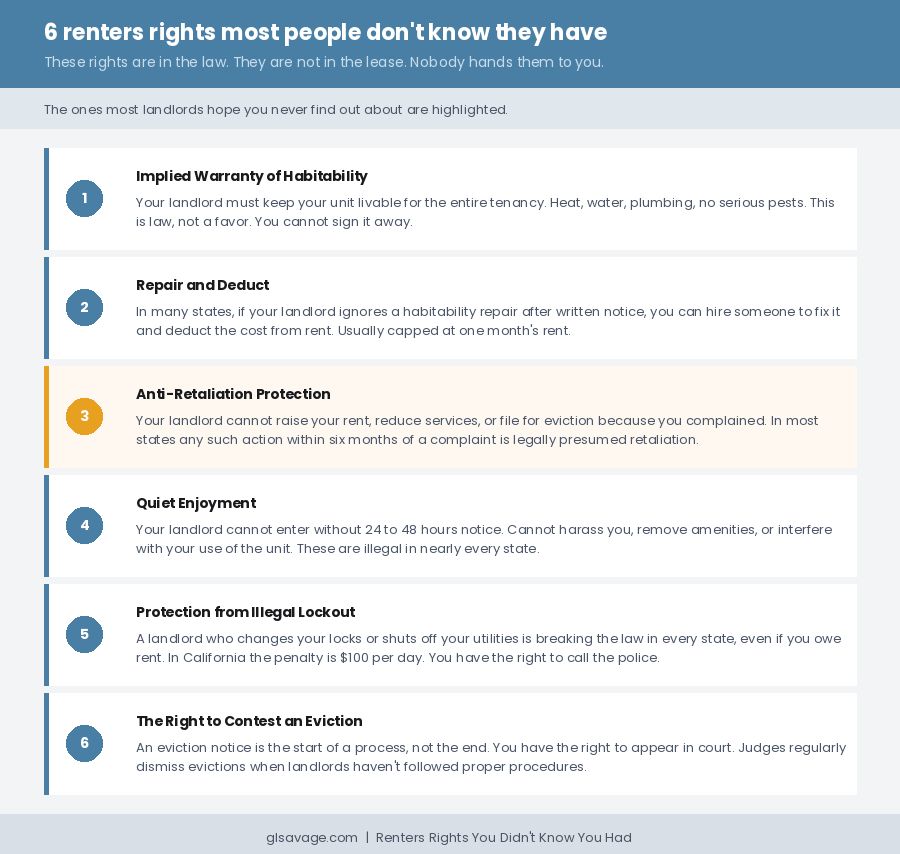
Every residential lease in virtually every state contains a legal promise that the landlord did not write and cannot remove. It is called the implied warranty of habitability, and it means your landlord is legally required to maintain your unit in a condition fit for human beings to live in, for the entire duration of your tenancy. Not just when you move in. The whole time.
The warranty covers the basics: working heat, running hot and cold water, functioning plumbing and electrical systems, a roof that does not leak, walls and floors that are structurally sound, and freedom from serious pest infestations. It also covers common areas of the building. If your landlord is not providing these things, they are in breach of a legal obligation that exists regardless of what your lease says. A lease clause that attempts to waive the warranty of habitability is unenforceable. You cannot sign away this right because it is not yours to sign away. It is a standard of law.
What most tenants do not know is that a breach of the warranty of habitability is not just grounds for a maintenance complaint. It is grounds for legal action. In most states, a tenant who has documented a habitability violation and given the landlord written notice and reasonable time to fix it can pursue remedies including rent withholding, rent reduction, repair and deduct, and in some cases lease termination with no penalty. The right to a livable home is not just a polite expectation. It is an enforceable legal standard with teeth. Document the condition, give written notice, and know that the law is on your side when your landlord refuses to act.
Repair and Deduct: The Right Most Renters Have Never Heard Of
In many states, if your landlord fails to make a repair that affects your health or safety after you have given written notice and a reasonable amount of time to fix it, you have the legal right to hire someone to make the repair yourself and deduct the cost from your next rent payment. This is called repair and deduct, and it is one of the renters rights you didn’t know you had that landlords most hope you never discover.
The right is not unlimited. It typically applies only to repairs that affect habitability, not cosmetic issues. Most states cap the amount you can deduct at one month’s rent, and many limit how often you can use it, commonly twice in a twelve-month period. You must give the landlord written notice of the problem and a reasonable time to fix it before you exercise the right. Thirty days is the standard benchmark for reasonable time in most states, though urgent issues like no heat or no water may qualify for a shorter window.
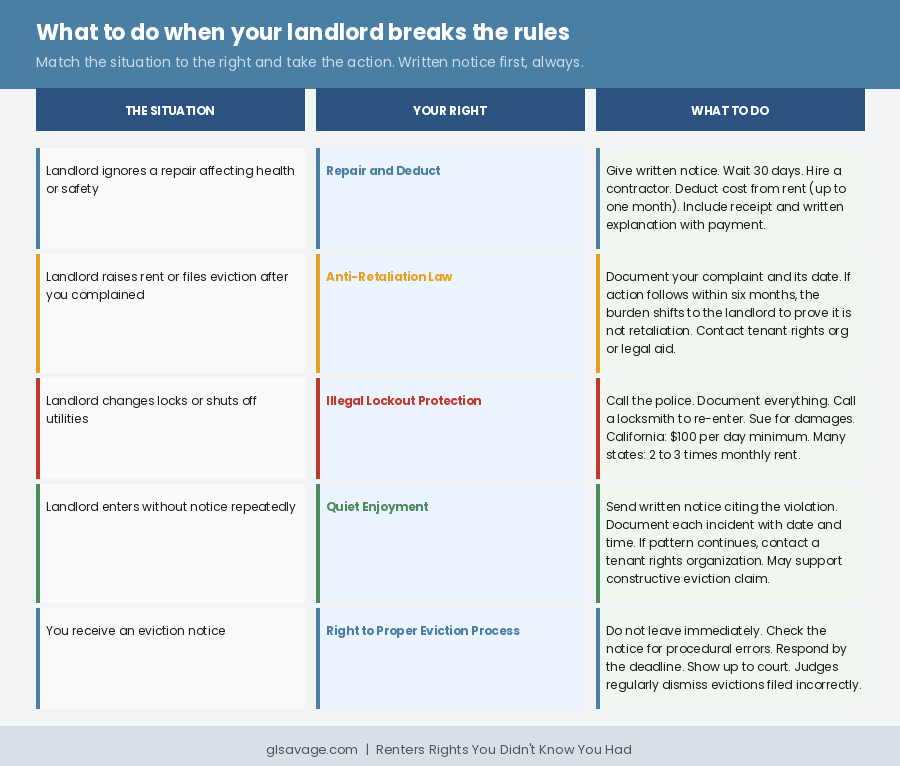
The process matters. Send your repair request in writing, keep a copy, and document the date. Get a quote from a licensed contractor. Make the repair. Deduct the cost from your rent check and include a copy of the receipt and a written explanation when you send payment. This creates the paper trail that protects you if the landlord responds by claiming you withheld rent without cause. See What Your Landlord Is Not Required to Tell You for context on the broader information gap between what landlords know and what renters know going into these situations.
Anti-Retaliation Protection: The Right That Stops Landlord Retaliation
This is one of the most important renters rights you didn’t know you had and one of the least used. If you complain to your landlord about a repair, contact a housing agency about a code violation, join a tenant organization, or otherwise exercise a legal right as a renter, your landlord cannot legally retaliate against you. Retaliation includes raising your rent, reducing services, threatening eviction, or actually filing for eviction. In most states, any of those actions taken within a specified period of a tenant complaint, often six months to a year, are legally presumed to be retaliatory unless the landlord can prove otherwise.
The practical effect of this law is significant. It means that calling code enforcement about a mold problem or a broken heating system is not the dangerous move many tenants assume it to be. The law specifically protects you from the most common fear: that complaining will get you evicted. If your landlord tries to evict you within six months of a good-faith complaint, in most states the burden shifts to them to prove the eviction is not retaliation. That is a meaningful legal protection that most renters never use because they do not know it exists.
The word to know here is good faith. The protection covers complaints you believed in good faith to be valid. It does not protect a tenant who makes a false complaint as a pretext to avoid paying rent. And it does not eliminate your obligation to pay rent. You can be evicted for nonpayment even while you have an active complaint pending, which is why continuing to pay rent while you pursue other remedies is almost always the right call.
Quiet Enjoyment
Every lease contains an implied covenant of quiet enjoyment, whether it says so explicitly or not. This is not just about noise. Quiet enjoyment means your right to use your home peacefully without interference from the landlord. It covers a specific set of landlord behaviors that many renters put up with not knowing they are illegal.
A landlord who enters your unit without proper notice is violating your right to quiet enjoyment. Most states require 24 to 48 hours of advance notice before a landlord can enter for repairs, inspections, or showings, except in genuine emergencies. A landlord who drops by whenever they want, shows up unannounced repeatedly, or enters without notice when no emergency exists is breaking the law in nearly every state.
A landlord who harasses you, makes threats, or interferes with your use of the unit is violating quiet enjoyment. This includes removing amenities that were part of your rental without cause, failing to address other tenants whose conduct makes your unit uninhabitable, and making the premises unreasonably difficult to access. In serious cases, a pattern of interference with quiet enjoyment can constitute constructive eviction, a legal doctrine that allows a tenant to leave the unit and be released from the lease without penalty because the landlord made the unit effectively unlivable. Read How to Get Your Security Deposit Back for the related context on how documentation of these kinds of landlord behaviors strengthens your position in any dispute.
Illegal Lockout and Utility Shutoff
This is one of the renters rights you didn’t know you had that landlords, particularly bad ones, count most heavily on you not knowing. In every state, a landlord cannot remove you from your home except through the formal court eviction process. There are no shortcuts. Changing your locks, removing your door, throwing your belongings into the street, or shutting off your water, heat, gas, or electricity to force you out are all illegal, and they are illegal even if you are behind on rent.
This type of illegal removal has a legal name: self-help eviction. It is prohibited in virtually every state, and the penalties for landlords who do it are significant. In California, for example, a landlord who illegally shuts off utilities or changes locks is liable for statutory damages of $100 per day for every day the violation continues, plus the tenant’s actual damages. Those actual damages include hotel costs, spoiled food, replacement of medications you could not access, lost wages, and any other costs caused by the illegal lockout. In many states, landlords who attempt self-help eviction also face penalties of two to three times the monthly rent.
If your landlord illegally locks you out or shuts off your utilities, you have the right to call the police immediately. In most states, law enforcement is authorized to require the landlord to restore access on the spot. You also have the right to call a locksmith and re-enter your own home. This is not breaking and entering because you have the legal right to possession of the unit. And you have the right to sue for damages. The landlord’s belief that you owe them money does not give them the right to take the law into their own hands, and courts treat self-help eviction seriously.
The Right to a Proper Eviction Process
Related to the above: the eviction process has specific legal steps your landlord must follow, and skipping any of them can invalidate the eviction entirely. Most tenants assume that an eviction notice means they must immediately leave. That is not how it works.
An eviction notice is the beginning of a legal process, not the end of it. After receiving a notice, you typically have a specified number of days to either fix the problem, meaning pay overdue rent or cure a lease violation, or respond. If the landlord then files in court, you have the right to appear, present your side, and contest the eviction. A landlord who does not follow the proper notice requirements, who files without legal grounds, or who tries to evict you in retaliation for exercising a legal right may find the eviction dismissed by the court.
The most important thing most tenants do not know: you have the right to show up to eviction court. Many tenants do not appear because they assume the process is already decided. Judges dismiss evictions regularly when landlords have not followed proper procedures. Showing up is the only way to find out whether the eviction you are facing was filed correctly.
The Right to Request an Itemized Move-Out Inspection
This is one of the renters rights you didn’t know you had that costs landlords the most money when tenants actually exercise it. In many states, you have the legal right to request a pre-move-out inspection before you vacate. At that inspection, the landlord must provide you with a written list of anything they intend to charge you for. You then have the opportunity to fix those items yourself before you leave, which prevents the landlord from charging their own rates for the same work after you are gone.
California requires landlords to notify tenants of this right after they give notice to vacate, and the inspection must happen within two weeks of the move-out date. Many other states have similar provisions. Most tenants never request this inspection because nobody tells them it exists. The result is that they pay inflated cleaning and repair charges they could have addressed themselves for far less. Ask for the pre-move-out inspection in writing and keep a copy of any list the landlord gives you at the walkthrough. Read What Your Landlord Is Not Required to Tell You for the full picture of what landlords are legally permitted to keep quiet throughout a tenancy.
Where to Use These Rights
Knowing your rights is the first step. Knowing how to use them is the second.
For repair issues, the process starts with written notice. A text message or phone call creates a record of sorts, but a dated letter sent by certified mail is what protects you legally if the matter escalates. State the problem, the date you first noticed it, how it affects your health or safety, and a reasonable deadline for repair. Keep a copy of everything.
For habitability violations, code enforcement is your ally. Your city or county has a housing inspector whose job is to document the exact violations a landlord may be disputing. A code enforcement report is objective third-party documentation that carries weight in court and in any dispute proceeding. Filing a code enforcement complaint is specifically one of the actions protected by anti-retaliation law.
For illegal lockouts, call the police first and call a tenant rights organization second. In many jurisdictions, police officers are specifically trained to recognize illegal lockouts and can compel landlord compliance on the spot. A tenant rights organization can help you understand the specific penalties available in your state and whether your situation warrants going further.
The HUD directory of tenant rights organizations is available at hud.gov. Legal aid organizations in most jurisdictions can advise you on state-specific rights and help you draft the written notices that trigger legal protections. You can find legal aid near you through lawhelp.org. These resources exist specifically so renters can use the rights the law already gave them.
The Honest Takeaway
The renters rights you didn’t know you had did not get into that category by accident. The system works better for landlords when tenants do not know the rules. Anti-retaliation law only protects tenants who make complaints. Repair and deduct only works for tenants who know it exists. Illegal lockout penalties only apply to landlords whose tenants knew to call the police and document the violation. The rights are in the law. They are not in the lease. Nobody hands them to you. You have to know to look for them.
Frequently Asked Questions
What is the implied warranty of habitability?
The implied warranty of habitability is a legal standard present in virtually every residential lease, written or oral, across the country. It requires landlords to maintain rental units in a condition fit for human habitation for the entire duration of the tenancy. This includes working heat, running water, functioning plumbing and electrical systems, a sound structure, and freedom from serious pest infestations. A landlord cannot make a tenant waive this right, and a lease clause that attempts to do so is unenforceable.
What is repair and deduct?
Repair and deduct is the legal right, available to tenants in most states, to hire someone to make a repair that affects habitability and deduct the cost from rent when the landlord has failed to make the repair after receiving written notice and a reasonable amount of time to act. It typically applies only to habitability issues, not cosmetic problems, and is usually capped at one month’s rent. The specific rules vary by state. Always give written notice first and keep copies of everything.
Can my landlord evict me for complaining about repairs?
No. Most states have anti-retaliation laws that specifically prohibit landlords from raising rent, reducing services, or filing for eviction in response to a tenant exercising a legal right such as reporting a repair need or filing a code enforcement complaint. In most states, any retaliatory action taken within six months to a year of a good-faith tenant complaint is legally presumed to be retaliation, and the burden shifts to the landlord to prove otherwise. Document your complaints and keep records of the dates.
What is quiet enjoyment and what does it protect me from?
Quiet enjoyment is a legal right implied in every lease that protects your ability to use your home peacefully without interference from the landlord. It means your landlord cannot enter without proper notice, cannot harass or threaten you, cannot remove amenities that were part of your rental without cause, and cannot interfere with your use of the unit. Most states require 24 to 48 hours of advance notice before a landlord can enter except in genuine emergencies. Repeated violations of quiet enjoyment can in some cases support a claim of constructive eviction.
Can my landlord change my locks or shut off my utilities if I owe rent?
No. This is illegal in every state regardless of whether you owe rent. It is called a self-help eviction and it is prohibited nationwide. A landlord who changes your locks or shuts off your water, heat, gas, or electricity to force you out is liable for significant damages in most states. In California the penalty is $100 per day plus actual damages. Many states award two to three times the monthly rent as a penalty. If this happens to you, call the police immediately and document everything. The only legal way to remove a tenant is through the formal court eviction process.
Do I have to leave when I receive an eviction notice?
No. An eviction notice begins a legal process. It does not end one. After receiving a notice, you typically have a specified number of days to either cure the problem or respond. If the landlord files in court, you have the right to appear and contest the eviction. Judges regularly dismiss evictions when landlords have not followed proper procedures, filed on improper grounds, or are evicting in retaliation for a tenant complaint. The most important thing you can do is show up to court.
What is the pre-move-out inspection right?
In many states, tenants have the legal right to request an inspection of their unit before they vacate, at which the landlord must provide a written list of anything they intend to charge for. This gives the tenant the opportunity to fix those items before leaving, rather than paying the landlord’s rates for the same work after move-out. California requires landlords to notify tenants of this right when they give notice to vacate. Ask for the inspection in writing, attend it, and keep a copy of any written list the landlord provides.
Where can I find out about my specific tenant rights by state?
The HUD website maintains a directory of tenant rights organizations by state at hud.gov. The LawHelp.org directory connects tenants to free legal resources by location. Your state’s attorney general website typically has a tenant rights guide for your specific jurisdiction. Tenant rights vary significantly by state and sometimes by city, so a state-specific resource is the most reliable starting point for knowing exactly what protections apply to your situation.