Every bill you pay, you have options. You can shop around. You can switch. Not with your utility. The state handed one company an exclusive territory and you are in it. No competition. No alternative. No leverage. That is the condition that produces the highest possible price with the least possible accountability, and it is the condition your utility operates inside every single day. The entire business model runs on one assumption: that you will pay the number on the bill and not ask what is behind it. There are utility bill assistance programs and energy assistance programs that can cut what you owe right now, this month, before anything else in your life changes. Most people who qualify have never heard of them. Not because they are hard to find. Because nobody in the system has any financial reason to tell you they exist. This article is that information.
Jump to a section:
- Why your bill is higher than it should be
- Programs that reduce what you owe
- Money the utility owes you
- If you are facing a shutoff
- How to actually get help
Why Your Utility Bill Keeps Going Up Even When You Use Less
Most people doing everything right are still watching their bill climb. Turning the thermostat down. Running fewer loads of laundry. Unplugging things. And the bill barely moves. Here is why, and it is not what most people think.
Almost every utility bill has two separate cost components. The first is a fixed monthly charge. You pay this no matter how much or how little energy you use. It covers the utility’s cost of maintaining the physical connection to your home. Cut your usage in half and this charge stays exactly the same.
The second component is the usage charge, billed per unit of electricity or gas. This is the part that conservation actually reduces.
Here is what the utility does not tell you. In many states, utility companies have been lobbying regulators for years to push more of the cost recovery into the fixed charge and less into the usage portion. When they succeed, they have effectively changed the rules so that doing the right thing stops rewarding you. You cut your usage by 30 percent and your bill drops by far less than 30 percent. The conservation worked. The bill did not move the way you expected. Most customers assume they did something wrong. They did not. The utility changed the math.
There is also a line item on most utility bills that barely gets noticed. It goes by different names depending on the company: Fuel Adjustment Clause, Purchased Power Adjustment, Energy Cost Recovery Factor. What it is, in plain terms, is a legal mechanism that lets the utility raise your bill every single month without asking anyone’s permission. Normally, raising rates requires a formal approval process from state regulators. This charge bypasses that entirely. When fuel prices go up, the charge goes up automatically. When your bill spikes and you did not change anything you did, this is often why. These charges are public record and can be challenged if they are calculated incorrectly. Almost nobody knows that. So the overcharges almost never get caught.
The fixed charge, the lobbying to shift costs away from usage, and the fuel adjustment clause are not separate problems. They are the same system running as designed, all moving in the same direction at once.
LIHEAP: The Biggest Utility Bill Assistance Program Most People Never Apply For
The Low Income Home Energy Assistance Program, called LIHEAP for short, has existed since 1981. It is the federal government’s primary program for help paying utility bills. It helps households cover heating and cooling costs, handles energy emergencies, and funds home upgrades that permanently lower what you use. It is one of the largest utility bill assistance programs in the country. Millions of households that qualify never apply.
The income limits are higher than most people assume. Eligibility is commonly set at 150 percent of the federal poverty level. For a family of four, that is roughly $46,800 a year. LIHEAP is not just for households in extreme poverty. Working families qualify and never find out.
Here is the part the program does not advertise. LIHEAP funding is not unlimited. Congress sets a fixed amount each year. States get their allocation. When it runs out, it is gone until the next funding cycle. The households that apply early in the heating or cooling season get served. The households that apply after the crisis has already hit often find the money exhausted. Apply before you need it. If your income could make you eligible, apply at the start of the relevant season, not after you have fallen behind.
One more thing they do not tell you: if your income fluctuates, some states will let you report income over a shorter recent period rather than a full year average. A household that had two or three slow months may qualify based on recent income even if the annual number looks higher. Local agencies know this option exists. Most applicants do not think to ask. When you call, ask specifically how they calculate income for eligibility and what the shortest reporting period they allow is.
Benefits are paid directly to the utility company. LIHEAP also has a crisis component for households already facing a shutoff notice, and those applications are processed faster.
To apply: visit Benefits.gov, call the National Energy Assistance Referral Hotline at 1-866-674-6327, or dial 211 from anywhere in the United States.
Utility Company Assistance Programs That Exist Because They Were Required To
Separate from federal programs, most utility companies run their own utility bill assistance programs. These are not charity. In many states, regulators require utilities to offer them. And in cases where they are voluntary, utilities have calculated that it costs less to reduce a bill than to chase down a debt through shutoffs and collections.
These programs are technically available to qualifying customers. They are practically invisible because no one is required to tell you they exist. They go by names like Percentage of Income Payment Plan, Low Income Discount Rate, Affordability Program, or Customer Assistance Program. What they offer varies but commonly includes discounted monthly bills based on household income, forgiveness of past-due balances over time, waived re-connection fees, and emergency hardship funds.
The only way to access most of them is to call and ask using the right language. Contact your utility and ask specifically whether they have income-based rate programs, low-income discount rates, arrearage forgiveness options, or payment assistance plans. Use those exact terms. Customer service representatives will frequently not volunteer this information unless you ask directly.
If you are approaching a shutoff date, calling before service is disconnected gives you significantly more options. Once service is cut off, re-connection fees pile on top of what you already owe, and some protections that applied before disconnection no longer apply after it.
Arrearage Forgiveness: How a Past-Due Utility Balance Can Actually Be Wiped Out
If you are behind on your utility bill, there is a program most people never hear about. It is called an arrearage management program. Arrearage is just the word for money you owe from past-due bills. The program works like this: you make consistent on-time payments going forward over a set period, usually 12 to 24 months, and a portion or all of your past-due balance is forgiven on a structured schedule.
These programs exist because utilities have done the math. Sending accounts to collections has a cost. Managing shutoffs and re-connections has a cost. A household making steady current payments is worth more to the utility than a delinquent account they may never recover. Forgiving the old balance costs the utility less than the alternative.
Your utility is not going to tell you this program exists. Ask directly. Ask whether they have an arrearage forgiveness program, a debt management plan, or any program that reduces past-due balances in exchange for consistent payments going forward. If the first person you reach says no, ask to speak specifically to someone in the billing assistance or customer hardship department.
The Weatherization Assistance Program: Free Home Upgrades That Permanently Lower Your Bill
Most utility bill assistance programs help you pay the bill you already have. The Weatherization Assistance Program, known as WAP, attacks the bill itself. It pays for home upgrades that permanently reduce how much energy your home uses, which means every single bill going forward is lower.
Income-qualified households can receive insulation, air sealing, heating and cooling system improvements, and other efficiency work. Contractors come to your home and do the work at no cost to you. The savings are permanent.
Eligibility is typically set around 200 percent of the federal poverty level, which is higher than many people expect. Renters can often qualify if the landlord gives permission, and the agency administering the program will often help facilitate that conversation.
Waitlists are common because demand exceeds available funding in most areas. That means applying early holds your place. Many local agencies administer both LIHEAP and the Weatherization Assistance Program at the same time. Applying for one may connect you to the other automatically. Dial 211 or contact your local community action agency to find the program administrator in your area.
Medical Baseline Rates: A Reduced Rate for Households With Medical Equipment
If someone in your household depends on medical equipment to stay alive or stay healthy, your utility may have a reduced rate specifically for that situation. Most of those households are paying full price right now because nobody told them to ask.
These are called medical baseline rates or medical allowance programs. They cover households with oxygen concentrators, home dialysis machines, refrigerated medications, ventilators, and temperature-sensitive conditions that require consistent heating or cooling to manage safely. They exist in a significant number of states and are buried in the technical rate documents utilities file with regulators, documents that no regular customer ever reads.
Contact your utility and ask whether a medical baseline rate or medical allowance program exists, what conditions and equipment qualify, and how to apply. The application typically requires a note from a doctor. The rate reduction can be meaningful and permanent. Qualifying conditions vary by utility and state so asking directly is the only way to know what applies to your situation.
Your Utility Deposit: The Money the Company Is Holding and Not Returning
If you paid a deposit when you set up utility service, that deposit is earning interest. In most states, utilities are legally required to pay interest on customer deposits. After a period of on-time payments, usually 12 months, the utility is required to return your deposit with the interest it has accumulated.
In most states this is supposed to happen automatically. In practice it frequently does not, because the utility has no financial motivation to remind you, and most customers never ask.
If you paid a deposit and have been making on-time payments for 12 months or more, call your utility and ask specifically about your deposit refund status. Ask whether interest has been accruing and when the refund will be issued. If you paid a deposit years ago and it was never returned, ask what happened to it. That is your money. The utility has been holding it. Deposits are disproportionately required from customers without established credit or banking history. If that pattern applies to your situation, the hidden costs of not having a bank account covers how it plays out across multiple bills at once.
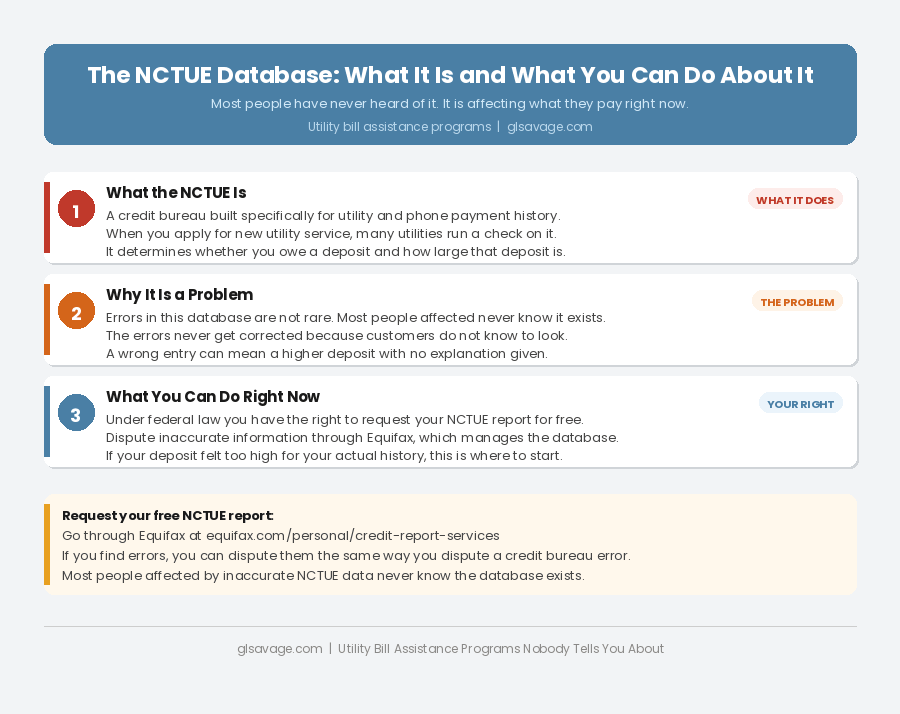
The NCTUE: The Hidden Database That Decides Whether You Owe a Deposit
Some people are paying a deposit on their utility account right now because of errors in a database they have never heard of. The utility never told them the database existed. The database never told them they were in it. They just got handed a deposit requirement and assumed that was how it worked.
It is called the National Consumer Telecom and Utilities Exchange, or NCTUE. Think of it as a credit bureau built specifically for utility and phone payment history. When you apply for new utility service, many utilities run a check on it. Late payments, delinquencies, and accounts that went to collections can appear in this database and affect both whether a deposit is required and how large it is. Errors in it are not rare. Most people affected never know the database exists, which means the errors never get corrected and the deposit never gets challenged.
Under federal law you have the right to request your NCTUE report and dispute anything that is inaccurate. Requests go through Equifax, which manages the database. If you have been required to pay a deposit that feels out of proportion to your actual payment history, this is where to start. If you want to understand the full picture of how databases like this shape what you pay across your financial life, this breakdown of why your credit score exists and who it actually serves covers the same pattern in a different context.
Free Home Energy Audits: A Program You Are Already Paying For
In many states, utilities are required to offer free home energy audits to residential customers. A contractor comes to your home, identifies exactly where it is losing energy, and tells you which improvements would save the most money. No cost to you.
Some audits include on-the-spot installation of basic efficiency items: LED bulbs, low-flow shower-heads, smart power strips, programmable thermostats. All free. The utility funds these programs because regulators require them to, and the cost is already built into the rates every customer pays every month.
Here is the part worth sitting with. The money to fund this program has already left your account. It is in your bill right now, every month, whether you use the program or not. The utility collects it either way. Whether you get the benefit of it comes down entirely to whether you make one phone call. Call your utility and ask specifically whether they offer a free home energy audit. This is separate from the Weatherization Assistance Program and does not require income qualification. Any residential customer can request it.
Community Solar: Lower Bills With No Panels, No Installation, No Ownership
Community solar is one of the easiest utility bill assistance programs to access. It requires no installation, no equipment, no ownership, and in many cases no money to sign up. Most qualifying households never use it because most qualifying households have never heard of it.
Here is how it works. You subscribe to a share of a solar farm somewhere else in your area. The electricity that share generates gets credited against your utility bill each month automatically. Savings typically run 5 to 15 percent depending on the program and the state. You do not change anything about how you use electricity. The savings show up on your bill within a billing cycle.
Low-income community solar programs with deeper discounts exist in several states specifically for qualifying households. Search for community solar programs in your state to find what is currently available. This is the program that requires the least from you and gets the least attention. Those two things are related.
Lifeline: The Phone and Internet Discount Tied to the Same Eligibility
The Lifeline program is a federally funded benefit that reduces monthly phone and internet costs for qualifying households by up to $9.25 per month, with higher discounts available on qualifying tribal lands.
Eligibility is based on income or participation in federal programs including LIHEAP, Medicaid, and SNAP. Here is the part that should make you angry: Lifeline and LIHEAP share the same eligibility thresholds and are almost never mentioned in the same conversation. The agencies that administer one rarely tell you the other exists. Millions of households that qualified for one never found the other. That is not an oversight. That is what happens when programs are designed to exist without being advertised. If you qualify for LIHEAP, check Lifeline immediately. Apply at lifelinesupport.org.
Stack the Utility Bill Assistance Programs: Most People Use One When They Could Use Several
The single most important thing to understand about these programs is this: asking one agency what else exists is itself a strategy. Each conversation surfaces programs the others did not mention. The agency handling LIHEAP may know about a state program your utility company does not mention. Your utility’s hardship department may know about a community solar program the weatherization office never brought up. None of them coordinate with each other. You are the only person in a position to collect information across all of them.
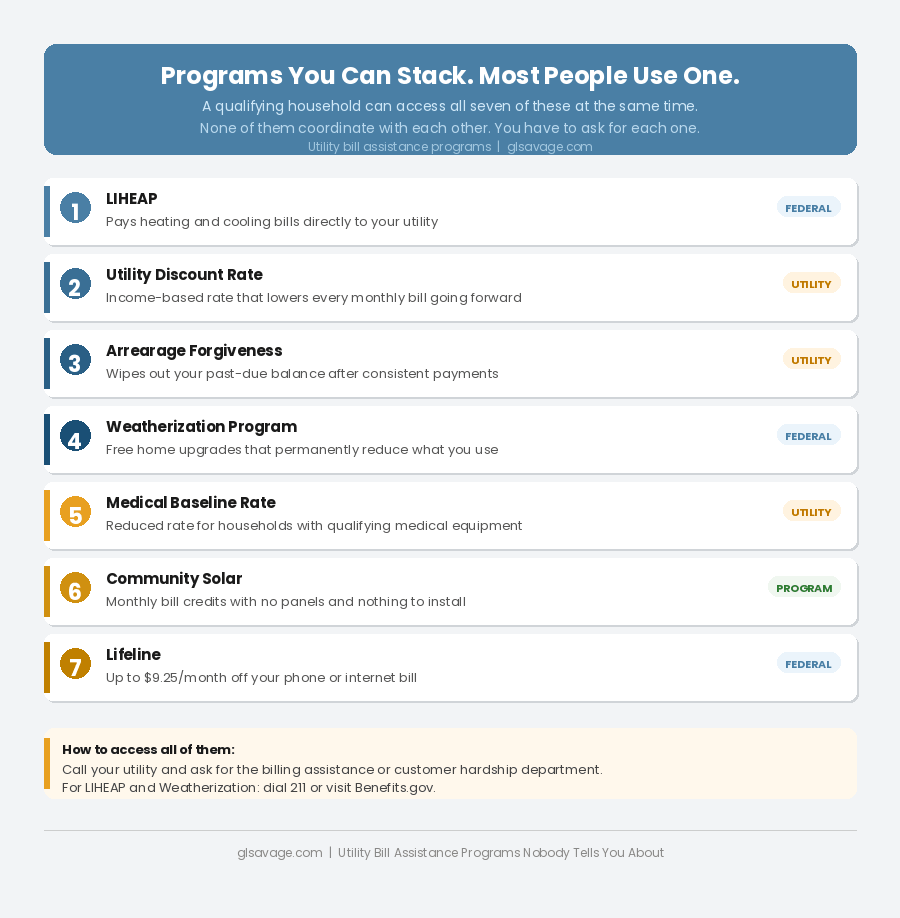
Federal utility bill assistance programs, state energy assistance programs, utility programs, and efficiency incentives can often be combined. A household that qualifies for the Weatherization Assistance Program may also qualify for all of these at the same time:
- LIHEAP to cover heating and cooling costs
- A utility low-income discount rate reducing every monthly bill going forward
- Arrearage forgiveness wiping out the past-due balance
- A medical baseline rate if anyone in the household qualifies
- Community solar credits applied automatically each month
- Lifeline reducing the phone or internet bill
- State energy rebates on qualifying improvements
Nobody coordinates this for you. If you are managing debt on top of high utility costs, understanding how minimum payments are designed to keep you paying is worth reading alongside this. When you contact the agency handling LIHEAP or the Weatherization Assistance Program in your area, ask what other programs they know about. Ask your utility what they offer for qualifying households. Ask your state energy office what exists at the state level. Keep asking until the answers stop being new.
Utility Disconnection Protections: The Other Half of Utility Bill Assistance Programs Nobody Mentions
In many states, utilities cannot legally disconnect service under certain conditions. These are not informal policies. They are regulations with the force of law. The utility’s compliance team knows every one of them. Most customers know none of them.
Common utility disconnection protections include restrictions during extreme heat or cold weather, designated winter moratorium periods where shutoffs are prohibited entirely, and protections for households that include a child under a certain age, an elderly resident, or a person with a documented medical condition. In some states, having a pending application for a utility bill assistance program is itself grounds to delay disconnection while the application is being reviewed.
These protections do not activate automatically. You have to invoke them. That means calling before service is disconnected, stating the specific protected condition that applies to your household, and requesting that disconnection be held. Calling after service is already off puts you in a different position with fewer options and additional re-connection fees on top of what you already owe.
Contact your state’s public utility commission, which is the government agency that oversees your utility company, to find out exactly what disconnection protections exist in your state and what you have to say to trigger them.
If You Get a Shutoff Notice, the Process Is Not Over
Most people who receive a shutoff notice assume they are out of options. That is not accurate. A shutoff notice is the beginning of a formal process, not the end of one.
In most states there is a formal dispute and appeal process with the public utility commission that can halt disconnection while the dispute is pending. You do not need an attorney to file. You need to know the process exists and submit the required information to the right agency. Most customers never file because they do not know this option is available. If a utility account has already gone to collections, how collection accounts affect your credit report covers the dispute process and what you can do about it.
When you call your utility about a past-due balance, ask specifically whether they are offering a formal deferred payment agreement or an informal payment arrangement. Those are not the same thing. A formal deferred payment agreement carries specific legal protections, including restrictions on disconnection while the agreement is in good standing. An informal arrangement does not. Most customers do not know to ask the difference, and most customer service representatives will not explain it unless you do.
Utility Scams That Target People Already in Crisis
People who have received shutoff notices are specifically targeted by scammers posing as utility company representatives. The pattern is documented and consistent: a caller claims to be from the utility, says your service will be disconnected within 30 to 60 minutes unless you make an immediate payment, and directs you to pay by prepaid debit card, gift card, wire transfer, or cryptocurrency.
Real utility companies do not demand immediate payment by prepaid card or gift card. They do not call and threaten same-day disconnection requiring instant untraceable payment.
People under financial stress are the primary target precisely because they are afraid and have less margin for error. Here is the part that should make you angry: the fear response the scammer is triggering is the exact same fear the real utility has been cultivating for months through shutoff notices, late fees, and threatening language on past-due bills. The utility primed you to panic. The scammer just pressed the button. A household living with a past-due balance in the back of their mind is conditioned to react when someone mentions disconnection in an hour. That conditioning is the mechanism the scam runs on.
If you receive a call like this, hang up. Call the number on your actual utility bill and verify your account status directly. A legitimate past-due balance will still be there when you call back. The scammer’s deadline will not be.
Energy Efficiency Tax Credits: Worth Knowing About
If you are in a position to make home improvements, the Energy Efficient Home Improvement Credit, expanded by the Inflation Reduction Act in 2022, covers 30 percent of qualifying upgrades including insulation, heat pumps, and efficient windows. The cap is $1,200 per year for most improvements and $2,000 for heat pumps, and it resets annually so upgrades spread across multiple years each qualify separately. Point-of-sale rebates for lower and moderate income households are also being rolled out through state energy offices. Check your state energy office for what is currently available in your area.
Renters and Utility Bills: The Layer Nobody Talks About
Some landlords are charging tenants more than their actual utility cost and keeping the difference. This is illegal in certain states. Most tenants have no idea it is happening and no idea they can check.
When a landlord pays one utility bill for the whole building and then passes costs to tenants through rent or a separate charge, the rules on what they are allowed to charge vary by state. In some states they can only pass through the exact per-unit cost. In others, markup is prohibited entirely. The landlord collecting an extra $30 or $40 a month from every unit in the building on top of what the utility actually charged them is not a hypothetical. It happens. Contact your state’s tenant rights organization or public utility commission to find out what the rules are in your state.
In subsidized housing, utility allowances are supposed to offset energy costs for tenants. Many of these allowances were calculated using consumption data from years or decades ago, against energy prices that no longer exist. The tenant gets an allowance built for a 1990s energy bill while paying current rates. Nobody adjusts it automatically. The gap is real money every single month and most tenants assume it is just how the math works.
Do not assume utility bill assistance programs do not apply to you because of how your utilities are billed. LIHEAP has specific provisions for renters with utilities included in rent, with benefits issued directly to the household rather than to a utility account. The Weatherization Assistance Program can apply to rental units with landlord permission. Ask before you assume you do not qualify. If you are a renter navigating high housing costs on top of everything else, the poverty premium covers how the system systematically charges more to the people with the least room for it.
If Your Bill Spikes: How to Dispute It
Before paying an unexpectedly high bill, ask whether it was based on an actual meter reading or an estimated one. Utilities estimate usage when they cannot access the meter, and those estimates are sometimes significantly wrong. If the bill was estimated, request an actual reading and ask for the bill to be recalculated. Ask for a plain-language explanation of any charge you do not recognize. You have the right to know what every line item means. If you suspect a meter problem, report it formally. Utilities are required to investigate, and if the meter is found to have been faulty most states require the utility to recalculate and credit the affected billing periods. If the issue is not resolved through the utility directly, file a formal complaint with your state’s public utility commission. A formal regulatory complaint carries significantly more weight than a customer service call and the commission has the authority to compel the utility to respond.
What to Actually Say When You Call
Most people read an article like this, feel informed, and then freeze when it comes to making the call. They do not know who to ask for, what words to use, or how to get past the first customer service representative who says there is nothing available. This is the script.
When you call your utility, do not ask if they have help available. That question is easy to say no to. Ask for specific things by name. These phrases open doors that vague questions do not.
Start here: “I would like to speak with someone in the billing assistance or customer hardship department.” That department exists at most utilities. The front-line representative may not know what is available. The hardship department does.
Once you are through, ask these questions one at a time:
- “Do you have an income-based rate program or a low-income discount rate I might qualify for?”
- “Do you have an arrearage forgiveness program or any program that reduces past-due balances for customers who make consistent payments?”
- “Do you have a formal deferred payment agreement, not just an informal arrangement?”
- “Are there any hardship funds or emergency assistance funds available right now?”
- “What is the status of my deposit refund and has interest been accruing?”
If the answer to any of these is no, ask: “Is there anyone else I should speak with about assistance options?” Keep going until you have spoken with someone who can actually confirm what is and is not available, not just the first person who picks up.
For LIHEAP and the Weatherization Assistance Program, do not call the utility. Dial 211 or visit Benefits.gov. Those programs are administered separately. The utility cannot apply for them on your behalf.
The System Is Counting on You Not Knowing Any of This
Utility bill assistance programs exist at the federal level, the state level, and inside your utility company right now. Free home energy audits. Arrearage forgiveness. Medical baseline rates. Deposit refunds the utility is sitting on. Disconnection protections that only work if you invoke them. Tax credits that reset every year. And a database most people have never heard of that is quietly raising what they pay every month and that they have the legal right to correct.
The households paying the most as a share of their income are the ones the system works hardest to keep in the dark. That is not a coincidence. The people with the least time and the least margin for error are the ones expected to find protections that were never advertised to them. The utility counted on that. Most of the time it was right.
Make a few phone calls this week. Ask the questions this article gave you. The programs are real, the money is there, and the only thing standing between you and a lower bill is knowing what to ask for. That is rent. That is groceries. That is one less thing keeping you up at night.
Frequently Asked Questions About Utility Bill Assistance Programs
Utility bill assistance programs are federal, state, and utility company programs that help households pay energy bills or permanently reduce energy costs. They include LIHEAP, the Weatherization Assistance Program, utility low-income discount rates, arrearage forgiveness programs, and medical baseline rates. Income thresholds vary but many extend to working households well above the poverty line. Most people who qualify have never heard of them because utilities have no financial incentive to advertise them.
LIHEAP is a federally funded program that helps households pay heating and cooling costs. Funding is limited and runs out by season, so applying early is critical. Find your local office at Benefits.gov, call the National Energy Assistance Referral Hotline at 1-866-674-6327, or dial 211. If your income fluctuates, ask whether they can calculate eligibility based on recent months rather than a full annual average.
LIHEAP eligibility is typically set at 150 percent of the federal poverty level, though some states set higher limits. For a family of four, that is roughly $46,800 a year. If your income fluctuates, some states allow eligibility to be calculated based on recent months rather than a full year. Contact your local LIHEAP agency to confirm the limit in your state.
Yes. Many utility bill assistance programs including LIHEAP have provisions for renters whose utilities are included in rent. Benefits may be issued directly to the household. The Weatherization Assistance Program can also apply to rental units with landlord permission. Do not assume a program does not apply because of how your utilities are billed. Ask first.
The Weatherization Assistance Program provides free home energy efficiency upgrades including insulation, air sealing, and heating and cooling improvements for income-qualified households. Unlike payment assistance, the improvements permanently lower energy consumption so every bill going forward costs less. Eligibility is typically around 200 percent of the federal poverty level. Wait-lists are common so applying early matters. Dial 211 or contact your local community action agency to find the program in your area.
Utility disconnection protections are state regulations that restrict when a utility can legally disconnect service. Common protections include restrictions during extreme weather, winter moratorium periods, and protections for households with children, elderly residents, or medically vulnerable occupants. A pending utility bill assistance program application can also delay disconnection in some states. These protections must be invoked by the customer before disconnection. Contact your state’s public utility commission to find out what applies in your state.
Arrearage forgiveness programs reduce or eliminate past-due utility balances in exchange for consistent on-time payments going forward over a set period, typically 12 to 24 months. Utilities offer these because recovering some payment costs them less than sending accounts to collections. Your utility will not tell you the program exists. Call and ask specifically whether they have an arrearage forgiveness program or a past-due balance reduction plan.
The National Consumer Telecom and Utilities Exchange is a database that tracks utility and phone payment history. Many utilities check it when new service is established to determine whether a deposit is required and how large it should be. Under federal law you have the right to request your NCTUE report and dispute inaccurate information through Equifax. If you have been required to pay an unexpectedly large deposit, this is the place to start.
In most states utilities are required to return your deposit with accrued interest after about 12 months of on-time payments. This is supposed to happen automatically but frequently does not. If you paid a deposit and have been paying on time, contact your utility and ask specifically about your deposit refund and when it will be returned with interest.
The Energy Efficient Home Improvement Credit covers 30 percent of qualifying upgrades including insulation, heat pumps, and efficient windows and doors. The cap is $1,200 per year for most improvements and $2,000 for heat pumps. It resets annually so upgrades spread across multiple years each qualify separately. Point-of-sale rebates for lower and moderate income households are also being rolled out through state energy offices. Check your state energy office for current availability.
What is community solar and how do I sign up?
Community solar programs let renters and homeowners who cannot install panels subscribe to a share of an off-site solar array and receive credits on their utility bill each month. No installation or equipment required. Savings typically run 5 to 15 percent. Low-income community solar programs with deeper discounts exist in several states. Search for community solar programs in your state to find what is available.
Lifeline is a federally funded benefit that reduces monthly phone or internet costs by up to $9.25 per month for qualifying households. Eligibility mirrors LIHEAP and other federal assistance programs. If you qualify for LIHEAP you very likely qualify for Lifeline. Most people who qualify find out about it too late or not at all because the two programs are almost never mentioned in the same conversation. Check Lifeline immediately if you have already applied for LIHEAP. Apply at lifelinesupport.org.
Do not ask vaguely if help is available. Ask to speak specifically with someone in the billing assistance or customer hardship department. Then ask by name: whether they have an income-based rate program, an arrearage forgiveness program, a formal deferred payment agreement, any hardship funds, and the status of any deposit refund. Vague questions get vague answers. Specific questions get real ones.
The front-line customer service representative may not know what is available or may not be authorized to offer it. If you are told nothing is available, ask to speak with someone specifically in the hardship or billing assistance department. Use the exact program names: income-based rate, arrearage forgiveness, formal deferred payment agreement. If the first person says no, ask who else you should speak with. Keep going until you reach someone who can actually confirm what exists.
Yes. You can ask whether the bill was based on an actual or estimated meter reading, request an explanation of any charges you do not recognize, and formally dispute errors with the utility. If the utility does not resolve it, file a formal complaint with your state’s public utility commission. A formal regulatory complaint carries significantly more weight than a standard customer service call.