
Blogging has paid real money for two decades and it still does in 2026. It has also gotten significantly harder in the past two years. The main reason is has gotten harder is because Google changed how it handles search traffic. A wave of AI-generated content flooded the platform and triggered penalty updates that hit legitimate blogs alongside the spam. The income model that worked in 2019 works differently now. None of that means blogging is dead. It means the full picture looks different from what it did five years ago, and knowing what actually changed is the only way to make a real decision about whether it is worth your time. This article covers how blogging income actually works in 2026, what the realistic timeline looks like, what has gotten harder, and what still holds up.
Is blogging in 2026 still worth it?
Yes, with a condition attached that changes everything. Blogging is worth it in 2026 if you understand that the model has fundamentally shifted. The version of blogging that worked in 2019, writing keyword-rich articles, getting organic Google traffic, and monetizing with display ads, is not dead but it is significantly harder and pays less than it used to. The version that works now looks different. Understanding why requires knowing what Google just did to the traffic that powers the whole thing.
There are currently around 600 million blogs worldwide. WordPress alone powers 43 percent of all websites on the internet. Blog readership has not collapsed. People still read long-form written content, particularly when they want depth, nuance, or a specific answer that a short video cannot give them. The audience is there. What changed is how much of that audience Google is sending to blogs versus answering the question itself and keeping the reader on Google’s page.
The thing that changed everything: Google AI Overviews
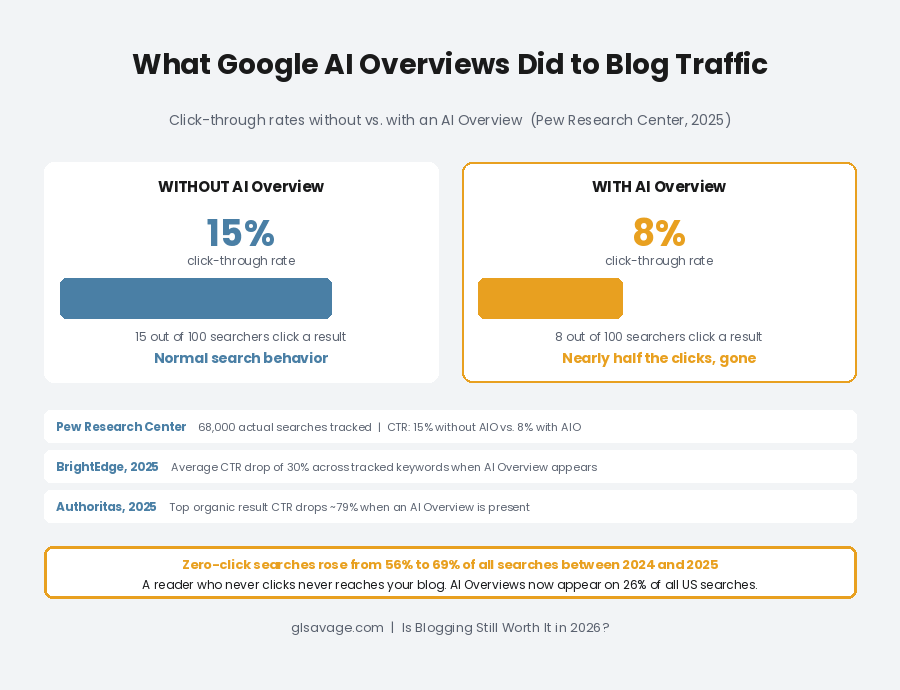
Google began rolling out AI Overviews in 2024 and expanded them significantly through 2025. By January 2026, AI Overviews appeared on roughly 26 percent of all US searches. The mechanism is straightforward. A reader types a question into Google. Instead of a list of links to articles, Google generates a summary answer at the top of the page using AI. The reader reads it. The reader does not click. They got what they needed without ever visiting a blog.
The impact on click-through rates is not subtle. Research from the Pew Research Center tracking 68,000 actual Google searches found that click-through rates dropped from 15 percent to 8 percent when an AI Overview was present. That is nearly half the clicks, gone. BrightEdge research put average CTR drops at 30 percent across tracked keywords. The Authoritas study found that when AI Overviews appear, the top organic result’s click-through rate drops by approximately 79 percent. Different methodologies, different numbers, but all pointing in the same direction.
For bloggers who built their income on display ad revenue from organic Google traffic, this is not a minor shift. It is the floor dropping out. A blog that earned $2,000 a month from 200,000 monthly pageviews does not earn $2,000 a month if Google now answers the questions that drove that traffic before visitors ever click through. The traffic does not disappear entirely. It thins. And for many bloggers, especially those in informational niches like recipes, how-to content, and general advice, it has thinned badly.
Google’s own leadership pushed back on this characterization. Google VP of Search Liz Reid published a statement in August 2025 claiming that total organic click volume to websites had remained stable year-over-year. Publishers immediately disputed this. A coalition of roughly 40 major publishers including the New York Times and Condé Nast released detailed data from their own analytics contradicting Google’s framing. The dispute is ongoing. What is not in dispute is that zero-click searches, where a user searches and leaves without clicking any result, rose from 56 percent to 69 percent of all searches between 2024 and 2025. A reader who never clicks never reaches your blog.
There is a second piece of this that the AI Overview data alone does not explain. Between 2022 and 2024, tens of thousands of people used AI tools to produce enormous volumes of thin blog content at scale. Publish a hundred articles a month for twelve months, hope some of them rank, monetize the traffic. Google’s helpful content updates in 2023 and 2024 were aimed directly at this, and they hit hard. Many legitimate blogs with genuinely useful content got swept up in the same penalty wave because they were in the same topic neighborhoods as the AI spam. Google has acknowledged that algorithmically impacted sites may not see recovery until the next core update cycle, and core updates happen roughly every few months. Some sites have gone through multiple cycles without recovering. Google has not been particularly clear about why some sites come back and others do not. The result is that 2026’s blogging landscape is simultaneously harder to enter for new bloggers and more unstable for existing ones than any point in the past decade. That context belongs in the picture.
How do bloggers actually make money in 2026?
Display advertising is the most visible income source for bloggers, but understanding how it actually works prevents the wrong expectations from forming.
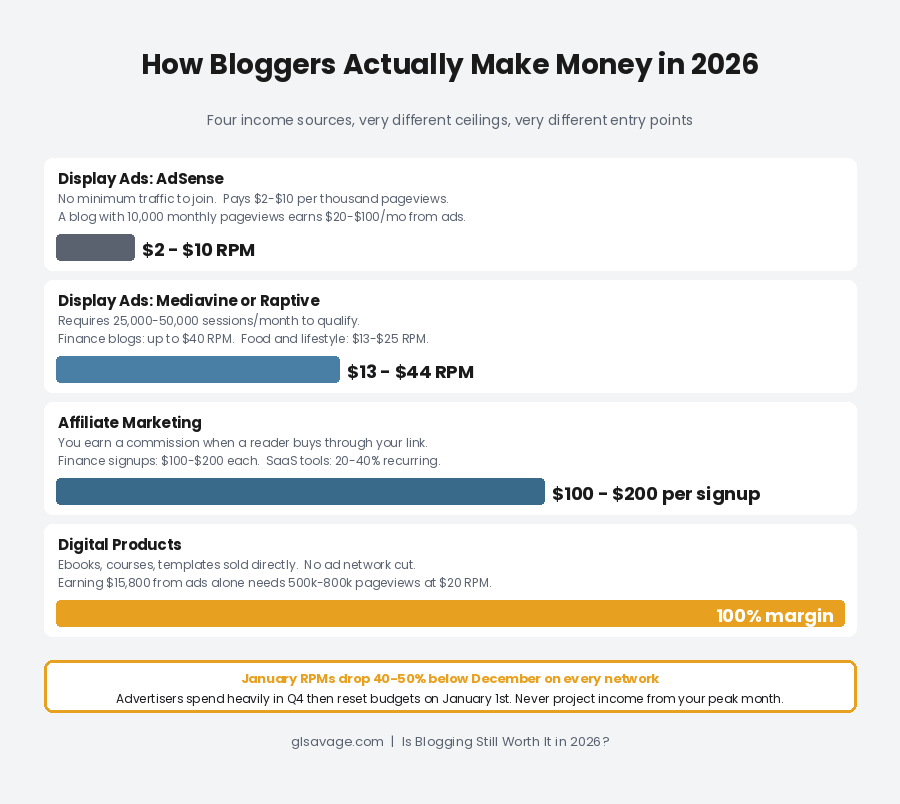
Google AdSense is the entry-level ad network. It requires no minimum traffic. It pays poorly. RPM on AdSense, which stands for revenue per mille or earnings per thousand pageviews, typically runs $2 to $10 depending on niche and audience location. A blog with 10,000 monthly pageviews on AdSense earns roughly $20 to $100 a month from ads. That number alone is why most early bloggers conclude blogging does not pay.
The premium ad networks, Mediavine and Raptive, pay significantly more. Mediavine lowered its entry requirement to 50,000 monthly sessions in 2025. Raptive cut its requirement from 100,000 monthly pageviews to 25,000 in October 2025. That is a 75 percent reduction in the traffic floor they require before accepting a publisher. When one of the two largest premium ad networks in the world drops its entry bar by three quarters, it is not doing bloggers a favor. It is responding to the fact that traffic has collapsed badly enough that they cannot fill their publisher network at the old requirement. That is the signal underneath the announcement. Real-world RPMs from bloggers using these networks run $13 to $44 per thousand pageviews depending on niche, season, and audience geography. Finance blogs on Raptive can see $25 to $40 RPM. Food and lifestyle blogs average $13 to $25. January is the worst month every year by a wide margin. Advertisers blow Q4 budgets and reset in January, which means the highest-traffic month many bloggers have, December, is followed immediately by the lowest-earning RPMs of the year.
The math matters. A blog earning a $20 RPM with 50,000 monthly pageviews earns $1,000 a month from display ads. That same blog with 100,000 pageviews earns $2,000. Getting to 100,000 monthly pageviews is where most blogs stall, or never arrive. According to survey data from Productive Blogging, it takes the average blogger 22 months to start earning any meaningful income from a blog, and an average of four years and one month to reach full-time income levels. Thirty percent of bloggers start earning something within six months. Most of the rest wait longer than they expected before seeing real money.
Affiliate marketing: where most of the real blogging money actually comes from
The bloggers earning serious income in 2026 are not primarily earning it from display ads. They are earning it from affiliate marketing, their own products, and sponsorships. Display ads are a baseline. They are not the ceiling.
Affiliate marketing means including tracked links in your content for products or services you recommend. When a reader clicks and buys, you earn a commission. The commission rate varies enormously by category. Amazon Associates, the most accessible program, pays 1 to 10 percent depending on product category. A finance blog recommending a credit card through a bank’s affiliate program can earn $100 to $200 per approved application. A software blog recommending a tool through a SaaS affiliate program can earn 20 to 40 percent recurring commission monthly for as long as that customer remains a subscriber. One successful affiliate article in the right niche can generate more income than months of display ad revenue from the same traffic.
The key mechanic of affiliate income that guides bury is this: affiliate income does not require massive traffic. It requires the right traffic. A blog with 8,000 monthly visitors who are specifically researching which project management software to buy is more valuable for affiliate income than a blog with 80,000 monthly visitors who came for a recipe and have no purchase intent. Intent matters more than volume in affiliate marketing. This is also why the AI Overviews problem hits informational content harder than commercial content. A reader deep in a purchasing decision is still clicking through to read the full comparison. A reader who just wanted to know how to fix a leaking pipe is not.
Digital products and courses: the part that does not depend on Google at all
The blogging income model that is most resilient to what Google is doing right now is one that does not depend on Google sending traffic to each individual post. Digital products, ebooks, templates, courses, spreadsheets, printables, built and sold through a blog’s email list or directly from the site, generate income whether the post that originally brought in that reader is getting organic traffic this month or not.
A blogger who built a list of 5,000 email subscribers over three years of consistent writing has something that Google cannot take away. The email list belongs to the blogger. Google’s algorithm changes do not affect whether those 5,000 people open an email on Tuesday. The bloggers who are most insulated from the AI Overview traffic problem are the ones who spent years treating their blog as a vehicle for building a direct relationship with readers, not just a vessel for organic traffic to monetize with ads.
The margin on digital products is the reason this matters financially. A blogger who sells a $79 ebook to 200 readers in a month earns $15,800 from that product. No ad network takes a cut. No affiliate program takes a split. The hosting costs a few dollars. The entire $15,800, minus payment processing fees, is the blogger’s. That same $15,800 from display ads alone would require 500,000 to 800,000 monthly pageviews at a $20 RPM. The math looks dramatic and it is, but the caveat matters: getting 200 sales from a single email list requires a genuinely engaged audience and a strong, well-matched offer. It does not happen automatically. The mechanism is real. Building an audience engaged enough to buy from you at that volume takes years, not months. But when it works, it works without Google in the room.
What blogging actually costs before it pays you
Starting a blog has a real but manageable upfront cost. Domain registration runs $10 to $15 per year. Web hosting for a new blog costs $3 to $15 a month on shared hosting. A basic WordPress theme costs nothing for free themes or $50 to $100 for a premium theme. A keyword research tool, which is genuinely useful but not mandatory on day one, costs $30 to $100 a month depending on the platform. Total startup cost for a reasonably equipped new blog is under $200 for the first year if you keep it lean.
Time is the real cost. Writing a single well-researched, properly optimized blog post takes four to eight hours depending on the topic, your research process, and your editing speed. Posting once per week is 200 to 400 hours per year. Most SEO experts recommend 50 to 100 published posts before a new blog has enough topical depth to gain significant Google traction, and that was before AI Overviews changed the landscape. At two posts per week, that is six months of consistent work before the site even has the content foundation to compete. The Google sandbox period, the time Google takes to fully trust and rank a new domain, typically adds three to six more months before organic traffic arrives in meaningful quantities even when the content is strong.
The people who build successful blogs treat year one as infrastructure, not income. They are building topical authority, meaning enough published depth on a subject that Google recognizes the site as a credible source on that topic, growing an email list from the first post, and learning which content their specific audience actually responds to. The income follows the audience. The audience follows consistent, useful writing over time. There is no shortcut in that sequence. Good content in month one does not skip the line.
What niches still work and which ones are getting eaten by AI
Not all niches are equally vulnerable to the AI Overviews problem. Understanding which content Google is likely to summarize versus which content requires the full article changes where a new blogger in 2026 should focus.
The content that AI Overviews eat first is the content with a short answer. Simple how-to instructions. Basic definitions. General advice. Recipe summaries. If the searcher’s question can be answered in two paragraphs, Google will answer it in two paragraphs and the click never happens. Any blog that built its traffic on questions with short answers is now competing with Google itself for the reader’s attention, and Google wins that fight every time.
The content that holds up is the content with a long answer that requires being there. Original research. Personal experience from actually using a product for six months. Comparison articles that require knowing the specific workflow where each tool breaks down, not just reading the feature list on the vendor’s website. Local and regional content that AI cannot fabricate without being wrong. Content that requires a person with real credentials and real experience to sign off on. A blogger who actually tested five project management tools and can describe the exact scenario where the third one loses your work quietly has something Google cannot synthesize from existing sources. A blogger who rewrote five other articles about the same tools does not.
Finance, legal, and medical content sit in a category Google treats differently from everything else. The logic is straightforward: if Google gets the answer wrong about how to fix a leaky pipe, someone has a wet floor. If Google gets the answer wrong about whether a debt collector can garnish wages or how a specific medication interacts with another, someone gets hurt financially or physically. Google holds these topics to a higher standard of proven expertise, and that scrutiny makes it harder for a generic AI summary to fully satisfy the search. These niches also carry the highest ad RPMs on the platform. The tradeoff is real. A new blogger without genuine background in finance or medicine will struggle to rank in these spaces, and should struggle. But a blogger with actual experience and specific knowledge that no one else has written has an opening that AI cannot synthesize from existing sources.
The honest comparison to other side hustles
Blogging has one of the longest ramp periods of any income-generating side hustle, but it also creates assets that can pay indefinitely. A blog post that ranks on page one of Google for a high-value keyword in 2023 can still be earning affiliate commissions and ad revenue in 2026 without the blogger touching it. That compounding, passive quality is something very few other side hustles offer. A second job generates income only when you show up. A well-built blog generates income while you sleep, or while you are not working on it at all.
Blogging rarely pays on its own. The blogs making real money use the audience the blog builds to sell other things. Affiliate income, covered in depth in Affiliate Marketing Is One of the Most Legitimate Ways to Earn Online. It Is Also One of the Most Lied About., is usually the first income source that moves the needle. Digital products are the layer on top of that, and Selling Digital Products Sounds Like Free Money. Here Is What Actually Happens. covers where that path gets harder than it looks. If you want to understand who actually captures the money in the blogging education space, specifically who is getting rich teaching people to blog, The Side Hustle Scam Machine: Who Is Actually Making Money and How answers that directly.
Blogging in 2026 is not the passive income machine it was marketed as in 2018. It is also not dead. It is a serious, slow-build business that rewards people who write about things they genuinely know, build a direct relationship with their readers through an email list from day one, and treat the first two years as investment rather than income. The bloggers who built that foundation before Google changed the rules are largely fine. The ones who built thin, AI-replaceable content and hoped organic traffic would keep flowing indefinitely are the ones struggling. The difference between those two outcomes is not luck. It is what kind of blog you decided to build.
Frequently Asked Questions
Yes, with realistic expectations. Blogging can generate real income in 2026 through display ads, affiliate marketing, digital products, and sponsorships. The timeline is long, typically 22 months on average before earning meaningful income and four or more years to reach full-time income levels. The AI Overviews shift has made informational content harder to rank and monetize than it was three years ago. Bloggers who build genuine expertise, an email list, and diversified income sources are in a stronger position than those relying solely on Google organic traffic and display ads.
The range is enormous. The average blogger earns $100 to $300 per month. About 21 percent of bloggers earn between $100 and $1,000 per month. Bloggers with five to ten years of experience average around $2,621 per month. Those past ten years average $5,625 monthly. A small number of established blogs earn six figures annually or more. Those numbers mostly come from diversified income stacks, affiliate marketing, products, and sponsorships, not display ads alone. Display ad income requires substantial traffic to become meaningful, and traffic is harder to build now than it was before AI Overviews.
Survey data puts the average at 22 months before a blogger earns anything meaningful. Thirty percent of bloggers who approach it strategically start earning within six months. Getting to full-time income levels takes an average of four years and one month. These numbers improve significantly when the blogger diversifies income sources from the start rather than waiting for traffic to reach display ad thresholds. Affiliate income and email list products can generate revenue with far less traffic than display ads require.
Google AI Overviews are AI-generated summaries that appear at the top of search results and answer the user’s question directly, reducing the need to click through to a blog. Research shows click-through rates drop from roughly 15 percent to 8 percent when AI Overviews appear, nearly cutting clicks in half. By January 2026, AI Overviews appeared on around 26 percent of US searches. Bloggers who built traffic on simple informational content are the most affected. Bloggers producing original research, personal experience, and expert-level analysis that AI cannot replicate are less affected.
Niches with high ad RPMs and purchase intent still work well: personal finance, software reviews, legal information, and health with genuine expertise. Niches built on content with short answers, how-to instructions, general advice, simple recipes, face greater headwinds because Google will just answer the question itself. The best niche is one where you have genuine knowledge or experience that AI cannot replicate from existing sources, combined with an audience that has purchase intent or strong interest in digital products. Niche selection matters far more than it did five years ago.
Mediavine and Raptive are the two premium display ad networks for bloggers. Mediavine requires 50,000 monthly sessions. Raptive lowered its requirement to 25,000 monthly pageviews in late 2025. Both networks pay $13 to $44 RPM depending on niche, season, and audience geography, compared to $2 to $10 on Google AdSense. Finance blogs on Raptive report $25 to $40 RPM. Food and lifestyle blogs average $13 to $25. All networks pay significantly less in January than in November and December when advertiser budgets peak.
Yes, and this is increasingly how serious bloggers are approaching the business. Email lists, social media audiences, Pinterest traffic, direct search, and community-driven platforms all send traffic independent of Google’s algorithm. A blogger who built an email list of 10,000 engaged subscribers can launch a product, run a promotion, or share an affiliate recommendation without Google being involved at all. The bloggers most insulated from the AI Overviews problem are the ones who treated their blog as a direct relationship with their audience rather than a funnel for Google traffic to ad revenue.