
Donating plasma for money is one of the few ways to show up somewhere on Monday and walk out with cash the same day. For some people, that trade is genuinely worth it. For others, it turns into a recurring drain they did not plan for. The difference between those two outcomes comes down to what nobody tells you walking in the door. This article covers both sides, the real numbers, and who donating plasma actually works for.
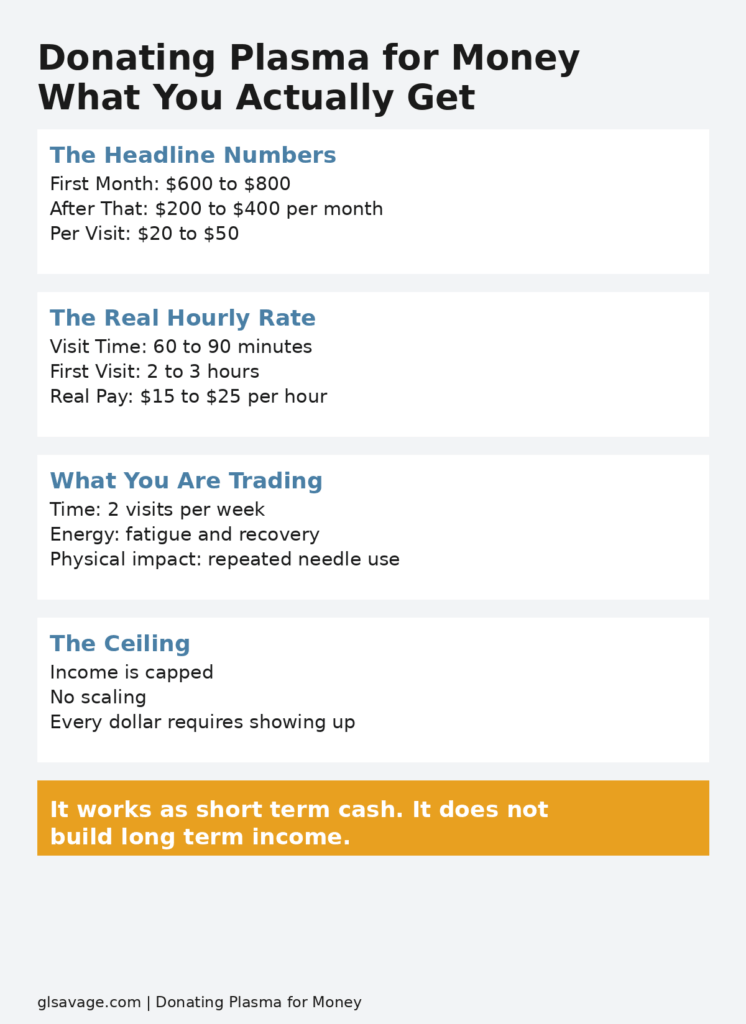
Donating plasma for money pays $30 to $100 per visit at most US centers, with first-month bonuses that can push new donor totals to $700 or $800. After the first month, regular donors typically earn $200 to $400 monthly. The per-visit rate drops once bonuses end, and the income is taxable whether you receive a 1099 form or not.
How much do you actually make donating plasma for money?
The ads promise $800 or more in your first month. Some centers advertise higher. Those numbers are real. They are also designed to hook new donors during the only stretch where the pay is that high.
The structure works like this. First-time donors get inflated per-visit rates plus completion bonuses for hitting a set number of donations in the first 30 to 35 days. Once those bonuses run out, usually by the end of month one, the per-visit rate drops to whatever the center pays its regulars. That is often $20 to $50 per visit, not the $80 to $100 you were making in week one.
After month one, the math looks more like $200 to $400 per month for someone donating twice a week. That is not a small number. It can cover groceries, a car payment, or both. But it is not the $800 you were promised, and the centers know it.
The time cost is the other thing they leave out of the ads. A first visit takes two to three hours because of the screening. Every visit after that runs 60 to 90 minutes. Add driving, parking, and recovery time, and most regular donors are earning the equivalent of $15 to $25 an hour.
Worth knowing: that rate is still higher than most entry-level jobs for someone without credentials. University of Colorado researcher Emily Gallagher, who studies the industry, has pointed out that for someone making $15,000 a year, plasma is one of the highest hourly wages available without any experience requirement. That is a real benefit, not a marketing line.
The takeaway is not that the ads are lies. It is that the post-bonus number is the one to plan around. If $200 to $400 a month still solves a problem, the math works. If you were building a budget around the first-month bonus as a permanent income stream, rebuild the budget first.
How the plasma industry actually works
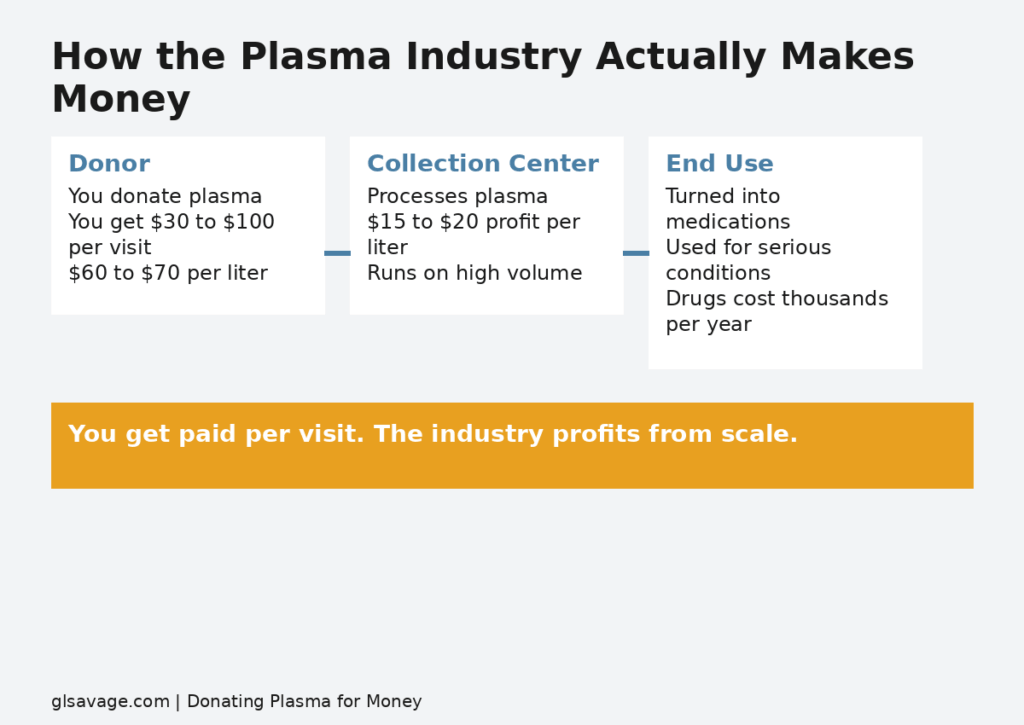
The center that pays you $50 for a visit sells that plasma for hundreds of dollars once it is processed into medicine. Plasma is the raw material for more than 200 treatments, including medications for hemophilia, immune deficiencies, burn recovery, and several rare diseases. Those treatments are priced like other specialty drugs, which means they can cost patients tens of thousands of dollars a year.
The profit math is the part most articles skip. According to data tracked by Georgetown University professor Peter Jaworski, the collection company makes roughly $15 to $20 in pre-tax profit per liter of plasma. The donor makes $60 to $70 per liter. Per individual transaction, the donor actually earns more than the company. The volume is what changes the math. A processor running dozens of centers stacks up those per-liter profits across millions of donations a year. Individual donors do not stack.
The US supplies roughly 70% of the world’s plasma because it is one of only a handful of countries that allows paying donors at all. Most of Europe, Australia, and Canada ban compensation. Those countries then import their plasma from American donors. That is a big part of why the industry is concentrated here and why the FDA allows a higher donation frequency than anywhere else.
There is a reasonable case for this system. Countries that ban paid donation, including France and Canada, consistently fail to collect enough plasma to meet patient demand. Jaworski’s research found that opening a paid plasma center near a blood donation center actually increases local blood donations slightly, not decreases them. Paid plasma keeps patients alive who would not otherwise get treatment.
There is also a reasonable case that donors are underpaid relative to the value they produce. Both can be true at the same time. The honest version is that donors are providing a product that generates billions in downstream revenue, and whether $50 a visit is a fair cut is a question you can answer for yourself once you know the actual numbers.
Where plasma centers are placed and why
Plasma centers do not open in rich suburbs. They open near payday lenders, pawn shops, check-cashing services, and bus lines. That is not a coincidence. It is site selection strategy.
Research from the University of Colorado Boulder and Washington University in St. Louis found that the presence of payday lenders and pawn shops in an area is a strong predictor of where new plasma centers will open, even after controlling for poverty and unemployment rates. Centers target markets where people already need short-term cash.
The piece that cuts both ways: the same research found that plasma centers actually reduce local demand for payday loans. The researchers estimated that US households avoid roughly $180 million to $227 million in payday and installment borrowing costs every year because plasma gives them a non-debt alternative. A typical two-week payday loan carries a 400% APR. Plasma, at $50 a visit, often beats that by a wide margin for people in a short-term cash crunch.
So the targeting is real, and it is also real that plasma is frequently a better option than the financial products sitting on the same block. Both facts hold. What it means for your situation depends on what you are comparing it to. If the alternative is a payday loan or an overdraft fee, plasma usually wins. If the alternative is building a more durable income stream, plasma is the short-term bridge, not the destination.
What donating plasma actually does to your body
Most people who donate plasma experience nothing beyond a bruise, some fatigue, or a brief dizzy spell afterward. The process is regulated, the equipment is single-use, and serious complications are rare. Peer-reviewed research covering more than 12 million US plasma donations found that serious side effects happen in less than 1% of sessions.
The long-term picture for frequent donors is less studied than the industry implies, and there are a few things worth knowing before you become a twice-a-week regular.
Plasma contains protein your body has to replace between donations. Frequent donors can see drops in their immunoglobulin levels over time. Immunoglobulins are the antibodies that fight off infection. Lower levels can mean more frequent or more severe colds and sinus infections for some long-term donors. This is documented in medical literature. It is not something most intake desks walk through.
The FDA donation frequency limit is based on a rule from 1992 that uses body weight as the only factor. It does not account for your height, your actual blood volume, your baseline health, or how long you have already been donating. Lower-weight donors give up a bigger percentage of their total plasma per session than heavier donors. Women experience higher rates of side effects than men at the same weight. One industry study found women made up 63% of adverse reactions despite being only 38% of donations.
Frequent needle sticks in the same vein build scar tissue over time. Long-term donors often have visible marks on the inside of both arms. Vein damage is real, and severe cases can make future blood draws or IVs difficult.
None of this means you should not donate. It means that if you are planning to be a twice-a-week donor for a year or more, the sustainable version looks like this: hydrate aggressively the day before and the day of, eat protein before and after, alternate arms between sessions, and pay attention to how you feel in the days after, not just during the visit. If you start feeling constantly tired, getting sick more often, or bruising easily, back off or take a break. That is the body telling you something.
Do you have to pay taxes on plasma donation?
Yes. The IRS treats plasma donation compensation as taxable income, regardless of how the payment arrives.
The reporting works like this. If you earn $600 or more from a single plasma center in a calendar year, the center is required to send you a Form 1099-MISC or 1099-NEC. You report that income on Schedule 1 of your Form 1040, under Other Income. Even if you earn less than $600 from one center, or if the center does not send you a form, the income is still legally taxable, and you are still required to report it.
Another thing to know: many centers do not issue 1099s even to frequent donors, because they treat the payments as compensation rather than contractor earnings. That does not mean the IRS does not know. Centers report to the IRS regardless of whether they send you the form. Unreported plasma income can trigger penalties and interest if you get audited later.
For regular donors, this matters. Two visits a week at $40 each adds up to over $4,000 a year. That is a tax bill of several hundred dollars in a typical bracket. If the plasma money is covering bills and you did not plan for the tax piece, the April bill eats back a chunk of what the income helped you cover.
The practical fix is to set aside 15% of every payment the day it hits. Separate account or separate envelope, does not matter which. At tax time, you already have what you owe plus usually a small surplus, and the whole thing stops being a surprise. For official guidance, the IRS page on reporting other income covers how Schedule 1 works.
What disqualifies you from donating plasma?
Centers turn away a meaningful percentage of people who walk in ready to donate. Knowing the disqualifiers in advance saves a wasted trip.
The core requirements are consistent across US centers. You have to be at least 18, weigh at least 110 pounds, and pass a physical exam and a health questionnaire. You need a valid photo ID, proof of address, and a Social Security number.
Beyond the basics, these are the most common reasons people get turned away, either temporarily or permanently. A recent tattoo or piercing (most centers require a four-month deferral depending on the state and whether the shop was licensed). A positive test for HIV, hepatitis B, or hepatitis C. Certain medications, including some antibiotics, isotretinoin (the acne drug sold as Accutane), and some blood thinners. Recent travel to countries where malaria or certain other diseases are common. Pregnancy or recent childbirth. Low iron or protein levels on the finger-prick screening the day you show up.
The iron and protein check is the one that catches people off guard. If your levels are borderline, you can be turned away at the door even if nothing else about you disqualifies. This happens more often to people who are already under-eating or under-sleeping, which unfortunately overlaps with the population most motivated to donate.
If you are turned away once, you can usually try again after a waiting period. If you are permanently disqualified, that flag follows you across most major chains because they share deferral data through a national system. Walking from CSL to BioLife hoping for a different answer rarely works.
Who donating plasma for money actually works for
Plasma donation is genuinely one of the better short-term income options in a specific set of situations.
It works when the cash is filling a specific gap you cannot fill faster another way. Covering rent during a tough month. Groceries until the next paycheck. Paying down a specific debt. Building a starter emergency fund. The donors who report the best experience are usually the ones using the money for a defined purpose with an end date.
It works when you are in solid health and not already depleted. If you are eating enough, sleeping enough, and not fighting off a chronic illness, your body will typically handle the twice-weekly schedule fine for most of a year.
It works as a bridge while you build something more durable. The donors who get the most out of plasma are the ones who treat it as a tool for a specific problem, not an open-ended boost to general spending. $400 a month aimed at paying off a credit card, saving for tuition, or building emergency savings is a different financial outcome than $400 a month that disappears into normal expenses.
It works for people who genuinely want to help patients and are fine being paid for their time. Plasma is the raw material for medicines that keep people with hemophilia, immune deficiencies, and rare diseases alive. For some donors the money is the main motivator, and for others it is a bonus on top of helping. Both are legitimate reasons to show up.
Who donating plasma for money does not work for
It does not work for people already running on empty. If you are under-sleeping, under-eating, or dealing with a chronic health issue that lowers your immunity, the twice-weekly schedule adds stress your body cannot afford. You can end up losing more in productivity, sick days, and general function than you gain in plasma pay.
It does not work as a long-term career strategy. $200 to $400 a month is real money, but it is capped. It does not scale. Every dollar requires showing up in person and sitting in a chair for an hour. If the goal is climbing out of financial stress permanently, plasma can be part of the bridge but not the destination.
It does not work for people who will not plan for the tax bill. If you know yourself and you know you will not set aside that 15%, the April bill takes back a chunk of what you earned.
It does not work when your body is sending signals. Chronic fatigue, frequent illness, or bruising that takes forever to heal are reasons to pause or stop, not reasons to push through. The industry will keep taking as long as you keep showing up. Nobody is going to stop you but you.
How to maximize your pay if you decide to donate
Stack the first-month bonuses. Every major chain runs new-donor promotions. You can only be a new donor at one center at a time, so pick the center with the best current bonus in your area, hit it hard during the bonus window, and bank the top earnings. Check CSL Plasma, BioLife, Octapharma, Grifols, and B Positive, plus any regional operators. Rates vary by local market and by season.
Rotate when the rules allow. After your new-donor bonus period ends at one chain, your per-visit pay drops. You can move to a different chain after the required waiting period (usually six months from your last donation at a center makes you eligible as a new donor again). This is how the system is designed, not a loophole.
Ask about referral bonuses. Most centers pay $10 to $50 for every person you refer who completes a set number of donations. If friends are considering it anyway, this stacks on top of your regular pay.
Track your sessions. Keep a simple spreadsheet with dates, amounts received, and mileage to and from the center. At tax time, if you want to report the income on Schedule C instead of Other Income, you can deduct mileage at the standard IRS rate (72.5 cents per mile for 2026) plus any related expenses. For a regular donor, the mileage deduction alone can shave several hundred dollars off the tax bill.
Plan the money before you start. Decide what the plasma money is funding. Rent. Groceries. A specific debt. Tuition. An emergency fund. The donors who burn out fastest are the ones who never set a goal and just keep going until they are too drained to go anymore.
Is donating plasma for money worth it?
The answer depends on what you are trading it for and what your situation looks like right now.
If donating plasma for money fills a specific gap you cannot close faster another way, you are in good health, and you are not planning to do it forever, the trade often makes sense. Many donors use plasma income to cover groceries, make a car payment, build an emergency fund, or keep the lights on during a rough stretch. None of that is something to apologize for, and for the people it works for, it works well.
If your body is already depleted, or if you are planning to treat plasma as a permanent income stream without building anything else underneath it, the math gets worse the longer you stay in. The income is capped. The health tradeoffs compound for heavy donors. The time is not reclaimable.
The industry is not going to decide this for you. The centers will take your plasma for as long as your body lets them. The only person who can weigh the full trade is the one sitting in the chair.
Frequently Asked Questions
First-time plasma donors typically earn between $50 and $150 for their initial visit, depending on the center, current promotions, and location. Most major chains bundle the first session into a larger new-donor bonus structure that can total $600 to $800 if you complete the required number of donations in the first month.
Most donors describe plasma donation as mildly uncomfortable, not painful. You will feel the needle going in and a pulling sensation during collection. Some people experience bruising, lightheadedness, or tingling in the fingers afterward. Serious pain during donation is not normal and should be flagged to the attendant immediately.
The FDA allows plasma donation up to twice in a seven-day period, with at least 48 hours between sessions. That works out to a maximum of 104 donations per year. Most major commercial chains in the US follow this schedule. The American Red Cross and some nonprofit centers use a stricter limit of once every 28 days.
Research on long-term plasma donation is limited. Peer-reviewed studies show no major increase in serious illness for donors who follow FDA guidelines, but frequent donors can see drops in immunoglobulin levels, which may make infections more likely. Bruising, vein damage, and fatigue are also more common in long-term donors.
Yes, but most plasma centers require a waiting period after a new tattoo, typically around four months depending on the state and the licensing of the tattoo shop. Tattoos from licensed shops in states with strict regulation may qualify sooner. Centers ask about recent tattoos at every visit.
Your first plasma donation typically takes two to three hours, including registration, medical screening, and the actual collection. Subsequent donations usually run 60 to 90 minutes from check-in to walking out. Add driving, parking, and post-donation recovery time when calculating your real hourly rate.
Yes. Plasma centers can permanently or temporarily defer donors for reasons including failed health screenings, positive disease tests, a history of intravenous drug use, or violating center rules. Major US plasma chains share deferral data through a national system, so being banned at one center typically means you cannot donate at others.