You are standing in the aisle holding two nearly identical bottles. One costs $3.49. One costs $5.99. For some products, they are literally the same item from the same production line with a different label. For others, there is a real quality gap that changes how much you use per application, and the shelf price savings do not survive that math. The answer to whether store brand is as good as name brand is not a yes or a no. It is a category-by-category question, and this is the breakdown.
How Store Brand vs. Name Brand Actually Works
Store brands, also called private label or generic brands, are not manufactured by the stores that sell them. Food companies and product manufacturers make them, sell them to the retailer at a lower cost, and let the store put its own label on the package. That happens in two different ways.
Some products are contract-manufactured, meaning the same company that makes the name brand runs store-label containers through the same production line. In those cases, the store brand and the name brand are identical or nearly identical products at different price points. Other products are independently formulated specifically to reach a lower price point, which can mean a different formula, different concentrations, or different ingredients altogether. The packaging does not tell you which situation you are in.
The price difference exists for two reasons. First, national brands spend heavily on product development, testing, and reformulation over time. Store brands largely skip those costs by working from formulas that already exist. Second, national brands spend enormous amounts on advertising and marketing to build recognition. Store brands market the store itself, not each individual product. Those combined savings get passed to the consumer, partially. The store keeps a portion as margin.
Gross profit margins on private label products run roughly 25 to 35 percent for retailers, compared to about 26 percent on national brands, according to research from Mercator Advisory Group and CB Insights. That looks like the store always wins more on the store brand. A Dartmouth Business School analysis found that in some product categories, the retailer’s actual net profit per unit on private label is lower than on national brands, because premium store-brand formulations require real investment in ingredients and packaging. The gross margin advantage on store brands is real and well-documented. It is not always as large as the headline number suggests.
What Shoppers Actually Think, and What the Data Shows
Store brands are not the backup choice they used to be. In 2025, total store brand sales reached $282.8 billion, a new record, with dollar sales growing at 3.3 percent compared to 1.2 percent for national brands, according to PLMA and Circana data. One in four grocery products sold in the United States is now a store brand. Fifty-four percent of shoppers surveyed by the Food Industry Association said they plan to buy more private label products going forward.
Consumer Reports ran blind taste tests and found store brands matched or beat name brands in quality more than half the time across multiple product categories. A 2025 study by First Insight found that 72 percent of shoppers could not correctly identify which product was a name brand when shown a store brand and name brand side by side. The quality gap that many shoppers assume exists is not consistently there in blind testing.
At the same time, University of Florida marketing research documented that when people know they are using a generic product, they rate it lower than the identical product under a name-brand label, even after rating the generic higher in a blind test. Brand perception changes the experience of the product independent of what the product actually is. That is worth knowing when you are making the call.
One practical note most shoppers miss: many major chains back their store brands with satisfaction guarantees. Hannaford and Giant Eagle offer double money back if you are not satisfied. That changes the risk calculation when testing a new generic in a category you are unsure about.
Is Store Brand as Good as Name Brand? Yes, for These Categories
Over-the-Counter Medications
This is the one category with a definitive answer because federal law settled it. The FDA requires generic over-the-counter drugs to contain the same active ingredient at the same dosage as the name brand equivalent. Store-brand ibuprofen is ibuprofen. Store-brand diphenhydramine is diphenhydramine. The inactive ingredients, the binders that hold the pill together, can differ, but the ingredient that makes the medication work is identical by law.
A 200-count bottle of name-brand ibuprofen commonly costs two to three times what the store equivalent costs. For zero difference in the active ingredient. This is the clearest category in the store brand vs. name brand debate, and it is also the one where most people still default to the name brand out of habit.
Canned Vegetables, Beans, and Pantry Staples
Canned corn, chickpeas, black beans, diced tomatoes, and green beans are commodities. The FDA regulates safety and processing standards across the industry. Sodium levels and tomato variety do vary between brands, so read both labels if that matters for your cooking or your health. For basic everyday pantry use, the store brand and the name brand are not meaningfully different products.
Flour, Sugar, Salt, and Baking Basics
All-purpose flour at the same protein percentage is the same product regardless of whose name is on the bag. Granulated sugar is sucrose. Baking soda is sodium bicarbonate. These are standardized commodities with no room for meaningful quality differentiation at the commodity level. One exception worth noting: imitation vanilla and pure vanilla extract are different products, not different quality tiers of the same thing. Check the label before assuming the cheaper bottle is a generic version of the expensive one.
Butter, Eggs, and Basic Dairy
Major dairy cooperatives produce large volumes and fill containers for multiple labels from the same production runs. The store-brand butter in many chains is the same product as the name brand sitting beside it. Eggs are federally graded, not brand-graded. Block cheddar, shredded mozzarella, cream cheese, and sour cream are all categories where store brands perform identically for cooking purposes. Specialty and aged cheeses are a different conversation.
Bleach and Basic Cleaning Supplies
Bleach is sodium hypochlorite in water at a federally regulated household concentration. Store-brand bleach at the same concentration as Clorox is functionally the same product for cleaning and disinfecting. Most basic all-purpose sprays follow similar logic. Dish soap is the exception where some store brands are thinner formulas that require more product per use, so it is worth testing before committing to a bulk purchase.
When Is Name Brand Worth the Money?
Laundry Detergent
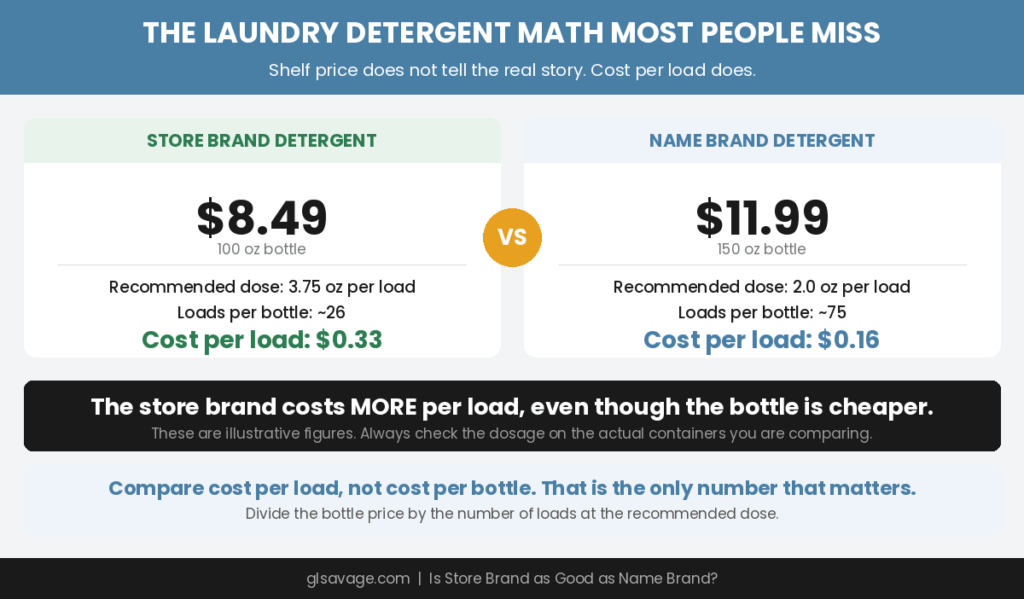
This is the category most people get wrong, and the reason is specific. Detergents work through enzymes that break down proteins, fats, and starches in fabric. Some generic brands contain lower enzyme concentrations or fewer enzyme types than name-brand formulas. More importantly, some require a significantly larger dose per load. If a store brand costs 30 percent less per bottle but the measuring instructions call for 50 percent more product per load, the math on actual savings changes substantially.
The only meaningful comparison is cost per load at each brand’s recommended dosage. Not cost per bottle. Not price per ounce. Cost per load. Check the back panel of both containers before deciding. For lightly soiled everyday laundry, most generic detergents perform comparably. For heavily soiled work clothes, gym gear, or kids’ clothing, concentration differences show up in results.
Trash Bags
A trash bag that tears mid-carry costs you the bag plus whatever clean-up follows. The issue is that failure rate changes actual cost per use in a way that is not visible on the shelf price. Some store-brand bags are entirely comparable to name brands. Others have higher failure rates at the seal or drawstring that eliminate the price advantage over time.
This one requires a real-world test. Buy one box. Use it under normal kitchen conditions for a week. If it holds, keep buying it. If it fails regularly, the name brand may be cheaper in actual practice. Most major chains’ store-brand bags perform adequately for regular kitchen use. Budget bags from discount chains are where the failure rate gap tends to be most noticeable.
Batteries
In low-drain devices like TV remotes and wall clocks, battery performance differences between store brands and name brands are minor. In high-drain devices like gaming controllers, digital cameras, and flashlights, the run-time gap is measurable and consistent in independent tests. For smoke detectors and carbon monoxide alarms, name-brand batteries are the standard recommendation. The per-battery savings on a generic four-pack do not offset the function those devices serve.
Extra Virgin Olive Oil
Basic vegetable oil and canola oil are commodity products and the store brand is a straightforward swap. Extra virgin olive oil is a different category. The extra virgin designation carries specific chemical and sensory standards, and enforcement of those standards in the United States market is inconsistent. Multiple independent investigations by food scientists have documented that a portion of olive oil labeled extra virgin in the American market does not meet those standards, with lower-priced products at higher risk. A bottle with a harvest date and a named origin gives you more information about what you are buying. Whether that matters for your intended use, cooking at high heat versus finishing a dish, is a separate question worth considering.
Paper Towels
A paper towel that requires three sheets to do what one sheet from a quality brand handles is not cheaper per use. Some store-brand paper towels are genuinely comparable. Others are thin enough that doubled or tripled usage closes the price gap. Buy one roll and test it before switching the whole household over.
Does the Store You Shop At Change the Answer?
Significantly. Store brands are not one uniform thing. They vary by retailer in quality, sourcing, and formulation in ways that matter to the comparison.
Costco’s Kirkland Signature line has documented manufacturing relationships with major name brands. Kirkland batteries have been connected to Duracell. Kirkland coffee has been linked to Starbucks. Trader Joe’s sources products from name-brand manufacturers who use the Trader Joe’s label as an additional distribution channel. These products are not in the same category as a budget chain’s house label formulated to reach the lowest possible price point.
A store that competes on quality tends to invest in store brands that reflect that positioning. A store that competes purely on price tends to have store brands that reflect that priority. This is not a universal rule. It is a starting point for deciding how much confidence to place in a store brand in a category you have not tested yet.
The Category-by-Category Breakdown
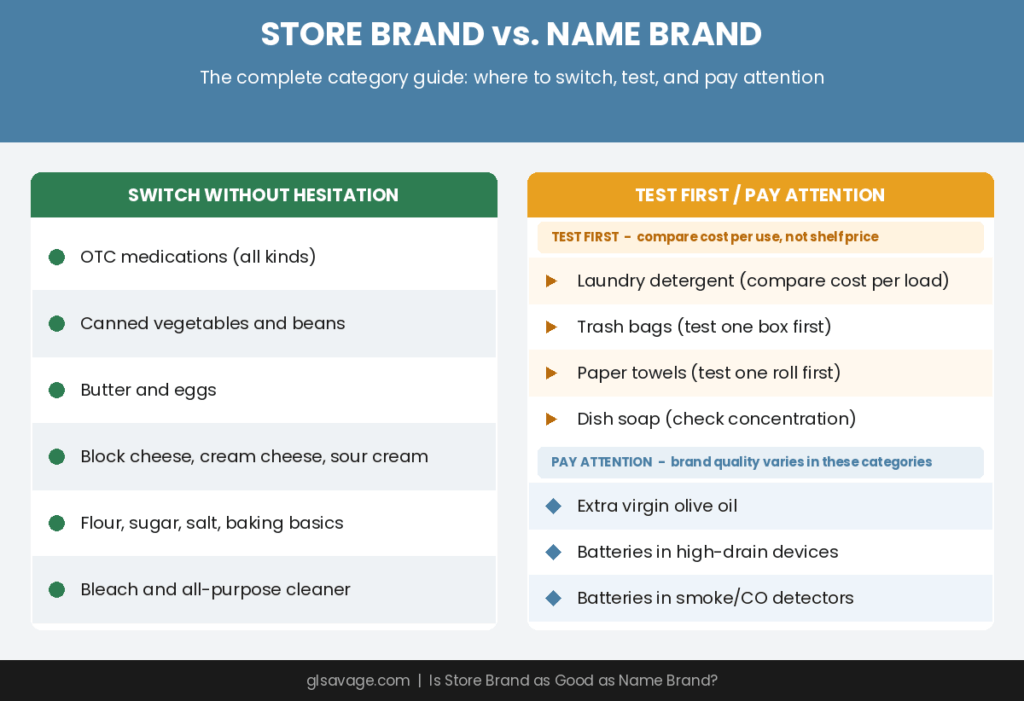
Switch without hesitation: OTC medications of every kind, canned vegetables, canned beans, butter, eggs, basic block cheese, cream cheese, sour cream, flour, sugar, salt, baking soda, baking powder, bleach.
Test before committing: trash bags, paper towels, dish soap, laundry detergent. Use one unit under real conditions and calculate cost per use at the recommended dosage, not cost per package on the shelf. Most major retailers offer money-back guarantees on store brands, so the downside of testing is low.
Worth paying attention to: extra virgin olive oil if finish quality matters for how you are using it, batteries in high-drain or safety-critical devices, laundry detergent for heavily soiled loads.
The average U.S. household spent $6,224 on groceries in 2024 according to Bureau of Labor Statistics data. Consumer Reports found average savings of 30 percent when switching to store brands across 30 common grocery items, with savings reaching 52 percent on specific products. For a household at the national average, a strategic switch on the right categories adds up to real money. How much depends on which categories you switch, which store you shop at, and whether cost per use holds.
For a broader look at how grocery pricing and cost-of-living systems work, The Poverty Premium Explained: How to Fight Back covers the structural side. For the full picture on what budget and processed food costs over time, The Real Cost of Eating Cheap runs those numbers. And if bulk buying is part of how you are thinking about this, Is Buying in Bulk Cheaper? covers when that math holds and when it does not.
Frequently Asked Questions
For commodity products like canned vegetables, butter, flour, eggs, and OTC medications, store brands are often identical in quality to the name brand, sometimes produced by the same manufacturer. For products where formula concentration or ingredient quality affects performance, including laundry detergent, olive oil, and paper goods, there can be a real quality gap. Consumer Reports blind taste tests found store brands matched or beat name brands more than half the time. There is no single answer that holds across all categories.
Often, yes. Contract manufacturing is widespread in groceries and household products. A major manufacturer will run store-label containers through the same production line as their name-brand product. This is well-documented at retailers like Costco and Trader Joe’s. At other retailers, store brands are independently formulated to reach a lower price point. The packaging does not reliably indicate which situation you are in for any given product.
OTC medications are the clearest win, as FDA regulations require the same active ingredient at the same dosage as the name brand. Canned goods, butter, eggs, basic dairy, baking staples, and bleach are reliable categories for switching. Trash bags, paper towels, and laundry detergent vary enough by product and retailer to warrant a cost-per-use test before committing. Most major retailers offer money-back guarantees on store brands, which lowers the risk of testing.
It depends on the product and what you are washing. Some generic detergents perform comparably for lightly soiled everyday loads. Others require a larger dose per load or contain lower enzyme concentrations, which reduces or eliminates the shelf-price savings and affects results on heavily soiled laundry. The correct comparison is cost per load at the recommended dosage on each container, not cost per bottle.
The extra virgin designation is not consistently enforced in the United States, and independent food science investigations have found that a portion of olive oil sold as extra virgin does not meet the chemical and sensory standards that designation requires. This is more common in lower-priced products. A bottle with a harvest date and a named region of origin gives you more verifiable information than a label claim alone. Whether this matters depends on how you are using the oil.
Two primary reasons. National brands spend heavily on research, development, and reformulation over time, and on advertising and marketing to build consumer recognition. Store brands largely avoid both of those costs. They work from existing formulas and market the store itself rather than each product individually. Those savings are split between a lower retail price for the consumer and a higher gross profit margin for the retailer.
Consumer Reports found average savings of 30 percent across 30 common grocery items when buying store brands, with individual items saving as much as 52 percent. For a household at the U.S. average of $6,224 spent on groceries annually, a strategic switch on the right categories could reduce that by $1,000 to $1,500 per year. Savings vary significantly by product category, retailer, and whether cost per use holds up against the name brand alternative.