Almost every article you find about YouTube as a side hustle was written by someone trying to sell you something. A course. A tool. A membership. An affiliate link to a ring light. The creators ranking for this topic have a financial interest in making YouTube sound more accessible than it is, because their income depends on you believing you can do it too. That is not a reason to dismiss YouTube. It is a reason to get the numbers from someone who is not selling the dream. YouTube has paid out over $70 billion to creators since 2021. More than 3 million channels are currently monetized. The income is real. So are the parts they leave out. This is the full picture on how a YouTube side hustle actually works, what it pays, and what it costs you before it pays you anything.
How does YouTube actually pay you?
YouTube pays creators through ads, but the number that shows up on your dashboard is not the number that hits your bank account. Understanding the difference between these two figures is the most important thing to know before you start.
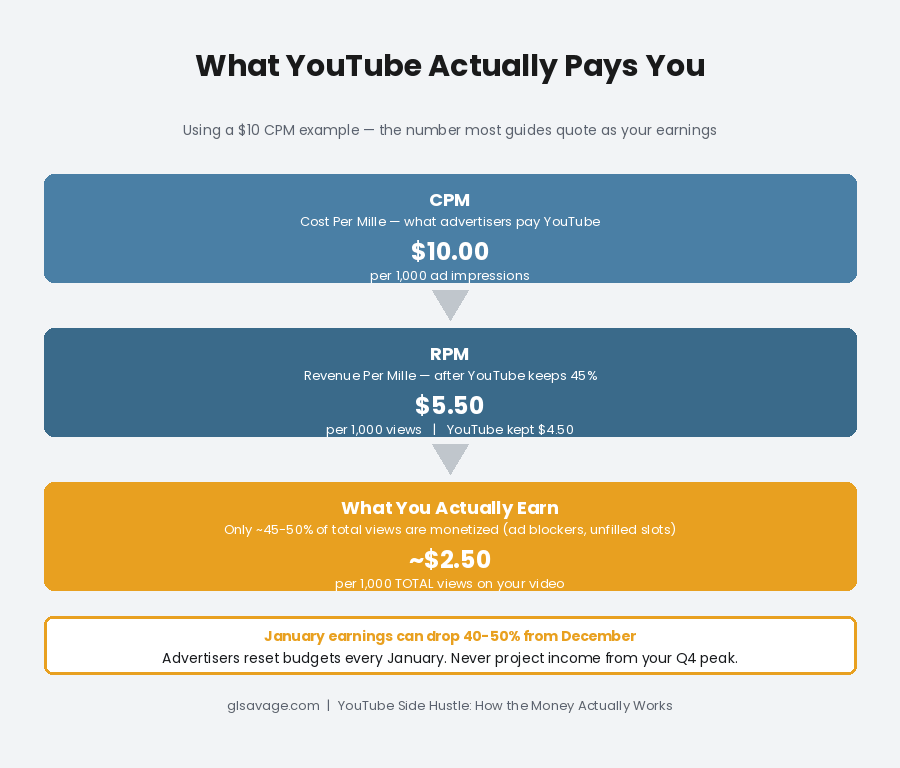
Advertisers pay YouTube to run ads on videos. The rate they pay is measured in CPM, which stands for cost per mille, meaning cost per thousand ad impressions. If your CPM is $10, advertisers paid YouTube $10 for every thousand times an ad played on your content. YouTube then keeps 45 percent of that before you see anything. What you actually earn is called RPM, or revenue per mille. Your take-home per thousand views after YouTube’s cut. A $10 CPM becomes roughly a $5.50 RPM. Most guides do not explain this distinction. They quote CPM as if it is what you earn. It is not.
Even your RPM is not applied to every view. Viewers using ad blockers generate nothing. Not every ad slot on every video gets filled by a paying advertiser. In practice, roughly 40 to 50 percent of your total views are monetized views. So if your RPM is $5 and only half your views generate ad revenue, you are earning closer to $2.50 for every thousand total views on your video. A video with 100,000 views, using those numbers, earns around $250. That math is the one nobody shows you in the thumbnail.
There is one more variable most people miss entirely. CPM rates collapse in January. Every year. Advertisers blow their budgets in Q4, November and December, when ad spending peaks for the holidays. January ad budgets reset to near zero. Creators who earned $800 in December routinely earn $300 to $400 in January from the same viewership. If you are building income projections based on your best month, you are building them on the wrong month.
What your niche determines about your income
Your niche is not just what you are interested in. It is the single biggest variable in how much you earn per view, and the difference between niches is not small. A factor of ten or more separates the top from the bottom.
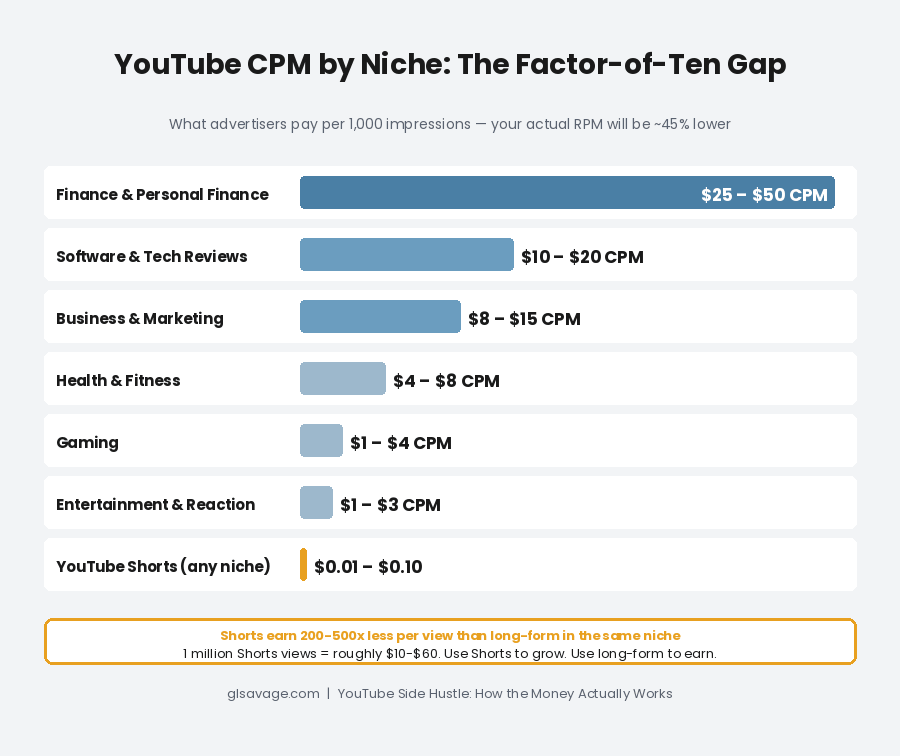
Finance and personal finance channels earn the highest RPMs on the platform. One personal finance creator reported earning $29.30 per thousand views by focusing on credit cards and investing. Finance channels see CPMs of $25 to $50 because the advertisers in those categories, banks, lenders, financial product companies, pay a premium to reach audiences that are likely to act. Someone watching a video about credit card rewards is probably looking for a credit card. That advertiser will pay a lot to be in front of them. The ad money flows from the advertiser’s budget through YouTube to you, and in finance those budgets are enormous.
Software tutorials and technology reviews earn well for the same reason. The audience is a buyer audience. A person watching a comparison video of project management tools is probably about to purchase one. Advertisers understand this and bid accordingly.
Entertainment, reaction videos, gaming, and general lifestyle content earn at the low end. Rates of $1 to $4 per thousand views are common in these niches. The audiences are huge but the advertisers are not bidding aggressively for them. Watching someone play a video game does not signal purchase intent the way watching a credit card review does.
YouTube Shorts sit below all of that. A Shorts video reaching one million views might generate $10 to $60 in direct ad revenue. The per-view income on Shorts is 20 to 100 times lower than long-form video. Shorts have real strategic value for growing a channel and reaching new audiences fast, but building a YouTube income on Shorts alone is not the path. Creators who post both Shorts and long-form content see roughly 23 percent higher overall revenue than those who do one or the other. Use Shorts to grow. Use long-form to earn.
Your audience’s location matters too. A view from the United States, Canada, Australia, or the United Kingdom generates more ad revenue than the same view from a country where advertisers spend less per viewer. Two channels with identical view counts but different audience geography can earn substantially different amounts from the same ads.
What you actually need before YouTube pays you anything
YouTube does not pay you for uploading videos. To earn from ads you need to qualify for the YouTube Partner Program, which requires 1,000 subscribers and 4,000 hours of watch time on your channel in the past 12 months, or 10 million valid Shorts views in the past 90 days. No active strikes on your account. Two-step verification enabled. Full compliance with all monetization policies. You apply, YouTube reviews the channel manually, and you are either accepted or not.
There is a lower entry tier at 500 subscribers and 3,000 watch hours that unlocks fan funding features like Super Thanks and channel memberships. It does not unlock ad revenue. For ad revenue, the bar is 1,000 subscribers with the full watch hour requirement.
Here is what the numbers actually look like. There are 115 million total channels on YouTube. Roughly 3 million are monetized through the Partner Program. That is fewer than 3 percent. Ninety percent of all YouTube channels have under 1,000 subscribers, meaning they have not cleared even the minimum bar to apply. The number is often quoted as a 97 percent failure rate, and that framing is accurate. Three out of a hundred channels that start ever reach the point where ad revenue is even possible. The other 97 keep posting or stop posting and earn nothing from ads. That is the real landscape. Know it going in.
How long does it actually take to make money on YouTube?
Reaching 1,000 subscribers takes most channels longer than people expect. VidIQ data puts the average at around 15.5 months of consistent uploading. A separate analysis of channel growth patterns puts the median at 254 days. The range is wide. Some channels hit 1,000 subscribers in two months because a video finds search traffic early. Others post for three years and never get there. Niche, searchability, and consistency matter more than production quality in the early stages.
The channels that grow fastest are not producing the most polished content. They are producing videos that answer a specific question a specific person is searching for right now. YouTube is a search engine as much as it is a social platform. A video titled “how to fix a leaking kitchen faucet” gets found by people who have a leaking kitchen faucet today. A vlog called “day in my life” competes with millions of identical videos from creators who already have audiences. For a channel starting from zero, searchability is the lever.
After crossing the monetization threshold, the income does not immediately become meaningful. The threshold is the starting line, not the payoff. A channel can be accepted into the Partner Program and earn $12 a month. Getting to $500 a month from ad revenue alone requires a level of viewership most channels do not reach for two or more years of consistent posting. The channels earning several thousand per month from ads have usually been at it for three to five years in higher-paying niches.
There is also a risk that nobody selling YouTube courses will mention. YouTube can demonetize your channel overnight. Policy changes, algorithm shifts, a single community guidelines strike, or a manual review decision can strip monetization from a channel you have spent years building. It has happened to large channels without warning. Your income on this platform sits on ground that YouTube controls entirely. That is not unique to YouTube. Every platform-dependent income has this risk. But it is real and it belongs in the picture.
Ad revenue is not where most of the money is
The guides written by people selling YouTube courses spend a lot of space on CPM and RPM. They spend much less time on the fact that ad revenue is not where most of the real YouTube money actually comes from. Creators earning $10,000 or more per month now derive about 41 percent of that from sources outside ad revenue entirely. The ones making serious money are using YouTube to build an audience, then converting that audience into income through channels YouTube does not take a cut of.
Brand sponsorships are typically the largest single income source for established creators. And they are available to much smaller channels than most people assume. A channel with 10,000 focused subscribers in a specific niche, cooking, personal finance, woodworking, home repair, is more valuable to a relevant brand than a general channel with 500,000 subscribers who are not buying anything. Niche authority matters more than raw size in the sponsorship market. A brand selling woodworking tools cares more about 8,000 engaged woodworkers than 400,000 people who watch entertainment clips. Sponsored segment rates range from a few hundred dollars for small channels to tens of thousands for large ones.
Affiliate marketing puts tracked links in your video descriptions for products you review or recommend. When a viewer buys through your link, you earn a commission. This does not require a massive audience. A channel with 5,000 subscribers that produces honest, detailed product reviews can generate meaningful affiliate income because those viewers are specifically in purchasing mode. Amazon Associates is the most accessible entry point. Niche-specific affiliate programs often pay significantly higher commission rates.
Channel memberships let viewers pay a monthly fee, typically $1.99 to $9.99 depending on the tier, for exclusive access to extra content, early releases, or direct interaction with the creator. One hundred members at $5 per month is $500 in predictable recurring income before a single ad runs. That income is not tied to whether any particular video performs well that week.
Digital products are the highest-margin option because they are made once and sold indefinitely. A fitness creator who sells a $49 workout plan, a finance creator who sells a budgeting spreadsheet, a cooking creator who sells a recipe book: all of that income bypasses YouTube’s 45 percent cut entirely. Creators who build a product alongside building a channel have something more durable than ad revenue alone, because the product keeps generating income whether YouTube changes its algorithm or not.
What it actually costs you before YouTube pays you anything
Getting on YouTube is free. The real costs are equipment, time, and the opportunity cost of both.
Equipment first. A microphone matters more than a camera. Bad audio is the fastest way to lose a viewer. People will watch mediocre video from a phone camera for a long time. They will not tolerate audio that sounds like it was recorded in a parking garage for more than about thirty seconds. A USB microphone runs $50 to $100 and makes an immediately audible difference. Basic ring light costs $20 to $50. A current smartphone camera handles video quality well enough to launch a real channel without buying dedicated camera gear at all. The total equipment cost to start reasonably is under $150.
Time is the real number. Planning or scripting a video, filming, editing, writing a search-optimized title and description, creating a thumbnail, and uploading takes two to six hours per video depending on your format and how fast you edit. One video per week is 100 to 300 hours per year. At one video per week for the average 15.5 months to reach 1,000 subscribers, you are investing roughly 130 to 400 hours before you earn a single dollar from ads. That is not a reason not to do it. It is the number you need to know before you decide.
The people who build a successful YouTube side hustle treat that time as an investment with a delayed return. The people who quit, and most people quit, almost always quit because the return did not arrive on the timeline they expected, not because the channel was not working. The channel was working. The timeline was longer than they planned for.
Can you make money on YouTube without showing your face?
Yes. Faceless channels in finance, tutorials, history, ambient music, and educational content have built real audiences and real income without the creator ever appearing on camera. Screen recordings, voiceovers, animations, and stock footage are all workable formats. The income mechanics are identical whether your face is on screen or not. CPM, RPM, and Partner Program requirements do not change based on production style. What matters is whether the content serves the viewer, not whether the creator is visible.
Who this actually works for and who it does not
A YouTube side hustle works for people who have something specific to say to a specific audience, who can commit to consistent output over a timeline measured in years rather than months, and who can treat the early period as an investment without expecting compensation for it. It works better in higher-paying niches where the creator has genuine knowledge. It works better when the channel is built alongside other income sources from the start, not treated as a standalone ad revenue machine.
It is the wrong choice if you need income in the next few months. The average timeline to cross the monetization threshold is over a year. The income after crossing starts small. If you are stretched thin right now and need cash flowing in the near term, Gig Work Real Pay: What the Apps Show You vs. What You Actually Keep and Affiliate Marketing Is One of the Most Legitimate Ways to Earn Online. It Is Also One of the Most Lied About. both describe paths that can generate income faster than YouTube’s ramp allows. For a broader look at where the money in the side hustle economy actually lands versus where it gets marketed to land, The Side Hustle Scam Machine: Who Is Actually Making Money and How covers that directly.
The channels that make it are almost never the ones that started with the highest production budgets or the most polished first videos. They are the ones that kept posting after month four when the subscriber count was still embarrassing, after month eight when the algorithm still had not picked them up, after the first year when the income was still $0. Persistence past the point where most people quit is the actual skill YouTube rewards. Everything else can be learned along the way.
Frequently Asked Questions
After YouTube takes its 45 percent cut, most creators earn between $2 and $10 per thousand total views. Finance and personal finance channels can earn $12 to $29 per thousand views or more. Gaming and entertainment channels typically earn $1 to $4. YouTube Shorts pay far less, around $0.01 to $0.06 per thousand views. The CPM figure on your dashboard is what advertisers pay before YouTube’s cut. Your RPM, revenue per mille, is your actual take-home and is always lower. A $10 CPM translates to roughly a $5.50 RPM.
Ad revenue requires 1,000 subscribers and 4,000 hours of watch time in the past 12 months, or 10 million Shorts views in the past 90 days, to qualify for the YouTube Partner Program. A lower tier at 500 subscribers and 3,000 watch hours unlocks fan funding features but not ads. Hitting the threshold qualifies you to apply. It does not guarantee approval, and approval does not guarantee meaningful income. It is the starting line, not the finish.
The average channel takes roughly 15.5 months of consistent posting to reach 1,000 subscribers, based on VidIQ data. Some channels get there faster. Many take longer. After crossing the monetization threshold, new partners typically earn $50 to $100 per month from ad revenue to start. Getting above $500 per month from ads alone requires years of consistent posting for most channels. Adding sponsorships, affiliate income, and digital products shortens that timeline significantly.
Yes. YouTube keeps 45 percent of ad revenue before paying you. Advertisers pay $10 per thousand impressions, you receive roughly $5.50. That cut applies to all ad revenue generated through the Partner Program. It does not apply to income you negotiate directly outside the platform. Brand deals, affiliate commissions, and product sales bypass YouTube’s cut entirely. That is why serious creators treat ad revenue as one piece of a larger income stack, not the whole thing.
Finance, personal finance, and investing earn the highest CPMs, sometimes $25 to $50 per thousand ad impressions. Software tutorials and tech reviews also pay well. The highest-paying niche is not always the right one. A niche you cannot produce content in consistently for three years is worth less than a lower-paying niche you can sustain. Most durable channels are built on genuine knowledge, not CPM chasing. A creator who knows nothing about finance but picked it for the rates will run out of things to say before the income ever becomes meaningful.
No. If you need income in the next one to three months, YouTube is the wrong choice. The average timeline to qualify for ad revenue is over a year. Income after qualifying starts small. YouTube is a long-horizon asset, not a fast cash generator. If the timeline pressure is immediate, gig work or freelancing can generate income this week. YouTube can run in parallel while other income comes in, but it cannot be the answer to a near-term cash need.
Fewer than 3 percent of YouTube’s 115 million total channels are monetized through the Partner Program. Ninety percent of channels have under 1,000 subscribers, meaning they cannot even apply for ad revenue. Of the roughly 3 million monetized channels, income is concentrated at the top. A small number of channels earn the bulk of the money. Real income is possible and real people are building it, but 97 out of 100 channels that start never earn a dollar from YouTube ads. That is the accurate number. Plan accordingly.