
The platforms that run thrift store flipping are not set up for your benefit. They are set up for theirs. In 2024, Poshmark tried to quietly change its fee structure and add a new buyer protection charge on top of what sellers already paid. Sales dropped. Sellers revolted. Poshmark reversed the whole thing within weeks. The platform had to back down. But the fact that it tried tells you everything you need to know about where you stand as a seller. You are not a partner. You are a revenue source. And that is before we get to the thrift stores now checking eBay before they price anything, the self-employment tax bill nobody warned you about, and the inventory sitting in your spare room four months after you bought it. Thrift store flipping can make you real money. This article covers exactly how, and exactly what it costs, with nothing left out.
What Thrift Store Flipping Actually Is
Thrift store flipping means buying items at a thrift store, estate sale, garage sale, or flea market for less than someone else will pay for them online, listing them on platforms like eBay, Poshmark, Mercari, Depop, or Facebook Marketplace, and keeping the difference after fees and shipping. The gap between what you paid and what you sell it for is your profit. The model is simple. Everything around it is not.
The categories that consistently produce that gap include brand-name and vintage clothing, shoes, video games and consoles, kitchen appliances, collectibles, sports equipment, electronics, furniture, and books with niche demand. What they share is one thing: the thrift store priced the item without knowing what it was worth. Your job is to know before they do. That knowledge is the entire business.
The secondhand market is not a niche. The U.S. secondhand apparel market grew 14 percent from 2023 to 2024, outpacing traditional retail by a wide margin. In 2025, 59 percent of consumers bought something secondhand. The buyers are real. The demand is real.
What People Actually Make
The typical part-time thrift store flipper brings in $500 to $1,000 a month. That number shows up consistently and reflects people treating this as a side income, not a full operation. Full-time resellers with deep category knowledge and efficient sourcing can make significantly more.
The success stories that circulate online are real. One reseller brought in nearly $123,800 in sales in a single year buying thrifted clothing and listing it across eBay, Mercari, and Poshmark, with over $192,000 in net profit across four years on roughly $50,000 in total inventory costs. Those numbers were reviewed by a journalist at CNBC. They are accurate. What gets left out is that she started in 2020, built it over four years, listed 10 to 20 items every single day, and described the work as requiring consistency, persistence, and organization without exception. The income is real. So is what it took to get there.
The people doing this well are not wandering thrift stores hoping something catches their eye. They study specific brands, track what actually sold on eBay in the last 90 days, learn which days their local stores restock, and build relationships with staff to get access to new inventory before it hits the floor. That is a business. It has a learning curve like any other.
Most experienced flippers set a firm margin floor before they buy anything. The common standard is at least 50 percent gross margin before fees hit. If you pay $20 for something, you need to sell it for at least $40 before expenses. Some set the bar at 10x. Paying $10 and only buying things they can sell for $100 or more. The math has to work item by item. There is no averaging your way out of a bad purchase.
The Costs Nobody Puts in the Headline
This is the section most articles about thrift store flipping bury or skip. These costs are real, they are not small, and they determine whether this makes you money or just keeps you busy.
Platform fees come out of every sale before you see a dollar. Poshmark takes a flat $2.95 on sales under $15 and 20 percent on anything $15 or over. Sell a $40 item on Poshmark and you keep $32. Sell a $12 item and you keep $9.05. eBay runs 13.25 to 15 percent of the total sale including shipping, plus $0.30 per transaction. Mercari charges a flat 10 percent on the combined total of item price and shipping.
Run that against a real flip. You find a Lululemon top at Goodwill for $8. You list it on Poshmark for $45. Poshmark takes $9. You net $36. Before you subtract the gas to the store, the poly mailer, the time spent washing it, photographing it, writing the listing, waiting for a buyer, packing it, and getting to the post office. Still real money. Just not the $37 the surface math suggests.
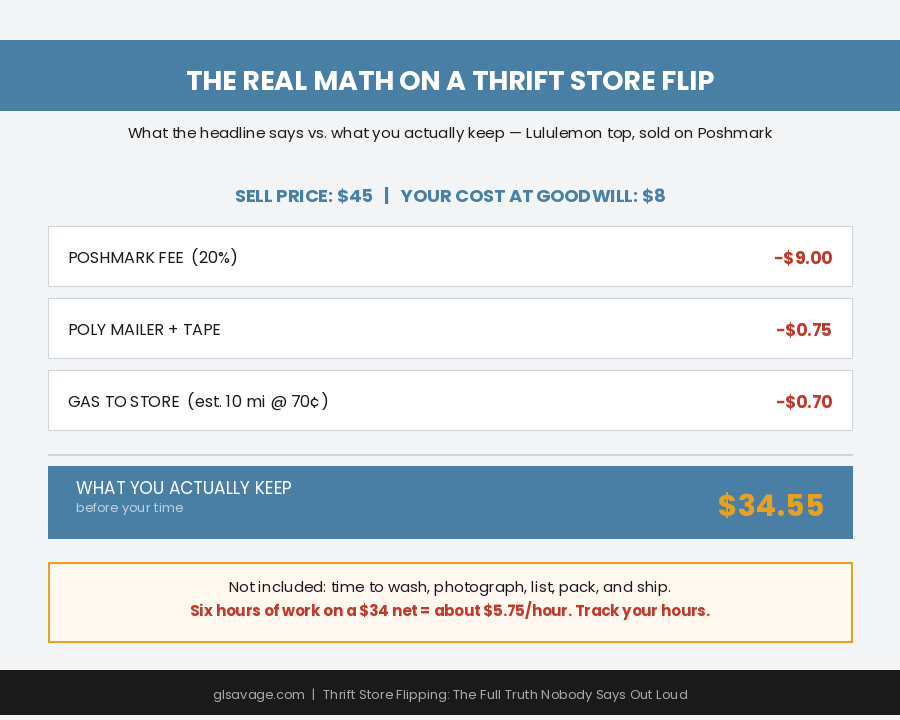
Shipping supplies are the second number beginners miss. Boxes, poly mailers, tape, bubble wrap, labels, and ink all cost money. None of it is free. On eBay you can pass shipping to the buyer, but high shipping costs push buyers away. On Poshmark the buyer pays a flat-rate label, which simplifies things but limits your flexibility. On Facebook Marketplace, local pickup removes shipping entirely, which changes the math completely for heavy or bulky items.
Storage is the third cost people do not think about until they are living in it. A part-time flipper with 50 items needs somewhere clean and organized to store things so they can find them when they sell. A full-time reseller managing 1,300 items needs a dedicated room or a storage unit. That is a monthly fixed cost coming out of real margin.
The only fix is to run the numbers before you buy, not after. Know the platform, know its fee structure, estimate shipping, and make the decision while you are still standing in the store. If the margin does not work, put it back. That discipline is the whole job.
The Time Cost Nobody Publishes
Thrift store flipping is not passive income. It is a second job with a variable hourly rate that most people never calculate.
The work is driving to stores and sorting through racks, researching items on your phone before you buy, getting things home, washing or cleaning what you bought, photographing every item, writing detailed listings, answering buyer questions, packing orders, making post office runs, and tracking every transaction for taxes. That is the job. All of it.
People who do this seriously do not think about what they make per sale. They think about what they make per hour. Six hours sourcing, photographing, and listing and netting $60 after fees and costs is $10 an hour. That might be worth it. It might not. Most people who feel like they are making good money at thrift store flipping have never run that calculation. They see deposits and assume it is working.
Inventory turnover changes everything. Some items sell in hours. Others sit for three months. Money locked up in unsold inventory is money you cannot use anywhere else. Slow-moving inventory turns the whole operation into a warehouse you are managing for free.
If you want the real math on what extra income costs to earn, Why a Second Job Often Costs More Than It Pays runs through it without softening the numbers.
The Sourcing Problem Getting Quietly Worse
Almost no thrift store flipping content addresses this directly: the sourcing environment has changed, and it has not changed in your favor.
More people discovered reselling during the pandemic and stayed. More of them are now in the same Goodwill you are in, looking at the same rack. Thrift store inventory quality declined in 2024. Prices went up. High-value items get found faster because more people who know their value are looking for them.
Some thrift stores now check Poshmark and eBay before pricing anything on the floor. At least one has been documented pricing its inventory at full Poshmark market rates. The information advantage that made thrift store flipping so profitable early on is being competed away. The stores are learning the same market you are trying to work.
There is an ethical dimension to this worth naming plainly. Thrift stores exist partly so people who cannot afford retail can access clothing and household goods. When resellers compete heavily for the best items and stores raise prices in response, the people absorbing that cost are the ones with the least flexibility. The categories hit hardest are the ones people on tight budgets actually need: plus-size clothing, children’s clothes, work boots, winter coats, professional attire. These are not luxury goods. They are basics. This is not an argument against reselling. It is information most articles on this topic skip entirely.
Practically, the sourcing problem means the skill floor has risen. The people consistently finding underpriced items have deep niche knowledge, sourcing routines that go well beyond Goodwill, and relationships with store staff. Estate sales, garage sales in wealthier neighborhoods, smaller independent thrift stores that have not updated their pricing yet, and online estate auction platforms all still produce real gaps. But none of that is as simple as walking into a chain thrift store and grabbing whatever looks valuable.
The Tax Situation Nobody Walks You Through Before You Start
Most people who start flipping do not think about taxes until a form shows up or April arrives with a number they were not expecting. By then, the decisions that would have reduced the bill have already been made.
The income is taxable. All of it. Whether or not anything arrives in the mail from the platform.
The form you may or may not receive is a 1099-K. It reports your total gross sales for the year to both you and the IRS. After the One Big Beautiful Bill Act was signed in July 2025, the federal threshold for receiving a 1099-K was restored to its original level: over $20,000 in payments and over 200 transactions on a single platform, for 2025 and forward. Confirmed by eBay’s own seller center. But your obligation to report income does not depend on receiving that form. The form not showing up does not mean the IRS is not watching. It means the platform is not required to send the paperwork.
The 1099-K reports gross sales, not profit. If the platform shows $8,000 in total sales but you spent $5,000 buying inventory, you owe taxes on roughly $3,000, not $8,000, once you subtract your documented costs. This is why tracking what you paid for every item from day one is not optional. Without those records you cannot prove your costs. You will overpay.
Here is the number most articles about thrift store flipping never mention: self-employment tax. When you earn income as a sole proprietor, you owe 15.3 percent on net earnings to cover both the employee and employer portions of Social Security and Medicare. As a W-2 employee your employer pays half. When you are self-employed, you pay both halves yourself. The 15.3 percent applies to 92.35 percent of your net earnings, not the full amount, and you can deduct half of what you pay from your adjusted gross income, which softens the hit somewhat. But it still stacks on top of your regular income tax. Someone in the 22 percent bracket with $20,000 in reselling profit is looking at a combined effective rate on that income somewhere between 35 and 37 percent, depending on their full situation. Tax professionals consistently say to set aside 25 to 30 percent of what you earn as you go. Most people starting out do not. April is rough for them.
If you expect to owe more than $1,000 in federal taxes for the year, the IRS requires quarterly estimated payments. The deadlines are April 15, June 15, September 15, and January 15. Miss them and you owe a penalty on top of the tax.
The tax code also works for you if you run this like a business from the start. Every mile you drive to a thrift store, estate sale, or post office is deductible at 70 cents per mile in 2025. A space in your home used exclusively for your reselling operation may qualify for a home office deduction. Platform fees, shipping supplies, and photography equipment are all deductible. Every expense you document reduces your taxable profit directly. The people who track everything owe materially less than the people who do not.
Keep a simple record for every item: what you paid, when you bought it, what it sold for, the fees, the shipping. A spreadsheet is enough. Track it as you go and April is manageable. Try to reconstruct it from memory in March and it is not.
The Platforms and What They Do Not Tell You
Where you sell determines what you actually keep. And where you sell can change underneath you.
In 2024, Poshmark announced a new fee structure that added a buyer protection charge on top of existing seller fees. Sellers saw sales drop by double digits almost immediately. The backlash was loud enough that Poshmark reversed the entire thing within weeks. The platform is now back to its original structure: a flat $2.95 on sales under $15 and 20 percent on anything $15 or over. But that episode is important information. A platform that runs your income can restructure how much it takes whenever it decides to. You do not vote on that. You either adapt or find somewhere else to sell.
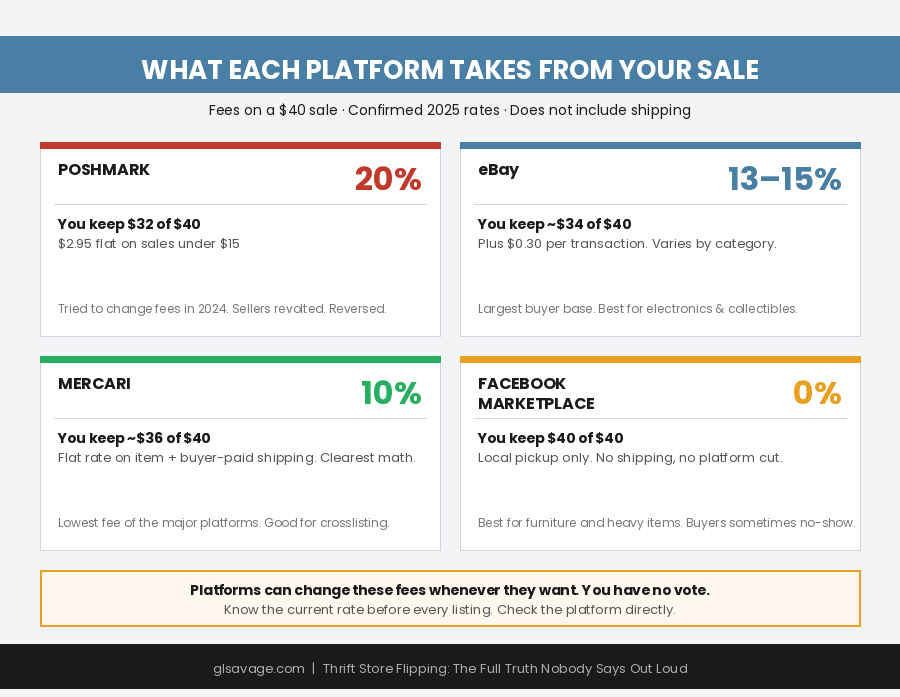
eBay has the broadest buyer base of any resale platform. It works across most categories, especially collectibles, electronics, video games, sporting goods, and anything people search for by brand or model number. Fees run 13.25 to 15 percent of the total sale including shipping, plus $0.30 per transaction. It requires more detailed listings than other platforms but reaches more buyers than any of them.
Mercari charges 10 percent on the total of item price plus buyer-paid shipping, as of January 2025. Smaller audience than eBay, broader category range than Poshmark. It works well as a second platform for crosslisting items that are not moving elsewhere.
Facebook Marketplace charges nothing for local sales. No platform fee, no shipping. For large furniture or heavy items where shipping would eat the margin, local is sometimes the only math that works. The tradeoff is coordinating pickup with buyers who do not always show.
Many experienced resellers list the same item across multiple platforms at once and remove it everywhere the moment it sells. Tools exist to automate this. The risk is selling the same item twice if you are not careful. The upside is that you are not dependent on any single platform’s algorithm deciding whether to surface your listing.
Who Actually Makes Money at This
Thrift store flipping is a real income source. The gap between who builds something real doing it and who ends up with a storage unit full of things nobody bought is predictable once you know what to look for.
The people making consistent money share a few things. They have real knowledge in at least one specific category before they start. They know which brands hold resale value, which specific items in their niche are collectible versus common, and which condition problems buyers will overlook. That knowledge does not come from a YouTube video. It comes from time spent in the actual market.
They are also patient with inventory that sits. Some items sell in hours. Others sit for months. People who need cash and price things to move quickly leave money on the table. People who can wait for the right buyer make more per item. If money is tight right now, the waiting part is harder. That is a real constraint, not a character flaw.
They can tolerate the operational grind. Photographing, listing, packing, and shipping are not the exciting part. They are the job. If those steps wear you down, the hourly rate will not make up for it. If you find a rhythm in them, the math can work.
The only way to know which camp you fall into is to start small. Twenty to fifty dollars on a first round of inventory is enough to show you what the work actually feels like and whether your eye for value produces margin, without risking money that would hurt to lose. If it works, scale. If it does not, you found out before it got expensive.
If you are weighing this against other ways to make extra income, The Side Hustle Scam Machine: Who Is Actually Making Money and How covers how to read the packaging on side hustle opportunities, and Gig Work Real Pay: What the Apps Show You vs. What You Actually Keep runs the real numbers on other options in the same space.
Thrift store flipping puts you in business with platforms that need you more than they let on. That is why Poshmark had to reverse course when sellers walked. Know what you are worth to them, know what they cost you, and make the decision with your eyes open.
Frequently Asked Questions
Most part-time flippers bring in $500 to $1,000 a month. Full-time resellers with tight sourcing and established niches can earn more. The number that matters more than what shows up in your account is your effective hourly rate, and most people doing this have never calculated it. Add up what you paid for inventory, what you cleared after fees and shipping, and how many hours every step took from purchase to delivered package. That tells you whether this is actually paying what you think it is.
Yes. All of it. Profit from reselling is taxable income whether or not a form shows up in the mail. For 2025 and forward, platforms are only federally required to send a 1099-K if you exceed $20,000 in payments and 200 transactions on a single platform, per the OBBBA signed July 2025 and confirmed by eBay directly. But your obligation to report income does not depend on receiving that form. On top of regular income tax, you owe self-employment tax of 15.3 percent on net earnings. Set aside 25 to 30 percent of what you make as you go. Keep records of every purchase and every sale from day one.
Brand-name clothing from labels like Lululemon, Patagonia, Carhartt, and North Face. Vintage graphic tees, denim, and band merchandise from the 1990s and 2000s. Video game consoles and games. Name-brand kitchen appliances. Collectibles with dedicated buyer communities. Working electronics. Sports equipment. Books that are out of print, technical, or tied to niche hobbies. Items people search for by name sell faster and more predictably than general secondhand goods.
It depends on what you are selling. eBay has the broadest reach and works across most categories. Poshmark has a strong fashion buyer base but takes 20 percent. Mercari is more fee-efficient at 10 percent and covers a wide range. Facebook Marketplace eliminates fees entirely for local sales, which matters most for large or heavy items. Most experienced resellers sell on more than one platform and adjust based on where the buyers for each item actually are.
The demand for secondhand goods is real and growing. Sourcing is more competitive than it used to be and thrift store pricing has risen in response. The opportunity still exists but requires more specific knowledge to find underpriced items than it did a few years ago. People who start in a category they already understand, hold firm margin requirements, and track everything from day one tend to find it worth the effort. People who expect easy money without real sourcing knowledge typically do not.
Open eBay and filter by Sold Listings. Not active listings, which show what sellers hope to get. Sold listings show what buyers actually paid. That is your realistic ceiling. Subtract the platform fee, estimated shipping, and what the item costs at the thrift store. What is left is your projected profit. If it does not hit your minimum, put it back. The buying decision is where profit gets made or lost. Not the selling.
Platform fees of 10 to 20 percent on every sale. Shipping supplies. Gas for sourcing. The time cost of photographing and listing, which most people undervalue when they calculate what they are making. Self-employment tax of 15.3 percent on net profit on top of regular income tax. Capital sitting in inventory that has not sold. And the buyer dispute or return on an item you thought was done. None of those things alone kills the math. Together, they change it considerably from what the headline numbers suggest.