Brands will pay you to film short videos of their products on your phone. No following required. No production crew. No posting to your own account. You hand over the video file and collect a check. That is the pitch for becoming a UGC creator, and the core of it is true. What the pitch skips is that the average pay per video dropped 44 percent in 2025 as the number of people offering this service nearly doubled in a single year. This article covers what a UGC creator actually does, what it pays at every stage from day one to established, and what the market looks like right now.
What is a UGC creator?
UGC stands for user generated content. A UGC creator is someone brands pay to film short videos or take photos of their products so the brand can use that content in their own ads and on their own social media pages. You do not post anything to your account. You shoot the video, deliver the file, and the brand uses it however their contract with you specifies. Your follower count is completely irrelevant because your audience is never part of the arrangement.
Brands pay for this because content that looks like a real person filmed it in their actual kitchen or bathroom outperforms polished commercial content in paid ads. Consumers have learned to tune out ads that look like ads. A video that looks like a real customer filmed it in their kitchen keeps more people watching and turns more of them into buyers. Brands get roughly 28 percent higher engagement from this kind of content compared to what they produce themselves, and it costs them 30 to 80 percent less than hiring an agency. UGC creators are the people providing that footage.
How is a UGC creator different from an influencer?
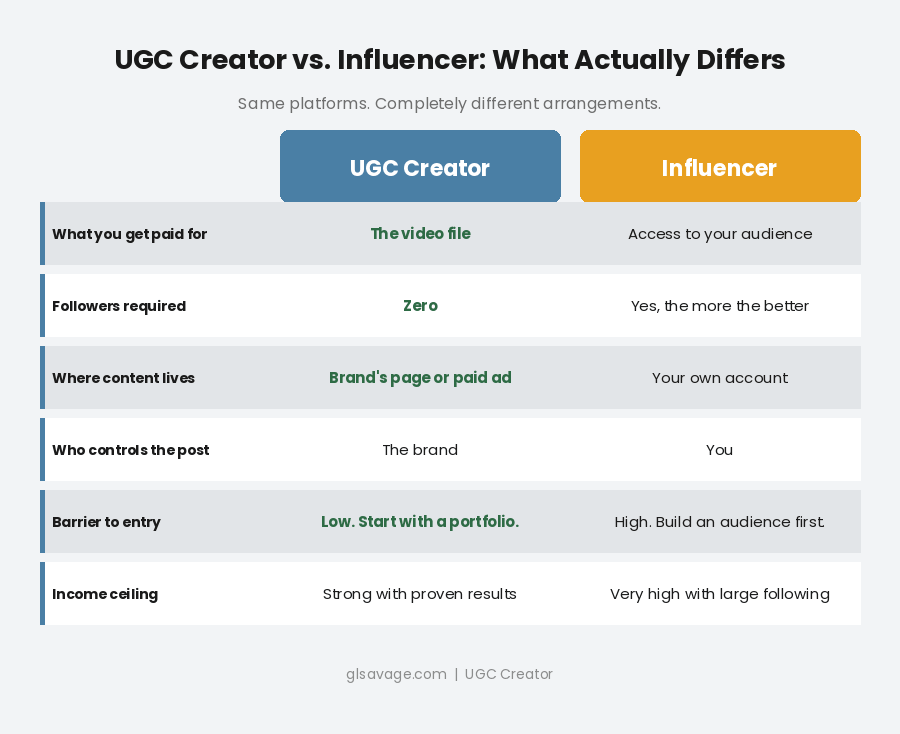
An influencer gets paid for their audience. When a brand hires an influencer, they are buying access to that person’s followers. An influencer with half a million followers gets paid because the brand wants those half a million people to see the post. No audience means no deal.
A UGC creator gets paid for the video file itself. The brand does not care how many followers you have because the content never lives on your account. They are buying footage to run in their own ads or post on their own pages. A creator with zero followers can charge the same as a creator with 50,000 followers if the quality of the content is equivalent. That is why UGC is accessible to beginners in a way that influencer work is not.
What does the work actually look like?
A brand sends you a product, a creative brief, and a deadline. A creative brief is just a document laying out what they want: the video style, the main message, the length, which platform it is going to run on, and sometimes a suggested script or talking points. You film it, edit it to basic standards, and deliver the file. Most videos run 15 to 60 seconds. They might be an unboxing, a before and after, a tutorial, a testimonial where you speak directly to camera, or a lifestyle clip showing the product in a normal setting.
The most important part of any UGC video is the first two or three seconds. On TikTok and Instagram, that opening is called the hook, and a viewer decides whether to keep watching or scroll past based almost entirely on it. Brands often ask for three or four different hook variations for the same video so their ad team can test which one holds attention longest. The ability to write and film a hook that makes someone stop scrolling is the single skill that most separates creators who get consistent repeat work from ones who do a few jobs and stall out.
Usage rights matter more than most beginners realize. When a brand buys your content, they are also buying specific rights to use it. A video posted once on the brand’s Instagram feed is worth less than a video the brand plans to run as a paid ad across multiple platforms for six months. The intended use changes what you should be charging, and most new creators do not know to ask about it. Charging a flat rate regardless of how the brand plans to use the content is one of the most common ways beginners undercharge without realizing it.
What UGC creator work actually pays
Every income figure you will see advertised in UGC courses and YouTube videos is a ceiling number. The $5,000 to $20,000 a month figures describe established creators with strong portfolios, repeat clients, and a track record of producing content that drives real sales results for brands. Those numbers exist. They are not where anyone starts.
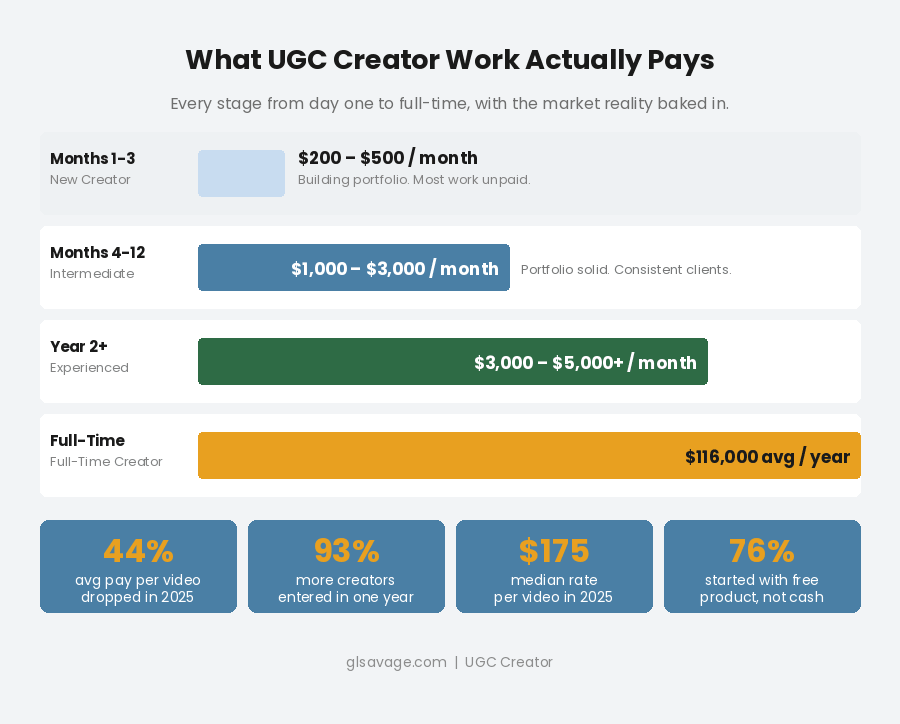
New creators in their first three months earn roughly $200 to $500 a month if they are actively pitching and landing work. Intermediate creators with a real portfolio and consistent clients earn $1,000 to $3,000 a month. Experienced creators who can show brands that their content converts can charge $3,000 to $5,000 or more monthly. The median rate for a single video in 2025 was around $175. For creators who treat this as a full-time business rather than a side income, ZipRecruiter data puts the average annual salary for a full-time UGC content creator in the US at around $116,000, with top earners above $125,000. Those figures describe people running this as their primary work, not a side project.
The average pay per video dropped 44 percent in 2025. The reason is supply. The number of people offering UGC services grew 93 percent in a single year. When supply nearly doubles, brands have more options and pay less for each one. A beginner starting in 2026 is entering a market that is significantly more competitive than the one the early success stories came from. The opportunity is real. The timeline to income is longer than the courses suggest, and the work required to stand out is greater than it used to be.
What pays more and what pays less
Health, beauty, supplements, and financial products tend to pay the highest rates because brands in those categories run heavy paid advertising campaigns and have budget to match. Tech products and software also pay well. Food, beverage, and lifestyle products pay closer to market average. Pet products have strong demand but lower rates on average.
Content intended for paid advertising pays more than content for organic social media posts, sometimes significantly more. A 60-second video a brand plans to run as a paid ad for three months is worth more than the same video posted once to their Instagram feed. Asking how a brand plans to use your content before quoting a rate is not aggressive, it is how this work is supposed to be priced.
Hook packages pay more too. A hook package is one main video delivered with three or four different opening variations. The people running a brand’s ads need multiple hooks to test against each other to find which opening keeps the most viewers watching. Offering this as a standard package rather than waiting for a brand to ask is how experienced creators increase what they charge per project without spending more time filming.
The rest of the picture
Most of the early work is unpaid. Before any brand pays you, they want to see examples of your work. That means filming content before you have clients to film it for. A 2023 industry survey found that 76 percent of UGC creators received products instead of money when they first started. You film content in exchange for free product, build your portfolio, and then move toward cash payment. The income projections circulating on social media do not include this phase because it does not fit the pitch.
UGC is freelance work, which means you are also running a small business. Cold outreach is the process of contacting brands you have no existing relationship with, introducing yourself, and pitching your services, and most of it goes unanswered. Chasing invoices when brands are slow to pay. Refilming because a brief was vague and the brand did not realize it until they saw the video. Managing revision requests. The administrative and sales side of the work takes up more time than the actual filming once you are past the beginner stage.
The platforms that connect creators to brands take a significant cut, typically 20 to 50 percent of what the brand pays. If a brand pays $150 for a video and the platform keeps 30 percent, you take home $105. At beginner rates, that math compresses quickly. Direct outreach to brands bypasses the platform cut entirely, but requires consistent sales effort and most cold outreach takes months to generate reliable results.
AI is changing the market. Brands are beginning to use AI-generated video content that shows a synthetic person promoting a product, with no human creator involved. It is not the dominant model yet, but it is growing. Creators who can show that their real-person videos produce better results for a brand than AI versions have a strong case for their rates. Creators doing basic, generic product walkthroughs face real long-term rate pressure as AI gets cheaper and more capable at replicating that kind of content.
What makes a strong UGC video versus a weak one
Brands evaluate your portfolio on the hook first. If the opening two seconds do not create curiosity, establish a problem, or make the viewer feel something immediately, the video fails before anything else happens. Strong hooks start with a question, a surprising claim, or a reaction. Weak hooks start with “Hi, I wanted to talk about this product today.”
They also look at whether it feels natural without looking careless. The lighting needs to be clean enough that the product is visible and the shot feels intentional. But overproduced content, with studio lighting and a ring light reflected in your eyes, signals paid ad. The sweet spot is a well-lit, stable shot that still feels like someone filmed it at home.
Structure matters last but it matters. A call to action is a line at the end of the video telling the viewer what to do next, like “link in bio” or “use code X for 20 percent off.” Every UGC video running as a paid ad needs one. Delivering a video without it signals you do not understand how the content will be used, and brands notice.
How to actually start
Pick two or three products you already own in a category you have a real connection to. Film three to five UGC-style videos using the structure above: a strong hook, context, product, call to action. Edit them to basic standards. This is your portfolio, and it needs to exist before you reach out to anyone.
Build a simple media kit. This is a one or two page document showing your sample videos, the product categories you cover, your base rates, your usage rights pricing, and your contact information. Canva has free templates. It does not need to be elaborate. It needs to look professional and exist.
Start on Billo. It is the most beginner-accessible platform for UGC work. Apply with your portfolio samples. Three strong videos are enough. Do your first few jobs at platform rates to get real brand feedback and build a track record.
In parallel, make a list of ten brands in your niche and find the marketing manager or content lead on LinkedIn. Send a short, direct email introducing yourself, linking your portfolio, and stating your rates. Most will not respond. The ones that do often become repeat clients that pay better than any platform rate.
The email does not need to be long. Four things: who you are, what you make, a link to your samples, and what you charge. Something like: “Hi [name], I create UGC content for [category] brands and I think [brand] would be a good fit. My videos are 15 to 60 seconds, filmed on iPhone, and built around a hook-problem-solution structure that works well in paid ads. My rate is $[X] per video, with usage rights priced separately depending on placement. Here is my portfolio: [link]. Let me know if you are looking for creators.” No flattery. No lengthy background. Brands get dozens of pitches. The ones that land are direct and show you understand how the content will actually be used.
Track the results of everything you deliver. If a brand tells you their ad results or posts the content publicly, screenshot it and document the engagement. Performance data is what justifies raising your rates. A creator who can point to content that drove real results charges more than a creator selling videos with no record behind them. Before you invest in any UGC course, The Side Hustle Scam Machine: Who Is Actually Making Money and How is worth reading first. It covers where the money in the side hustle economy actually goes.
Who this works for and who it does not
UGC creator work suits people who are comfortable on camera, or willing to get there. It especially suits people who have a specific area of life they know well. Skincare, fitness, cooking, parenting, home improvement, tech, finance: any niche where you have real lived experience gives your content an authenticity that brands can see and generic creators cannot fake. That credibility is exactly what they are buying.
It is a bad fit for people who need income in the next few weeks. The ramp to consistent paid work is three to six months for most people who approach it seriously. People who pitch five brands and quit when they do not hear back are the ones who conclude UGC does not work. It works. The timeline is not what the courses selling it suggest, and the early months look nothing like the income projections. Before committing to UGC as a second income stream, Why a Second Job Often Costs More Than It Pays is worth reading for the full picture on what side income actually costs in time and money.
The full picture
Brands need this content and the market for it is growing. The core proposition, get paid to film short videos with no audience required, is real. So is the ramp period, the early phase where most work involves free product instead of cash, and the three to six months most people need before consistent income arrives. Both sides of that are worth knowing before you start.
Frequently Asked Questions
UGC stands for user generated content. A UGC creator films short videos or takes photos of products for brands to use in their ads and on their social media pages. The creator does not post the content to their own account. They deliver the file to the brand and get paid for the content itself, not for any audience they have.
No. Follower count does not matter because the content never posts to your account. The brand is buying a video file for their own use. A creator with zero followers can charge the same as a creator with 50,000 followers if the quality is equivalent. This is the fundamental difference from influencer marketing, where the audience is the entire point of the arrangement.
The median rate per video in 2025 was around $175. Beginners typically start at $75 to $150 per video. Experienced creators with proven ad performance behind their work charge $300 to $1,000 or more. The average rate dropped 44 percent in 2025 as the number of creators nearly doubled. Rates also increase when usage rights are included, meaning how the brand plans to use the video and for how long.
Film three to five sample videos for products you already own before contacting any brand. These free portfolio samples are what brands evaluate when deciding whether to hire you. Once you have samples, apply to Billo or list on Fiverr. Three solid videos are enough to start. In parallel, reach out directly to brands in your niche with your portfolio and a short email stating your rates.
For the right person with the right expectations, yes. Brand demand for this kind of content is real and growing. The average pay dropped in 2025 as competition increased, and most people take three to six months to reach consistent paid work. People who go in with a specific niche, strong content, and realistic expectations about the timeline tend to build something that works.
A smartphone from the last three to four years, a ring light, and a basic tripod. Total cost is under $50 if you do not already own a ring light and tripod. Professional cameras are not required and can actually work against the authentic feel brands are specifically trying to achieve.
Usage rights determine how a brand is allowed to use the video you create: where they can post it, whether they can run it as a paid ad, and for how long. A video used once on organic social media is worth less than a video the brand plans to run as a paid ad across multiple platforms for six months. Most beginners charge a flat rate regardless and leave significant money on the table. Always ask how the brand plans to use the content before quoting a price.