Amazon FBA is a real program that has helped real people build real income. This guide to Amazon FBA for beginners covers the full picture: more than 55,000 independent sellers crossed a million dollars in sales on Amazon in 2024. About 86 percent of sellers on the platform report being profitable. The program works. What nobody explains in the YouTube ad is that it works in a very specific way, with a fee structure that can quietly kill your margins if you do not understand it going in, three completely different ways to do it that most guides treat as one thing, and a current sourcing landscape that is meaningfully different from every guide written two years ago. This article covers all of it.
What is Amazon FBA and how does it work?
FBA stands for Fulfillment by Amazon. You source products, send your inventory to one of Amazon’s hundreds of warehouses around the country, and Amazon takes over from there. When a customer places an order, Amazon picks the product off the shelf, packs it, ships it, handles customer service if something goes wrong, and processes returns. You are not driving to the post office. You are not answering complaint emails at midnight. You are not renting storage space. Amazon does that work for you as part of the arrangement.
Your products also become eligible for Prime two-day shipping the moment they are checked into an FBA warehouse. That matters more than most beginners realize. Amazon has over 200 million Prime members. A large share of them filter search results to show Prime-eligible products only, before they look at anything else. Sellers who store and ship their own products generally do not get that Prime badge. Without it, a significant portion of Amazon’s most active shoppers will never see your listing.
The process works like this. You create a seller account on Amazon Seller Central, the dashboard where Amazon sellers manage everything. You list your products, designate them as FBA inventory, pack and label them according to Amazon’s specific requirements, and ship your stock to whichever fulfillment centers Amazon assigns. Once your inventory is checked in and confirmed, your listing is live and Amazon handles the customer-facing side of every transaction.
The three ways to actually do Amazon FBA
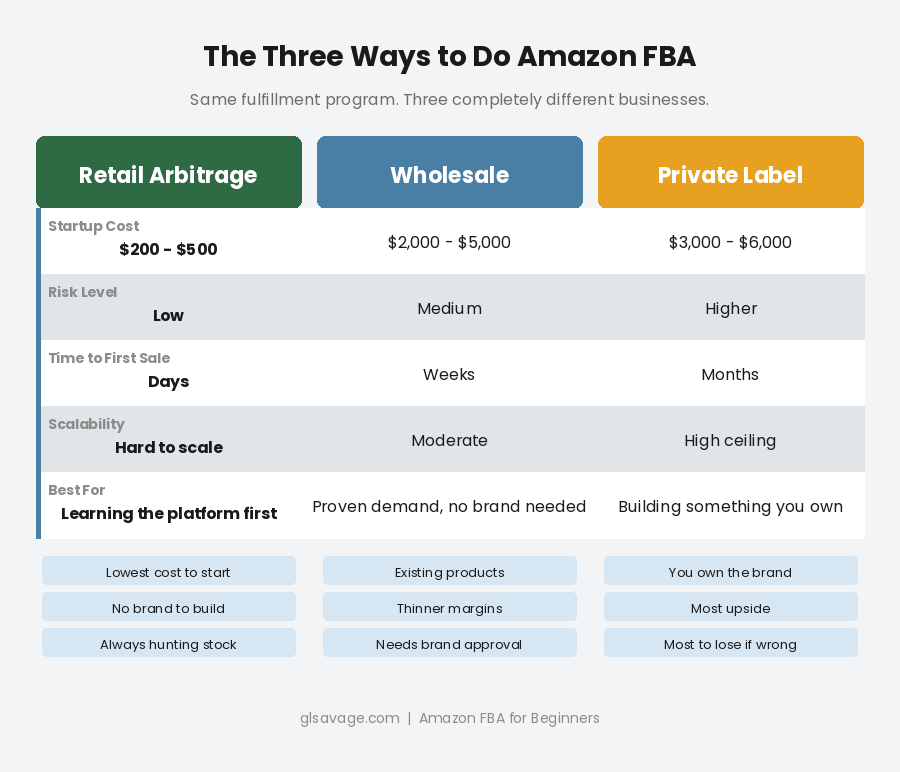
Here is the thing almost every beginner guide skips entirely, and it is the most important decision you make before you spend a dollar. Amazon FBA is not one business model. FBA is a fulfillment method. You can apply it to three completely different approaches to finding products to sell, and each one has different startup costs, different risks, and a different timeline to seeing money come in.
Private label is the model most people picture. You find a manufacturer, source your own branded product, design the packaging, and sell it under your own brand name. Nobody else is selling the exact same thing on the same listing. You own it. The upside is that you control the product, the pricing, and the listing, and you can build something that compounds over time. The downside is that it costs the most to start, takes the longest before you make a sale, and carries the highest risk if you picked the wrong product. Most private label beginners need between $3,000 and $6,000 before their first sale goes through.
Retail arbitrage is the opposite end of the cost spectrum. You go into physical stores, find products that are discounted or on clearance, and resell them on Amazon for more than you paid. No manufacturing. No branding. No overseas suppliers. You can start with a few hundred dollars and a free scanner app on your phone that tells you whether a product is profitable to flip. The tradeoff is that it does not scale easily because you are always hunting for the next batch of inventory, and your listings are not protected since any other seller can list the same product alongside you. But it is the lowest-cost way to learn how Amazon actually works before you put serious money down. If you are weighing retail arbitrage against dropshipping, Is Dropshipping Worth It? The Pros and Cons Nobody Says Out Loud breaks down that comparison directly.
Wholesale sits in the middle. You buy existing, recognized products in bulk directly from distributors or brands, and sell them on Amazon using FBA. You are not creating anything new. You are selling products that already have demand and reviews. The margins tend to be thinner because other sellers can sell the same product, but the guesswork about whether anyone wants it is already done. Most wholesale sellers spend a few thousand dollars to get started and need approval from brand owners before they can list.
Private label gets the most attention because it has the highest ceiling. But if you are starting out with limited money and want to understand how the platform works before betting big, retail arbitrage or a small wholesale account is often the smarter first move.
What does Amazon FBA actually cost?
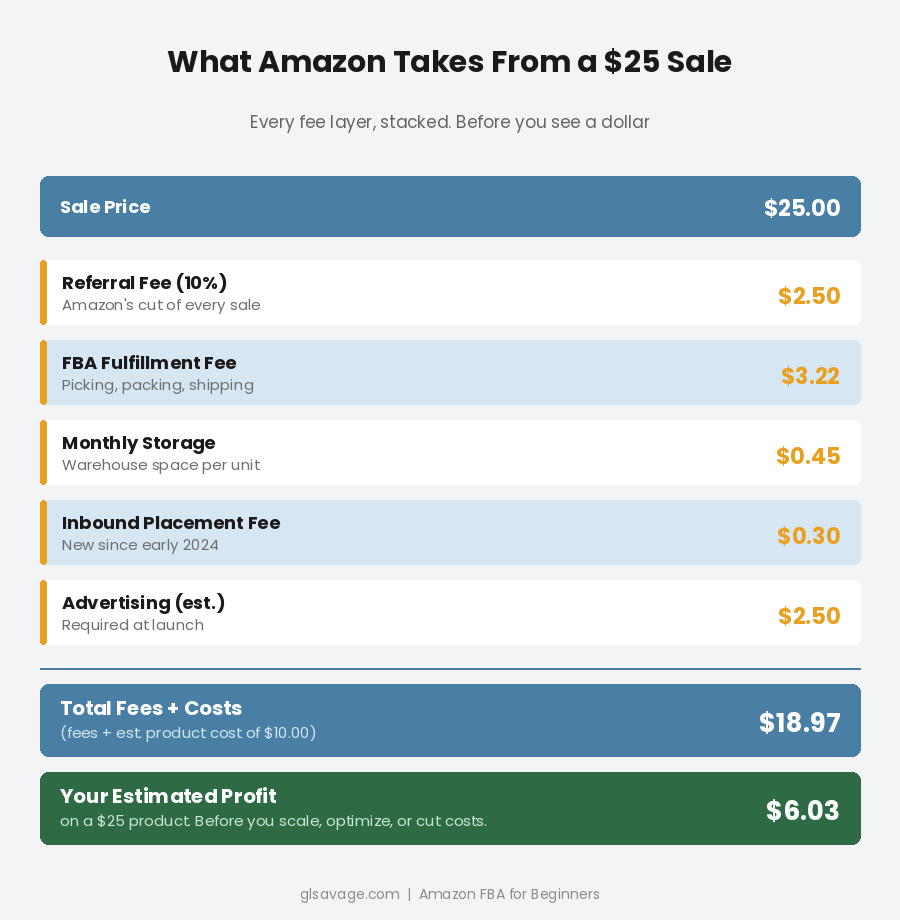
This is where beginners consistently get surprised. FBA is not one fee. It is a stack of fees layered on top of each other, and every single layer needs to be in your math before you invest in any inventory. Miss one and your profit calculation is wrong before you have sold a single unit.
Start with the seller account. A Professional account costs $39.99 per month. That is the account you need to run paid ads, access the full tool set, and seriously compete on the platform. There is an Individual account at $0.99 per item sold with no monthly fee, but it locks you out of advertising and other features that matter once you are trying to grow.
The referral fee is Amazon’s cut of every sale, completely separate from FBA. It runs between 8 and 15 percent of the sale price depending on what you are selling. Electronics are at the low end. Clothing, beauty, and jewelry run higher. This fee applies whether you ship orders yourself or let Amazon do it through FBA.
The FBA fulfillment fee is what you pay Amazon for the actual picking, packing, and shipping. These are calculated based on the size and weight of your product. A small, standard-size item runs around $3.22 per unit. Bigger or heavier products cost more. Apparel has its own pricing tier that runs roughly $0.30 to $1.00 higher per size bracket than comparable non-clothing items.
Storage fees are charged every month based on how much space your inventory takes up in the warehouse, measured in cubic feet. From January through September, standard-size products run around $0.78 to $0.87 per cubic foot per month. From October through December, that jumps to roughly $2.40 per cubic foot because holiday demand makes warehouse space scarce. Products that do not sell fast become more expensive to hold the longer they sit.
Long-term storage fees now kick in at 181 days, which Amazon shortened from 365 days a few years ago. If your product is still sitting in the warehouse six months after you sent it in, you start paying an additional charge on top of the regular monthly storage cost. Slow-moving inventory stops being a neutral situation quickly.
Then there are the fees most guides do not mention until you have already been hit by them. Since early 2024, Amazon charges an inbound placement service fee every time you send a shipment to their warehouses. That fee covers how Amazon distributes your inventory across their fulfillment network. It is per shipment, not per unit, and it adds up. If your products get returned, Amazon charges a return processing fee in certain categories. If your inventory stops selling and you want it back, Amazon charges a removal fee per unit. If you want Amazon to dispose of it instead, that also costs money per unit. None of this is free.
Put it together on a real product. On a $25 item, you might pay $2.50 to $3.75 in referral fees, $3.22 to $5.00 in fulfillment fees, and ongoing storage costs on top. When you factor in advertising, which you will need, research shows the combined cost load can eat up 50 to 61 percent of revenue on many products. The math does not make FBA unprofitable. It makes margin the thing that determines whether you have a business or an expensive lesson. Products that carry 30 to 40 percent gross profit before any Amazon fees have room to absorb the stack. Products going in with 15 percent usually do not come out the other side intact.
What changed about sourcing in 2025
For years, the private label playbook was simple. Find a product on Alibaba. Source it from a factory in China. Ship it to Amazon. Sell it at a markup. That model still exists, but the math behind it shifted significantly in 2025 and beginners who build their business plan around older guides are going to find costs they did not budget for.
Tariffs on goods imported from China hit historic highs in early 2025, reaching as high as 145 percent on certain product categories before a temporary agreement in May 2025 reduced them. Even after that reduction, tariffs on Chinese imports are substantially higher than they were in 2023 or 2024. What that means in practice is that a product you see quoted at $3.00 per unit from a Chinese factory might actually land in the US at $4.00 or more by the time import duties are added. On a $25 product with a thin margin, that one dollar difference can eliminate your profit entirely.
This is not a reason to walk away from FBA. It is a reason to calculate your landed cost, which means your product cost plus shipping from the factory plus import duties at the current rate, before you decide anything about a product. Sellers adjusting to this are sourcing from Vietnam, India, and Mexico, which carry lower tariff exposure. Some are working with domestic suppliers. Some are choosing products where the category is complex enough to manufacture that the only realistic option is still overseas, and they are pricing their products to reflect the actual import cost. All of those paths work. What does not work is building a margin model on 2022 numbers.
The part Amazon does not advertise
Amazon can suspend your seller account. It happens more often than new sellers expect, and the timing is unpredictable. When your account is suspended, every unit of your inventory in Amazon’s warehouses is immediately frozen. You cannot sell it. You cannot quickly get it back. Storage fees keep accumulating on inventory you cannot move. If the suspension goes unresolved long enough, Amazon can dispose of your inventory entirely, and that disposal is on their timeline, not yours.
Suspension triggers include policy violations, intellectual property complaints filed by brand owners, a high rate of customer returns, incomplete product documentation, and listing errors. Some of those are entirely within your control. Some are not. A competitor can file an intellectual property complaint against your listing, and even if it is completely without merit, your listing can be taken down while you work through Amazon’s appeals process. That process exists and most sellers who appeal in good faith get reinstated, but the timeline is not fast and there is no guarantee.
Stranded inventory is a separate, quieter problem. If your product listing gets suppressed because of a pricing error, a missing detail in your product description, or a category restriction you were not aware of, your inventory sits in the warehouse but cannot be purchased. Storage fees keep running. Amazon notifies you and gives you 30 days to fix it, but a new seller who is not checking their Seller Central dashboard regularly can miss the window entirely.
Active management is what separates sellers who avoid these situations from sellers who get blindsided by them. Amazon’s Seller Central has an Account Health dashboard that shows your standing on every metric Amazon tracks. Checking it regularly takes ten minutes. Not checking it is where problems quietly compound.
Is Amazon FBA worth it for beginners?
The data says yes, under specific conditions. About 64 percent of FBA sellers reach profitability within their first year. Around 86 percent of people who sell on the platform report being profitable. The median FBA seller brings in roughly $35,000 a year in revenue. Those are real numbers from real sellers.
The same data also shows that roughly 40 percent of new FBA sellers quit before month six. Not because the model is broken. Because they went in without enough capital, chose a product that could not survive the full fee stack, or expected profits before the business had time to find its footing. Months one through three are almost always a learning period, not a payout period. Advertising is building. Reviews are accumulating. The listing is getting refined. Sellers who understand that going in treat those months correctly. Sellers who expect immediate returns quit exactly when things are about to turn.
FBA also has a practical time advantage worth naming. Most sellers spend fewer than 20 hours per week running their Amazon businesses. About 31 percent spend just four to ten hours weekly. When Amazon is handling fulfillment, customer service, and returns, that work is simply not on your plate. For someone who works full time and wants to build something on the side without quitting their job first, that structure is a meaningful advantage, especially compared to the income-to-time math that makes most second income pursuits far less profitable than they look on paper. Why a Second Job Often Costs More Than It Pays runs that math in full.
FBA vs FBM: what the difference actually means
FBM means Fulfilled by Merchant. You sell on Amazon but store and ship your own inventory yourself. You pay Amazon’s referral fee and your account subscription. You do not pay FBA fulfillment fees or storage fees. You handle everything logistics-related on your own.
The difference that matters most is the Prime badge. FBM sellers generally are not Prime-eligible. That means the two-day shipping badge does not appear on your listing. Amazon’s most active shoppers filter by Prime before they browse. Without the badge, you are not in their search results.
FBM makes sense for products that are heavy or oversized enough that FBA’s fulfillment fees would make them unprofitable, for slow-moving items where monthly storage fees would pile up, or for sellers who already have a fulfillment operation running and do not need Amazon’s warehouses. Many experienced sellers use both simultaneously, running FBA on their fast-moving and lightweight products and FBM on anything where the FBA fee structure does not work. That combination is often more efficient than committing fully to either model.
How to actually start Amazon FBA
Go to sell.amazon.com and create a seller account. You need a business email, a bank account, a government-issued ID, a credit card, and your tax information. Choose the Professional plan at $39.99 per month if you are planning to sell more than 40 items a month or run advertising.
Decide which business model fits your budget and your appetite for risk. Retail arbitrage if you have limited capital and want to learn the platform before betting big. Wholesale if you want existing product demand without building a brand from scratch. Private label if you have $3,000 to $6,000 available and want to build something you actually own.
Research your product before you spend anything on inventory. This step is not a formality. You are looking for a product that people are already searching for, that does not have twenty-page results from big established brands, and that carries enough profit margin to survive every fee layer after Amazon takes its cut. Tools like Helium 10 and Jungle Scout are designed for exactly this. Amazon also has a free FBA Revenue Calculator you can use to model your per-unit profit before you commit to any product. Use it on every product you consider.
Source your inventory. For private label, that means finding a manufacturer through Alibaba or a similar platform, requesting samples to verify quality, and calculating your full landed cost, which is factory price plus freight plus current import duties, before you finalize anything. For wholesale, that means applying to distributors and getting approved to sell their brands. For retail arbitrage, it means a scanner app and store runs. Whichever path you choose, your cost model needs to reflect actual current numbers, not estimates based on older guides.
Pack and label your inventory exactly according to Amazon’s prep requirements. These rules are specific and Amazon does not make exceptions. Products that arrive at fulfillment centers wrong get flagged, held, and can generate charges to fix them. Amazon publishes the full requirements inside Seller Central. Read them before you pack anything.
Build your listing before your inventory ships. Your product title, the bullet points describing the product, your images, and the backend search terms you enter all affect where Amazon’s algorithm places you in search results. A listing with bad photos or unclear copy is invisible even with a great product behind it. Professional product photography is worth the cost.
Launch with advertising budget ready. New listings have no sales history and no reviews, which means Amazon’s algorithm puts them at the back of search results by default. Sponsored Product ads, which are Amazon’s paid advertising system, generate the early sales momentum that pushes a new listing up in organic rankings. Almost every successful FBA launch runs ads from day one. Budget for it before you ship your first box, not after.
Before you commit to any product
Run the FBA Revenue Calculator on it first. It is free, it is accurate, and it outputs your actual per-unit profit after every fee layer is applied. If the number that comes out is too thin to cover your product cost, freight, duties, and advertising, the product is not the right one. Find a different product. The calculator is at sellercentral.amazon.com and takes about five minutes per product to use properly.
Check whether Amazon itself sells the product or sells directly on the listing you are targeting. When Amazon’s own inventory is competing on your listing, they control the pricing and almost always win the sale. That is not a fight worth starting.
Verify your actual landed cost with current tariff rates on anything you are sourcing from China. Your landed cost is not just the price the factory quoted. It is that price plus freight plus whatever import duties apply right now. Those duties changed significantly in 2025. Build the real number in, not the number from previous years.
Check the Account Health section of your Seller Central dashboard regularly once you are live. Ten minutes a week. That is what it takes to stay ahead of the situations that catch sellers off guard.
The bottom line on Amazon FBA
More than half a million people are building income with this program right now. The infrastructure Amazon provides is real, the Prime badge is a real advantage, and the time it frees up by handling fulfillment is something you actually feel once it is running. It is also a business with a specific cost structure that punishes guesswork, a sourcing environment that changed in 2025 and requires updated math, and a platform that can move fast when something goes wrong on your account. The people who do well understand all of that before they send in their first shipment. That is the full picture.
Frequently Asked Questions
It depends on which approach you take. Retail arbitrage, where you buy discounted products and resell them, can be started with a few hundred dollars and a scanner app. Wholesale, where you buy existing brands in bulk, typically requires a few thousand dollars. Private label, where you create your own branded product, requires $3,000 to $6,000 to cover inventory, product photography, listing setup, and launch advertising. Starting private label with under $2,000 makes it very hard to order enough units for the per-unit cost to make sense.
There is no single number. Amazon charges a referral fee of 8 to 15 percent of your sale price depending on category, a fulfillment fee based on the size and weight of your product, and a monthly storage fee based on the warehouse space your inventory uses. Add advertising costs and the total can reach 50 to 61 percent of revenue on many product types. That is why your gross profit on the product before any Amazon fees is the single most important number to calculate before you commit to selling anything.
Yes, if you go in with enough capital and do the product research properly. Amazon handles the logistics. Your job is choosing the right product, sourcing it at a cost that works, building a strong listing, and budgeting for advertising at launch. About 64 percent of FBA sellers reach profitability within their first year. The ones who do not usually entered with a product that could not survive the fee structure, or expected profits too early in the process.
Most sellers spend more than they earn in months one through three while building reviews and figuring out their advertising. About 64 percent reach profitability within their first year. Sellers with a product that has real margin and a proper launch budget often see their first profitable month somewhere between month four and six. Sellers in highly competitive categories with thin margins take longer or sometimes never get there.
With FBA, you buy and own your inventory, store it in Amazon’s warehouses, and Amazon ships it when orders come in. With dropshipping, you never hold inventory. A customer orders from you, you order from a supplier, the supplier ships directly to the customer, and you keep the margin. Amazon’s policies prohibit the most common form of dropshipping, which is buying from another retailer and having them ship to Amazon customers. FBA requires upfront inventory cost. Dropshipping does not, but comes with less control over quality, shipping speed, and supplier reliability.
Yes, and most beginners start exactly that way. Once your inventory is in Amazon’s warehouse and your listing is live, you are not managing daily shipments. The heavy time investment comes at the beginning: product research, sourcing, and the initial launch window. After that, ongoing management is mostly checking inventory levels, adjusting your ad bids, and reordering before you sell out. About 31 percent of FBA sellers spend just four to ten hours per week running their businesses.
Your inventory is immediately frozen and cannot be sold. Storage fees keep running on units you cannot move. Amazon has an appeals process and most sellers who pursue it in good faith get reinstated, but the timeline varies and is not something you control. Common causes are policy violations, intellectual property complaints, a high rate of returns, and missing documentation. Checking your Account Health dashboard in Seller Central regularly is the most reliable way to catch and fix issues before they turn into a suspension.