There is a very specific business model hiding inside the side hustle course industry, and once you see it you cannot unsee it. Someone builds a social media following by posting about how much money they make. Their audience grows. Their audience wants to know how to do what they did. So they sell a course teaching people how to do what they did. The thing they did was build a social media following by posting about how much money they make. Their income stream is you. The course is the hustle. You are the product being sold to. This is not universal. Some side hustle courses are genuinely useful and have helped real people build real income. But the industry has a structural problem that nobody making money from it has any reason to explain to you. This article will.
Why the Side Hustle Course Industry Exists
The online course market is enormous. Research firms put the global e-learning industry somewhere between $300 and $500 billion depending on how they define the sector, and every projection points to continued double-digit annual growth through the end of the decade. Platforms like Udemy, Kajabi, Teachable, and Thinkific have made it easier than it has ever been for anyone with an internet connection and something to say to package that into a product and sell it. The barrier to creating a course is almost nonexistent. Record some videos, write some PDFs, set up a payment page. Done. You can be selling a side hustle course by next Tuesday.
That low barrier to creation is the first thing to understand. It means the quality of what is being sold varies enormously. A course that costs $997 is not automatically worth more than one that costs $97. A course from someone with a million followers is not automatically better than one from someone with ten thousand. The packaging and the marketing are not the product. The information and the results are the product. Those two things are often disconnected in ways that cost people real money.
The second thing to understand is who actually benefits from the side hustle course ecosystem. Kajabi, one of the major course hosting platforms, says its creators have collectively earned over $10 billion since the platform launched. In 2023, Kajabi’s own press releases put the average creator earning at $37,000 per year. By 2025, their marketing materials were reporting the average at $190,000. Both numbers come from Kajabi itself, which has every reason to publish its most flattering data. Neither figure tells you what happens to the people who sign up, build a few products, and earn almost nothing. Those people are not in the average. When a guru shows you their income screenshots, they are showing you where they landed after years of building an audience, testing pricing, and figuring out what sells. They are not showing you where their students land. Those numbers are different, and most course creators do not publish them.
The Income Disclosure Problem
This is the part the industry does not want to talk about. When someone sells you a course promising you can make $5,000 a month, $10,000 a month, or quit your job in 90 days, they are making an earnings claim. In the United States, the Federal Trade Commission requires that earnings claims reflect what a typical person achieves, not what the best-case outlier achieved. This rule exists because showing you a screenshot of someone making $50,000 a month while implying that is what you can expect is misleading by design.
Most side hustle course sellers do not publish income disclosure statements showing what their average student actually earns. The ones who do rarely highlight those numbers prominently. When the FTC analyzed income disclosures from 70 multi-level marketing companies in its 2024 Staff Report, it found that most of the disclosures emphasized high earners, buried low-earner data, and did not account for what participants spent trying to build the business. While that report focused on MLMs, the same pattern runs through much of the side hustle course world. The testimonials on the sales page are the outliers. The average results are not on the sales page because publishing them would make the course much harder to sell.
This does not mean every course is dishonest. It means the system is set up to obscure the real odds, and you have to do the work of finding them before you pay.
The Upsell Ladder Nobody Shows You Upfront
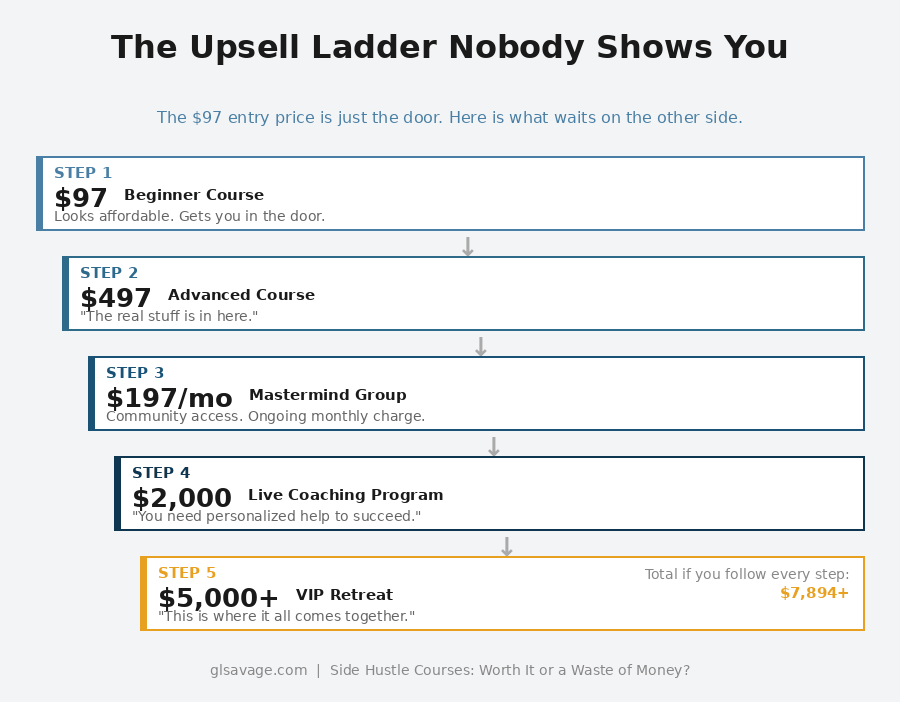
Most side hustle courses are not a single product. They are the entry point to a ladder. You buy the $97 beginner course. Inside it, you discover that to really implement what you learned, you need the $497 advanced course. Inside that, there is a mastermind group for $197 a month. Then there is a live coaching program for $2,000 or a VIP retreat for $5,000. The initial price is rarely the total price. It is the door.
This is not automatically dishonest. Tiered products that offer increasing depth at increasing price points can be genuinely useful. The problem is when the entry course is deliberately incomplete, designed to create dependency on the next level rather than to give you everything you need to succeed. If you buy a beginner course and find that every lesson ends with “and you will learn exactly how to do this in the advanced program,” you bought marketing material, not education.
The question to ask before buying any course is simple: what do I get, specifically, for what I am paying right now? A legitimate course can answer that question in plain language. It lists what is covered, what you will be able to do after completing it, and what is not included. If the sales page talks about outcomes and big results without specifying what the course actually contains, treat that as a warning sign.
The Two Types of Side Hustle Courses
There are two fundamentally different types of side hustle courses. They need to be evaluated completely differently, and most people do not know this distinction before they pay.
The first type teaches a skill that has value independent of the course itself. A course that teaches you how to do bookkeeping, how to build websites, how to write copy, how to repair appliances, how to do tax preparation, how to do video editing. These courses teach something you can do for clients who will pay you for that skill. The skill exists in the real world. Businesses need it. You can go find those businesses and offer it. The course is a faster way to learn something that would otherwise take longer to learn on your own. If the instruction is solid and the skill is real, these courses can be worth the money.
The second type teaches you how to make money in a way that primarily works because you also sell courses about it. Courses on how to sell courses. Courses on how to build a personal brand so you can sell courses. Courses on affiliate marketing where the primary affiliate product you are marketing is the course itself. Courses on dropshipping that are funded by people buying courses about dropshipping. This is not automatically a scam. Some of these courses contain real, useful information. But the model has a circular quality that matters: the person teaching it makes money because people buy the course, not necessarily because the underlying hustle works at scale for beginners. If the instructor’s primary income source is course sales, ask yourself what that tells you about the income source they are teaching you to pursue.
What a Legitimate Side Hustle Course Looks Like
Legitimate courses exist across both categories above. Here is what distinguishes them from the ones designed to take your money and leave you no better off.
The instructor shows verifiable receipts from the actual hustle, not just course sales. If someone is teaching you how to make money with print on demand, they should be able to show you their Etsy store, their actual sales data, and their actual margins, not just testimonials from students or screenshots of PayPal deposits that could be from anything. If their demonstrated income is from selling the course about print on demand, that is a different business than the one they are teaching you. For more on what the print on demand model actually involves before you pay anyone to teach it to you, Print on Demand: What They Don’t Tell You Before You Start covers the full picture. And if you want to understand what dropshipping really requires before investing in any course on the subject, The Truth About Dropshipping: What It Really Takes to Make Money breaks down the mechanics and the real numbers.
The course publishes realistic outcome data, not just outlier testimonials. Some courses now include statements like “results are not typical” or “most students who complete this course do not achieve the income shown in testimonials.” That disclaimer is legally required when they are making earnings claims, but the honest courses go further and actually show you what typical completion looks like. What percentage of students finish the course? What do students who finish the course earn, on average? If the course creator cannot or will not answer those questions, that tells you something.
The content is specific and actionable, not motivational. A legitimate course tells you exactly what to do, in what order, with what tools, and what to expect at each stage. A course heavy on chapters about your mental approach to success, success story videos, and “you can do this” energy while light on step-by-step instruction is not teaching you a skill. It is selling you a feeling. Feelings are not income.
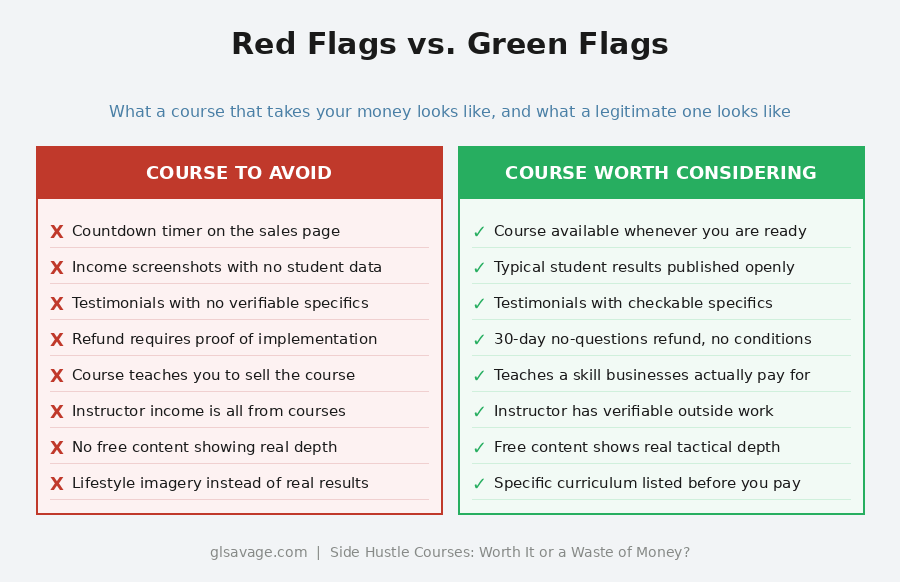
The refund policy is real and enforceable. Thirty days, no questions asked, money back. Not “complete all modules and attempt implementation and provide proof and submit a form and wait for review.” A refund policy with fourteen conditions attached is not a refund policy. It is a legal fiction designed to make you feel protected while making it functionally impossible to get your money back.
The price matches the depth. A $27 PDF guide should not promise to change your finances. A $997 course should contain enough substance to justify that price compared to what you could learn for free on YouTube, Reddit, or through library books. The right question is not whether the price is high or low. It is whether what is delivered justifies what is charged, relative to freely available alternatives.
The Red Flags That Should Stop You Cold
These are not opinions. These are patterns that consistently show up in courses that take money and deliver nothing of value.
Urgency pressure. Limited spots. The price goes up in 24 hours. The bonus disappears at midnight. Enrollment closes Friday. This is a sales technique designed to prevent you from thinking clearly. Legitimate courses are available when you are ready to buy them. The artificial deadline exists to stop you from doing research, talking to people who took the course, or sleeping on the decision. If you are being pressured to decide right now, the answer should always be no. Walk away, research at your own pace, and buy later if it still makes sense.
Testimonials with no specifics. “This course changed my life” is not a testimonial. “I was earning $47,000 a year in my job and I now earn $8,000 a month from my Etsy shop, here is my shop link” is a testimonial you can verify. Vague success stories without checkable specifics are not evidence of anything. They are marketing copy.
The instructor’s lifestyle as the proof. Private jets. Luxury cars. Beachside offices. Stacks of cash. These images are a substitute for actual evidence that the course works. Anyone can rent a Ferrari for a photo shoot. Anyone can pose on a yacht they do not own. The Federal Trade Commission has named lavish lifestyle imagery, luxury cars, yachts, and vacation homes, as red flag earnings claims in its proposed rulemaking on deceptive money-making opportunities. Using someone else’s lifestyle as implied proof of what you will achieve is exactly the pattern the FTC is targeting. If the sales page is heavy on aspirational imagery and light on verifiable outcome data, the imagery is doing the persuasion work that the results cannot do.
The course teaches you to sell the course. The clearest version of this is a course that includes a module on affiliate marketing for the course itself. You learn the material and you are then encouraged to sell the course to other people for a commission. When the business model taught inside the course is partially “sell this course to more people,” you are looking at a system that generates income primarily through recruitment, not through the underlying hustle being taught. This is how multi-level marketing, MLM, works, and it is the structural signature of that territory regardless of whether the product is legally defined as one.
No free content that demonstrates real depth. Legitimate course creators share enough free content to show you what they know before you pay. A YouTube channel with real tactical advice, a blog with genuine how-to information, a podcast with actionable detail. These are signals that the person actually knows what they are talking about and is willing to demonstrate it without payment. A creator whose entire free content strategy is “here’s how much money I’m making and here’s why you should buy my course” is demonstrating that the sale is the primary thing, not the knowledge.
Where Courses Are Actually Worth Paying For
None of this means online courses are a waste of money. Some of them provide the fastest, most organized path to a skill that would otherwise take much longer to develop through trial and error. The ones that deliver on that promise tend to share a few characteristics.
Skills with external demand. Bookkeeping, web development, copywriting, video editing, tax preparation, appliance repair, social media management for local businesses, data entry and virtual assistant work. These are things businesses and individuals need and will pay someone for. A course that teaches you one of these skills well can pay for itself with a single client. The skill does not disappear if the platform the course was hosted on shuts down. You own it.
Courses attached to real communities. Some course ecosystems come with active student communities where people share real results, ask real questions, and provide honest feedback about what is working and what is not. These communities are worth more than the course material itself in many cases. They are also where you can see what typical students are actually experiencing, not just what the testimonials say. If the community is full of questions like “why is this not working” and “has anyone actually made money from this,” that is your answer about typical results before you pay.
Platforms with honest review systems. Udemy, for all its faults, allows verified purchasers to leave reviews that the instructor cannot delete. Those reviews are worth reading carefully. A course with 4.7 stars from 40,000 students and a comment section full of specific “here is what I applied and here is what happened” feedback is a different product from a course with 4.9 stars from 200 reviews that all read like they were written by the same person.
Free trials or sample content before you pay. If a course platform allows you to preview several lessons before purchasing, preview them. The production quality of a course tells you something. The depth of the sample content tells you more. If the preview lessons are motivational and vague while the actual paid content is supposed to be tactical and specific, that gap is usually consistent throughout the course.
What to Do Before You Pay for Any Course
Every one of the warning signs above is useful. But what you actually need is a process. Here is the exact sequence to run on any course before you hand over money.
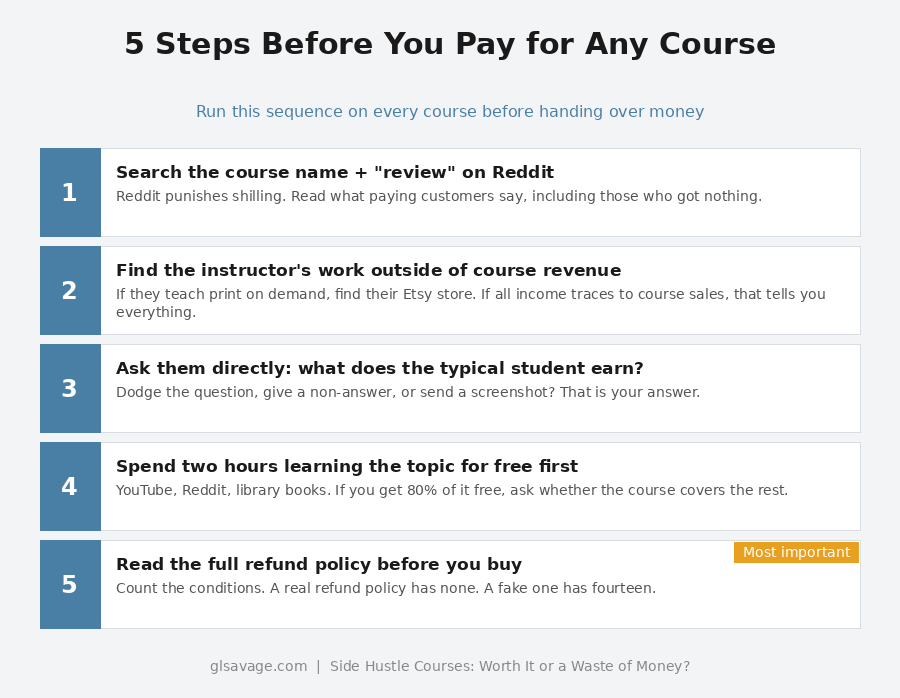
Step one: search the course name plus the word “review” on Google, YouTube, and Reddit. Not the sales page. Not the testimonials the course seller curates. Independent reviews from real buyers on forums and comment sections. Reddit in particular tends to be honest because the community punishes obvious shilling fast. Search for the course name on Reddit’s search bar and read what people who paid for it actually say, including the people who did not get results.
Step two: find the instructor’s work outside of course revenue. If they teach print on demand, find their actual Etsy store. If they teach freelance copywriting, find their actual client portfolio. If they teach Amazon FBA, find third-party confirmation they sell on Amazon. If the only verifiable income you can trace to the instructor is from selling the course itself, that is not proof the underlying hustle works. That is proof selling courses works for them.
Step three: ask the course creator directly what the typical student result is. Email them. DM them. A legitimate course creator knows their student outcomes. If they dodge the question, give you a motivational non-answer, or respond with a testimonial screenshot instead of actual data, you have your answer. Silence on that question is an answer too.
Step four: spend two hours learning the topic for free first. YouTube, Reddit, library books. Cover as much ground as you can without paying. Then look at what the course offers and ask honestly whether it covers meaningfully more than what you just found for free. If you can get 80 percent of the substance in two free hours, the remaining 20 percent needs to be worth whatever they are charging for it.
Step five: check the refund policy before you buy, not after. Read the full terms. Count the conditions. If getting your money back requires completing all modules, submitting proof of implementation, and waiting for a review committee, it is not a real refund policy. Buy only from courses with unconditional refund windows of at least 30 days. If they will not offer that, ask yourself why a seller confident in their product would refuse to back it.
The Honest Answer to Whether a Side Hustle Course Is Worth It
It depends entirely on what the course teaches, whether the instructor demonstrably knows it, whether the skill has real market demand independent of the course, and whether you will actually do the work to apply it.
No course makes you money. You make money. The course is information. Information without application is an expensive PDF. The courses that work are the ones that teach a real skill to someone ready to use it. Someone who has researched enough to know the skill actually pays. Someone who treats the course as the start of the work, not a substitute for it.
The side hustle course industry is not going anywhere. The demand for a path out of financial stress is real and understandable. That demand is what the industry runs on. The predatory end of it, the part with the private jets and the countdown timers and the income screenshots without average student data, is designed to convert financial desperation into course revenue. It does not have to convert yours.
You can learn an enormous amount for free. YouTube, Reddit communities, library books, and free trials on platforms like Coursera and LinkedIn Learning cover a vast amount of territory without costing anything. The side hustle courses that are worth buying sit on top of that free foundation and provide organization, depth, or community that genuinely accelerates your progress. If a course cannot tell you what it offers beyond what you could find for free in four hours of YouTube searching, that is your answer.
Frequently Asked Questions About Side Hustle Courses
Some are. The ones worth buying teach a skill with genuine market demand, are built by someone who demonstrably uses that skill themselves, provide specific actionable instruction rather than motivational content, and come with a real refund policy. The ones not worth buying substitute lifestyle imagery for proof, hide average student results, pressure you to decide before you can research, and teach you that the real money comes from selling the course to someone else.
The clearest signs are urgency pressure designed to stop you from researching, income screenshots without average student outcome data, testimonials with no verifiable specifics, a refund policy with so many conditions it is functionally impossible to use, and a business model where the course itself is the primary product being taught to sell. The FTC requires that earnings claims reflect what a typical buyer achieves. When a course shows only the best-case outliers, that is a legal and ethical problem, not just a sales tactic.
Ask these questions before paying anything. Does the instructor show verifiable income from the actual hustle being taught, not just from selling the course? Does the course publish realistic outcome data for typical students, not just outlier success stories? Is the refund policy simple and enforceable with no conditions? Can you preview sample content that demonstrates real depth before buying? Is the skill being taught something businesses or individuals pay for in the real world, independent of the course?
Price alone tells you almost nothing. A $29 course can be excellent. A $2,000 course can be worthless. What matters is whether the content justifies the price relative to what you could learn for free, and whether the skill being taught has proven income potential that does not depend on you also selling the course. Before paying for anything above $100, spend a few hours researching the topic using free resources and see how much ground you can cover without paying. Then evaluate whether the course covers meaningfully more than what you found for free.
For most topics, yes. YouTube, Reddit, free library resources, and free trials on platforms like Coursera and LinkedIn Learning cover an enormous amount of useful ground at no cost. Where paid courses add genuine value is in the organization of that information, access to community support, and depth on specific technical skills that are harder to assemble from scattered free sources. The test is simple: spend a few hours learning about the topic for free, then evaluate whether what a paid course offers is worth the gap between free and paid.
Skills with real external demand that businesses or individuals will pay someone for. Bookkeeping and basic accounting. Web design and development. Copywriting and content writing. Video editing. Tax preparation. Virtual assistant work. Social media management for local businesses. These are real skills that solve real problems for real paying clients. The hustle is finding those clients, which requires marketing effort. But the skill itself holds value independent of any course platform or income claim.
This is the most important question you can ask before buying any side hustle courses, and the one most course marketing is designed to prevent you from answering. Look for verifiable external proof: a public Etsy shop, a public LinkedIn profile with client work, a portfolio, a published book, or any third-party confirmation of their work outside of course sales. If every income screenshot, every result, and every testimonial you can find traces back to course and coaching revenue rather than the underlying hustle being taught, take that seriously. They found a hustle that works for them. It is selling the course to you.